Go Solar, Make Money

Cassandra Kling, an old friend of mine, currently with Infinite Energy, is sponsoring “Solar Energy Options for your Home” Tuesday, May 12. 7 – 8 PM. Hampton Inn, 16 Frontage Drive, in Clinton, NJ. Find out about Solar technologies, Installation, Incentives, the costs and how to make money. The answer is SREC’s. Go Solar. Fight Climate Change. Make Money.

Earth Day 2009

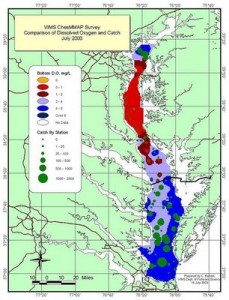
Shows Oxygen and Fish Catch in the Chesapeake

The Chesapeake: Oxygen & Fish Catch

Poisoned Waters,” a documentary on PBS Frontline examines the state of our nation’s waterways. It focuses on the Chesapeake and the Puget Sound. As the title suggests, the nation’s waterways are far from pristine. Click here for Tim Wheeler’s review in the Baltimore Sun and here for Frontline. The documentary suggests that the Clean Water Act, in response to Earth Day, 1970, started off well. But gutting regulation, castrating the EPA, allowing open dumping and externalizing cleanup costs do not solve pollution problems. Perdue, in his denial that chicken manure contributes to algae blooms in the Chesapeake, sounds like a shill for the tobacco industry saying “Well we know the plaintiff smoked 4 packs a day for 25 years. How do we know the cigarettes caused lung cancer? How do we know lung cancer killed him? He died when his heart stopped. The cancer was in his lungs.”

This image, from Science Daily, shows a dead zone in the northern stem of the Chesapeake. The area in red shows oxygen depletion. The area in blue shows oxygen. The green circles in the blue zone show fish catch.

On Earth Day, 2009, we have much to do.  It is not as if we have accomplished nothing in the last 39 years. However, we see two glaring omissions in the clean water act. It doesn’t regulate farm waste or coal ash. We also need to understand that regulation and enforcement are effective and deregulation and voluntary compliance does not work.  After all,  we have police and prosecutors to chase and bring to trial criminals in order to protect the citizens. Speed limits and parking regulations are not “goals” or “guidelines” for voluntary compliance. They are hard and fast laws. Break the law; get a ticket. This paradigm must be applied to protecting the nation’s waterways.

But here’s an idea: Take this algae-manure system and transform it from one that is destroying an estuary into one that is creating the biofuels for the next generation of cars and power plants!

Scott Simon: Captains of Integrity

From this morning’s Weekend Edition Saturday, Scott Simon’s essay, Captains of Integrity. Even if you’re a regular listener – it’s worth reading on the page for the essay itself, as a reminder that at times the production values of radio – and a familiar voice – can prevent us from catching the full power of words. Here’s a link to the piece, including the audio. The full text follows:

· Over the past few weeks, there have been captains in the news to remind us of responsibility, which is a form of conscience.

Capt. Richard Phillips has been acclaimed for risking his own safety for that of his crewmates aboard the cargo ship Maersk Alabama.

But another ship’s captain, Cmdr. Frank Castellano of the U-S-S Bainbridge, took the responsibility to order Navy Seals to open fire on the pirates when he thought, after four days, there might be a moment of opportunity to free Captain Phillips.

If something had gone only slightly wrong – if a single bullet, fired by a man on the deck of a boat in a bobbing sea, had missed by a fraction – Captain Phillips might have been killed, and Commander Castellano would have been second-guessed by every talking head from Fox News to Pacifica Radio.

Capt. Chesley Sullenberger has reminded admirers how many things had to go utterly right for him to make his famous, almost splashless landing of his disabled US Airways jet onto the Hudson River in January.

His decision to put down in the water, rather than risk crashing into midtown Manhattan, seems so wise now. But had wind whipped up the water or tipped a wing, people who don’t know how to make a paper airplane would have second-guessed the decision Captain Sullenberger made in a split second.

This week, Richard Scheidt died, at the age of 81. Mr. Scheidt became a photographic icon when he was a Chicago firefighter in December, 1958, and called to a fire at the Our Lady of Angels school.

Ninety-two children and three nuns were killed in the smoke and flames. The photograph that raced around the world showed Mr. Scheidt, his face grimy and his shoulders slumped, carrying the body of a 10-year-old boy in his arms.

He became a captain. And this week, Dep. Commissioner Bob Hoff recalled how, in scores of fires that were never in the news, Captain Scheidt would hold back his men but go first into a burning building.

Commissioner Hoff told the Chicago Tribune, “He never asked anyone to do something he wouldn’t do.”

I think many Americans have been uplifted to see real-life captains who, unlike some captains of finance and industry, have the character to make hard decisions, share risks, think of others, and live by the consequences.

It’s been reassuring to see such men and women and know that in these times, in scores of places, “The captain is on the bridge.”


Frances Perkins, The Woman Behind The New Deal

There’s a new biography of Frances Perkins, U. S. Secretary of Labor from 1933 to 1945, and the first woman appointed to the U.S. Cabinet. The book is The Woman Behind the New Deal, by Kristen Downey, (amazon.com). It was discussed last night on NPR. Perkins was largely responsible for the U.S. adoption of social security, unemployment insurance, federal laws regulating child labor, and adoption of the federal minimum wage. One of the items on her agenda that she did not accomplish was universal health care.

Continue reading

Alan Sorum on appropriate power technology in Alaska

From Alan Sorum’s essay,  Appropriate Use of Technology for Power Generation in Alaska.

Alaska does not currently support large-scale electric utilities. There also needs to be a minimal number of customers served by each power line to justify its construction. Weather can be severe and cause failures in the system. This increases costs and accessibility for repairs. Many residents live beyond the economical limits of connection to commercial electric utilities.

Small-scale power systems in rural Alaska offer potential improvements in power distribution, generation and efficiency.

Distribution performance can be improved by the use of small-scale power generators. Smaller generators can be placed much closer to the actual point of consumption. Disruptions to the power supply are reduced and access for line repairs is much easier. Short power lines lose less power in transmission, and the power delivered is “cleaner”, since there are fewer opportunities for broken insulators and lightning storms.

Gas or diesel fired co-generation produces power efficiently, utilizing fuel cells and waste heat for community needs. Hybrid generation systems feature a primary generator, powered by diesel, natural gas. wind or hydro. A computerized inverter allows the primary to charge large banks of storage batteries. During periods of low consumption, the generator shuts down and the system runs off of power from the batteries. Trace Engineering builds a system like this that also allows wind or small hydro to charge the batteries.

Saving energy within a household has the greatest impact on the overall costs for an entire system. There are many ways to save energy in a household. These include super-insulation, using energy efficient light bulbs and appliances, installing high-performance windows and improved conservation techniques.

Rural residents are vulnerable to high costs of power, poor weather conditions, power distribution failures and lack of available support services. The rural versus urban appropriation of state resources will continue to generate debate in Alaska. It is likely funds provided for the power cost equalization program will continue to decline.

Small-scale power generation systems that utilize renewable energy resources could be a bright spot in the future of Alaska. Rural residents can expect improvements to their quality of life with the advent of affordable and reliable electrical power. Using appropriate technology for power generation and distribution makes good sense for the natural capitalists living in rural areas of our state.

Alaska is an extreme example of the necessity of distributing, decentralizing, or localizing power grids – and making consumption as frugal as possible.

Popular Logistics found Sorum’s essay on Google’s Knol system. We think it may have been first published on Suite101.com.

Mr. Sorum has also written good pieces on marine safety and emergency communications, which we hope to excerpt in the near future.

The Trouble With CERES, BICEP, and the Way Forward

The Trouble with CERES, BICEP, and the Way Forward (audio)

Back in the fall of 1989, CERES announced the creation of the Ceres Principles, a ten-point code of corporate environmental conduct to be publicly endorsed by companies as an environmental mission statement or ethic. Today, the Waxman/Markey Bill brings together energy efficiency, renewable energy, and cutting greenhouse gases. … good for business and consumers. Makes it easier to move toward a clean energy economy.

BUT the CERES principles fall short in some very important ways.

  1. Adherence to the CERES Principles is voluntary; not mandatory.
  2. The “CERES Principles” are just that – principles. They are not goals.
  3. The government must fully support them, and back them, and push them, and enforce them.
  4. While there are milestones in the 20 year history the Ceres Principles, there are no dead-lines for the future.

And we need to act now. As Gore noted, “We’re borrowing money from China to buy oil from the Persian Gulf to burn it in ways that destroy the planet. …that’s got to change. … Enough wind blows through the Midwest corridor every day to meet 100 percent of US electricity demand. … Enough solar energy falls on the surface of the earth every 40 minutes to meet 100 percent of the entire world’s energy needs for a full year.

Here are the details. Continue reading

Mark Benjamin of Salon shreds Army credibility on report denying manipulation of PTSD diagnoses

-In an interview broadcast this morning on WNYC, Mark Benjamin, national correspondent for Salon.com, discredits an Army report which found that no manipulation of PTSD diagnoses at Fort Carson, Colorado. It seems appropriate to start by removing what is, on its, face, a strong piece of evidence – the Army’s self-exoneration. In the WNYC interview, Benjamin points out that:

  • What was released was a “summary” of an “informal” investigation
  • The summary report was itself heavily redacted, thus greatly reducing its persuasive value.
  • It ignored a tape recording supporting the underlying claim, earlier reported by Benjamin and Michael de Yoanna

In other words, had the investigation been conducted by an inspector general, outside of the chain of command, offered some protection to witnesses concerned about retaliation, and at least took account of the original recording – the investigation’s conclusion(s) would be more credible for a number of reasons: (1) absence of a motive to fabricate, or a motive to ignore, evidence; (2) Offered witnesses – essentially whistle-blowers – some protection; and (3) didn’t obviously ignore relevant and facially credible evidence.

“I believe that I did have PTSD” is the latest piece in a series by Mark Benjamin and Michael de Yoanna on Salon.com.

Links to their earlier pieces can be found at the bottom of the page.

PTSD Resources

At the University of Medicine and Dentistry in New Jersey

National Center for PTSD

VetTrauma.org

Posttraumatic Stress Disorder Overview – Military Benefits from Military.com

Wind Energy Generating Capacity – Doubling Every 4 Years

According to WorldWatch, Vital Signs, 2007-2008, in 2006 we had 74.2 GW of installed wind capacity and 8.6 GW of installed solar worldwide, and 370 GW of installed nuclear capacity. If we double the capacity of Wind and Solar twice we’ll be at 331.2 GW. Double it again, we’re at 662.4 GW. By the 4th doubling, we’re at 1.325 terawatts.

Offshore Wind

According to the Global Wind Energy Council, installed wind power is doubling every 3 or 4 years – from 74 GW in at the end of 2006, to 120 GW in 12/08 to 322 in Dec. 2013. The rate will slow slightly – wind capacity will increase “a modest” 22% per year, which is modest compared to the increase of 28% per year over the last 10 years. Installed wind powered electric generating capacity will double in less than 4 years (see: Global wind energy markets will continue to boom, March 11, 2009), and quadruple within 7 years.

Obama In Strasbourg, On Sustainability

At the “Town Hall” meeting in Strasbourg, France, April 3, 2009,  (Washington Post, LA Times, NY Times, White House.gov, NY Times Video)   President Obama spoke intelligently and well. FRANCE NATO OBAMA SARKOZY

He summed up the challenges we face:

We also know that the pollution from cars in Boston or from factories in Beijing are melting the ice caps in the Arctic, and that that will disrupt weather patterns everywhere. The terrorists who struck in London and New York plotted in distant caves and simple apartments much closer to your home. And the reckless speculation of bankers that has now fueled a global economic downturn that’s inflicting pain on workers and families — is happening everywhere, all across the globe.

President Obama also made very strong statements on “Sustainability” and “Globalization.”

Continue reading

How to fix GM? A 4 Point Plan:

President Barack Obama fired GM CEO Rick Wagoner. He was replaced by Fritz Henderson, who had been Vice Chairman and Chief Operating Officer. While I agree that Wagoner should probably have been fired, I think his replacement should have been someone from the outside. Promoting from within is a good thing when a company is doing well, but not when the company is collapsing. General Electric, for example, has always promoted new CEO’s from within. But GE was not in trouble when Welch took over, or when he handed the reins to Immelt. IBM was in trouble when the Board brought in Lou Gerstner, an outsider, to, as he put it, teach that elephant to dance. GM is in serious trouble. As an insider, Henderson may be too in step with the corporate culture to change anything.  As an outsider I can see what Henderson might miss.

So how would I fix GM?

  1. Every car, light truck, and truck that comes off the lot should be a diesel  electric hybrid. Like the Toyota Prius, and GM could license the technology from Toyota, but it should burn diesel fuel. That would pave the way to bio-diesel.
  2. Offer a 2 kw solar electric system with every car. This should be priced at $15,000, installed. It’s $10,500 after the economic stimulus plan’s 30% tax break. It would It would charge the batteries, or power a small home during daylight hours.
  3. Give everyone stock options, and limit salaries to $390,000 – less than the salary of the President of the United States.
  4. Demand that the government – my new management – take over the burden of health care for all my employees, my retirees, and every other citizen. Medicare works well for my father. It would work well for me!

How economic dislocation leads to new efficiencies

Last night I passed the Virgin Megastore in Times Square. Signs outside said – “last 3 days – fixtures for sale.” And did what I often do – watch and observe. I can’t say much about what was happening with the regular stock – but started watching worker traffic and the flow of fixtures.
From what I could see, the regular workers were working very hard, answering every question they could, leaving no customers hanging for long, and making it clear they were coming back. For workers who have been limited to part-time and rarely make overtime rates, and aren’t getting placement help, this isn’t necessarily the behavior one might predict.

Jesse Bien, (pronounced “bean” like the legume, not “bi-en” like the Frecnh word for “good”) The person in charge of the fixtures liquidation – apparently with the help of no more than a handful of his own help (although they may have been selected Virgin employees). In the midst of a chaotic environment, he’s working hard, funny, calm, and very quietly and clearly in charge. Knowing enough about the value of everything that he was no pushover in negotiations – but pricing things low enough that my guess is that he’ll empty the place before whatever his deadline is. (There are a lot of wall units in a very nicely finished grade of what I think is 3/4 plywood Baltic Birch, ideal for retail display, and beautiful in other uses).

There’s always pain (human) and loss (economic) in a business failure – but if people like Jesse Bien are available – and used – to reallocate goods –

  1. the environmental impact of the business closing is limited, perhaps approaching zero;
  2. other businesses – existing and startup – who are lucky enough to know about it and make wise choices – reduce their startup costs and thus be more competitive.

The Greeks didn’t define “chaos” as the absence of order – they defined chaos as a state which contained the potential for order to emerge.

Our recovery from this economic crisis – indeed, from any disaster – depends on versatile, resilient people like this Jesse Bien. If he’d been in World War II, he would have been running logistics for General Omar Bradley; in a non-military disaster – what those of us who study them call  “hastily formed networks” – he’d be the guy who could see the biggest available picture, and who other people would naturally think ought to be in charge.

And yes, I bought some things; no he had (and at this writing still has) no idea about this blog. I’m used to negotiating prison sentences – among other things. I anticipated that the volume and noise would work for me, but I’m not in his league. Maybe not even playing the same game. But I think I got a deal that was fair to me and good for his client.

Maybe when he’s done with Virgin we need to hire him to straighten out the mortgage situation. My money says says he can get the best outcome possible.

It’s people like Jesse Bien that make the American economy dynamic and vital in good times, and pull us out of the mud in bad times.

Republican Alternative Energy: Coal, Oil, & Nuclear Power

The Republican Road to Recovery”  according to John Boehner, Eric Cantor, Mike Pence, Thaddeus McCotter, Cathy McMorris Rodgers, John R. Carter, Pete Sessions, Kevin McCarthy, David Dreier, Roy Blunt, who signed it, “Keeps Energy and Fuel Costs Low.” It mentions wind and solar, but focuses on coal, oil, oil shale, offshore drilling, and nuclear power.

The document says “Republicans want energy independence with increased development of all natural resources, including renewable energy sources, such as wind and solar.” It doesn’t mention “global warming.” It mentions the term “greenhouse gases” once, stating, incorrectly, that nuclear power doesn’t produce greenhouse gases. Mining, processing, and transporting nuclear fuel, and managing radioactive wastes, produces tremendous amounts of greenhouse gases.

It points out that “Senators Ted Kennedy and John Kerry … have long fought a renewable wind project in waters off of Massachusetts…. Cape Wind, would provide 75 percent of the electricity demand for Cape Cod, Martha’s Vineyard, and Nantucket island. “

The document focuses on coal, oil, and nuclear power. These are not clean, renewable, sustainable energy sources.  Ultimately, therefore, it attempts to “greenwash” coal, oil, and nuclear power.

the Administration has already taken steps to hinder the leasing of the Outer Continental Shelf (OCS) which is estimated to hold at least 19 billion barrels of oil, and Democrats have long championed the prohibition on drilling in the Arctic Coastal Plain – which is estimated to hold 10.4 billion barrels of oil. Furthormore, Democrats continue to block the procurement of advanced alternative fuels from sources such as oil shale, tar sands, and coal-to-liquid technology. U.S. Oil shale alone could provide about 2.5 million barrels of oil per day.

Republicans also support opening the Arctic Coastal Plain to energy exploration and development.

And despite expert agreement that nuclear power is reliable, clean, and affordable without producing air pollution or greenhouse gases, Democrats continue to block its development.

Republicans realize that there are better solutions to restore freedom and security in our energy market.  Republicans recognize the importance of exploring for American oil and gas in an envionronmentally-sound manner and support immediately leasing oil and gas resources in the OCS through an an expedited and streamlined procedure.

Republicans support removing government barriers to new nuclear reactors as long as they meet strict security and safety criteria.

Americans realize that the future of energy is in alternative and renewable sources. In order to promote the development of renewable and alternative energy, Republicans support promoting the leasing of federal lands which contain alternative energy such as oil shale. … spurring a market by using fuels derived from oil shale, tar sands, and coal.