NATO: Taliban prison attack, "isolated incident"

The BBC reports that NATO is calling the Taliban attack on a prison in Kandahar – releasing 900 inmates, under half of them members of the Taliban – is an “isolated incident.” One supposes that this probably is better for Taliban morale, and from their point of view, might be thought a “major tactical breakthrough” or a “show of strength.” More from the BBC report after the jump: Continue reading

NY Times: Saudi oil production nearing all-time high

Cryptogonpoints out this piece in the Times which suggests that the Saudis are producing at exceptionally high capacity, trying to limit price increases. From  Plan Would Lift Saudi Oil Output

, from the June 14th times:

Saudi Arabia, the world’s biggest oil exporter, is planning to increase its output next month by about a half-million barrels a day, according to analysts and oil traders who have been briefed by Saudi officials.

The increase could bring Saudi output to a production level of 10 million barrels a day, which, if sustained, would be the kingdom’s highest ever. The move was seen as a sign that the Saudis are becoming increasingly nervous about both the political and economic effect of high oil prices. In recent weeks, soaring fuel costs have incited demonstrations and protests from Italy to Indonesia.

Saudi Arabia is currently pumping 9.45 million barrels a day, which is an increase of about 300,000 barrels from last month.

While they are reaping record profits, the Saudis are concerned that today’s record prices might eventually damp economic growth and lead to lower oil demand, as is already happening in the United States and other developed countries. The current prices are also making alternative fuels more viable, threatening the long-term prospects of the oil-based economy.

Toyota promises plugin-hybrid by 2010

Toyota promises plugin-hybrid by 2010, according to Chuck Squatriglia on Wired’s Autopia:

It’s no secret Toyota’s been working on a plug-in hybrid to compete against the forthcoming Chevrolet Volt, but Wednesday’s announcement sets a firm deadline and makes it clear Toyota has no plans of ceding the green mantle to General Motors. It also underscores how quickly the race to build a viable mass-market electric car is heating up.

The company’s ambitious “low-carbon” agenda

includes cranking out 1 million hybrids a year and eventually offering hybrid versions of every model it sells. In the short-term, Toyota says it will produce more fuel efficient gasoline and diesel engines and push alternative fuels like cellulosic ethanol and biodiesel. It’s also pumping big money into lithium-ion batteries. With fuel prices going through the roof and auto sales going through the floor

because of it, Toyota president Katsuaki Watanabe says the auto industry has no choice but to move beyond petroleum.

“Without focusing on measures to address global warming and energy issues, there can be no future for our auto business,” he told reporters in Tokyo, adding, “Our view is that oil production will peak in the near future. We need to develop power train(s) for alternative energy sources.”

Watanabe’s reference to peak oil echoes that of GM CEO Rick Wagoner, who in explaining the company’s decision to shut down four truck factories said rising fuel prices and mounting demand for efficient cars are “structural, not cyclical.” In other words, the two biggest automakers in the world realize petroleum’s days are numbered

Continue reading

EmerGEO – discovered on OpenSourceCommons

Open Source Commons, a project of the Open Society Institute Information Program, is a resource for open-source and open-architecture (i.e. not necessariy free) tools. In answering the question “What Tools do Nonprofits Use?”, provides this answer:

Social Source Commons is a place to share lists of software tools that you already use, gain knowledge and support, and discover new tools. It’s a place to meet people with similar needs and interests and answer the question: what tools do they use?

Within a minute or two of looking at the sitek I found a listing for EmerGeo Solutions, which makes a number of relevant GIS solutions, and which we’d like to evaluate and test as part of a “best practices and tools” project we’re now planning with another group. (More about that shortly). Here’s a look at Emergeo Solutions’ product line, and we hope to have more for you on that soon. But in any case – it’s a safe bet that Open Source Commons will be invaluable. More from EmerGEO:

EmerGeo™ has been installed and exercised in the City of Vancouver Emergency Operation Centre since product launch in October 2003. The software has been installed in several emergency centres and disaster-tested during major events like the 2004 wild land fire event in B.C. The software is designed to streamline inter and intra-agency communications and improve coordination of planning/response/recovery activities among all responding agencies and organizations involved in an event.

EmerGeo™ is built with Interoperability in mind; therefore, we recognize that it is essential to integrate with other emergency planning and response software used by emergency managers, such as the WebEOC crisis management system, alerting and communication technologies and hazard risk vulnerability tools. EmerGeo Solutions is expanding the use of its emergency mapping engine through partnerships with value-added technology providers and emergency and security experts around the world.

From EmerGEO Solutions.

Recently Read: “Survive a Nuclear Blast” at Wired’s Wiki How-To

“How to Survive a Nuclear Blast”

, in the Wired How-To Wiki, is an excellent primer. For historical background, we strongly recommend Eugene P. Wigner’s Who Speaks for Civil Defense?, published in 1968, which provides an excellent start in explaining why the United States, notwithstanding its public commitments to the contrary, never bult adsequate blast or fallout shelters.

"The exact scenario … had actually been foreseen … years ahead of the event"

From the appellate court decision in Nash v. Port Authority of New York and New Jersey. The Port Authority had moved to set aside a jury verdict or, in the alternative, be granted a new trial. The litigation involved the 1993

truck-bombing, which killed six people and injured hundreds. The Appellate Division, First Department (New York’s intermediate appellate court) ruled against the Port Authority in a unanimous decision decided on April 29, 2008, with an opinion by Presiding Justice Jonathan Lippman:

the exact scenario followed by the 1993 World Trade Center bombers had not merely been foreseeable, but had actually been foreseen and brought to the attention of the Port Authority management by its internal and retained security consultants years in advance of the event.

The entire opinion is worth a read – and is so well-written that non-lawyers will likely be able to follow some of the nuances of the legal arguments.

MIT Professors, Grad students, develop nanotube detector for airborne toxins

From Nano TechWire, this excerpt from Super-sensitive and small: New MIT detector uses nanotubes to sense deadly gases
 

Using carbon nanotubes, MIT chemical engineers have built the most sensitive electronic detector yet for sensing deadly gases such as the nerve agent sarin.

The technology, which could also detect mustard gas, ammonia and VX nerve agents, has potential to be used as a low-cost, low-energy device that could be carried in a pocket or deployed inside a building to monitor hazardous chemicals.

“We think this could be applied to a variety of environmental and security applications,” said Michael Strano, the Charles and Hilda Roddey Associate Professor of Chemical Engineering and senior author of a paper describing the work published this week in the online edition of Angewandte Chemie.

Read the rest at NanoTechWire.

Urgent Request to Sign Petition Objecting to FEMA decision – no ice in disasters

SIGN THIS PETITION:

FEMA has decided that it’s not going to deliver ice in disasters, except in narrowly defined “medical” or “life-threatening” circumstances. Ice, of course, is a staple in disasters. The Disaster Accountability Project has coverage of the FEMA decision here

.

And DAP has also organized a petition drive – sign the petition at this link .

Architect Sheila Kennedy: "It’s curtains"

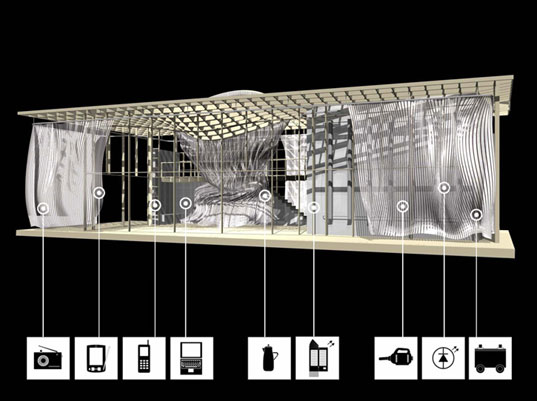
Architect Sheila Kennedy has, with her colleagues (whose names we don’t know, hence no attribution) designed The Soft House; Jorge Chapa at Inhabitat has an excellent post on Kennedy’s prototype house whose solar-collecting curtains would produce 16KWH. We strongly recommend you read Chapa’s post – and that you check in regularly at Inhabitat.

Sheila Kennedy/KVArch

Given our concern with worst-case scenarios – and preventing them – this technological use could go far in prevention by producing more power cleanly and locally. But we want to see rugged and waterproof textile uses for tents and canopies and emergency shelters and sails – consider the possibility of transporting the equivalent of a circus tent to the site of a disaster or power failure – as contrasted to the transportation of heavy petroleum-consuming generators – or solid photovoltaic panels or turbines.

One last thought: Kennedy’s design, we suspect, likely does more than produce energy: it probably acts as a cooling mechanism, preventing or mitigating the effects of a heat emergency.

NanoTechWire has a short interview with Sheila Kennedy here.

J.C. Winnie/After Gutenberg – replacing transportation fuel with renewables

The ever-methodical J.C. Winnie at After Gutenberg has an outline of how the United States could replace fossil fuels with renewables for transportation needs – and this without a large change in vehicle weight, use patterns, or increases in mass transportation. Add those, and we’d have a plan that would be not only environmentally more palatable, but would substantially increase environmental efficiency. From After Gutenberg:

Carbon dioxide (CO2) is the most important anthropogenic GHG; and, such anthropogenic emissions unequivocally contribute to

climate change. The rise of CO2 corresponds to

the rise in global temperature and loss of arctic ice mass. Annual carbon emissions grew by about 80% between 1970 and 2004. Coal-fired electric power plants comprise the single biggest source of CO2 emissions in the world. By and large, such admonishments are being ignored by U.S. policy-makers.

While a planetary engineer in Germany, Roland Moesl, envisions saving life as we know it on Planet Earth, a green pundit in America, David Roberts, describes the Syllogism of Doom. Of course, in Germany between 2000 and 2003 their installed PV capacity quadrupled. And, this was while Germany was becoming the world leader in wind development. It is way past time, ‘Merika, to start doing things right.

A good start would be “the most comprehensive and credible report released on wind power by a federal agency in a decade” (and studiously ignored by mainstream media), which indicates how we could achieve 20% wind power by 2030. Yes, 2030 is too late to stop using coal, but as many have observed, no single strategy will suffice. Switching sooner to electric vehicles, strong support for solar and wind energy development, conservation and improved efficiencies can make an earlier contribution than the delayers have programmed us to expect. The growing risk with peak oil is that in their search for alternative fuel, Americans will ignore much more catastrophic change brought on by anthropogenic emissions. The coal and corn zombies must be repulsed.

That’s just an excerpt. Read the rest of this persuasive analysis at Project Gutenberg.

And we’ll pose a question – we’re beginning to notice county and local impediments to renewable installation – and an absence of state mandates to require utilities to buy surplus power back at reasonable rates. If end users installing renewables in grid-tied systems are discouraged from building capacity in excess of their own use, we’re going to have problems.

One alternative is the setting up of local power coooperatives. But we’re leery of solutions that require lots of lawyers and incorporations. As Malcolm Gladwell points out in The Tipping Point, sometimes the tipping point is making things easy.

Reorganization of Special Forces command likely "unremarkable"

blog at the Washington Post: “In This Case, Rumsfeld was right”: (I’m quoting at length because Arkin writes better, and I’m not sure how much to pare away without distorting a nuanced point)

If there were a musical about the Pentagon today, the opening number and reprise would be “If Rumsfeld Was for It, We’re Against It.”

Witness the portrayal of the reversal of a “controversial” plan by the former secretary of Defense, first reported in the New York Times last week, to use special operations forces as the lead element in the war against terror.

There is a lot wrong with the way the United States has been “fighting” the war against terror in the past seven years, and there is much wrong with the special operations aesthetic. But any push to reduce their role and turn over counter-terrorism to the conventional military instead is wrong in every way.

I have often criticized special operations for being too secretive and for a lack of basic accountability; for pursuing a “direct action” (read: head-hunting) approach to counter-terrorism that is circular and never-ending; and finally for believing their own P.R. about how great they are. But the “quiet warriors,” as they often call themselves, are just the right element of the military to contribute to counter-terrorism efforts.

If there’s going to be a “war” against terrorism, it needs to be quiet and stress the non-military. This means a small military footprint and fewer bases and a fully coordinated “interagency” and international effort. For all this, the Army and Marines are just too much of a blunt instrument. Haven’t we learned that blundering out there, as we are blundering in Iraq, just confirms our desire for subjugation and empire in the minds of far too many in the Islamic world?

First the news: As reported in the Times, Special Operations Command, which under presidential directive has been given authority to conduct independent counter-terrorism missions, is supposedly backing off of this unilateral role and focusing on working with regional commanders to conduct joint operations. Adm. Eric T. Olson, the new special operations commander, says that he will continue to play the role as counter-terrorism coordinator around the world, a “shift” that the Times suggests means the old Rumsfeld way is dead and that special operations command will not conduct unilateral operations.

In some ways the news is unremarkable.It is simply impractical for special operations forces to do their own thing without coordinating fully with the regional commands and the CIA and the conventional forces, particularly in Iraq and Afghanistan, where 90 percent of the effort is expended. In fact in Iraq the coordination has become so intimate that a two-star special operations forces general has been deployed there to coordinate at the highest level of the military command, a level of collaboration that has proven more useful and productive.

– snip –

So are special operations forces being spanked getting some comeuppance? I don’t think so. For all the changes, the super-secret “Delta Force” and commando and intelligence teams of the Joint Special Operations Command, the elite of the elite, are going to continue to conduct unilateral operations and go where the conventional military — even the conventional Special Forces — can’t. Of course, to be effective, they have to coordinate with the regional commanders, the CIA and State Department, FBI, etc. Duh.

– snip-

That doesn’t necessarily mean it should be the Pentagon’s job, and it certainly doesn’t mean that Rumsfeld was able to implement a sensible plan through all of his megalomania. But a shift of the conventional military to a global counter-insurgency focus? If this is the plan, both our counter-terrorism efforts and our military needs will be weakened.

William Arkin’s Early Warning blog at the Washington Post is morphing into a weekly column and discussion group. That’s probably good for Arkin – and Arkin’s work once a week is still a lot better than no Arkin at all.

McCain’s Katrina claims refuted

Senator McCain, during a recent New Orleans press availablility, said that he

“supported every investigation” into the government’s role regarding the hurricane, when in fact he twice voted against an independent commission.”

From “Katrina Kerfuffle,” on FactCheck.org .

Notwithstanding the merits of the the votes in question – it’s hard to have a national discussion about important issues – such as what the lessons learned from Katrina might be – when United States senators lie, are uninformed, or misinformed, about their own voting records.

Magnetbox.com: EveryBlock special reports

Ben at MagnetBox – a keen observer of information arrays and streams – reports on Everyblock.com and its new special reports about more complex geographically-related data:

We’ve launched our first EveryBlock “special report” — an analysis of Chicago addresses mentioned in the recent federal investigation “Operation Crooked Code.”

As explained on our about page, an overall goal of EveryBlock is to point you to news near your block. We’ve been working hard to do a good job of this so far by accumulating public records, cataloging newspaper stories and pulling together various other geographic information from the Web. However, over the past few months as we’ve been building the site, we’ve come across a number of types of information that don’t exactly fit the EveryBlock mold.

We’ll interrupt this excerpt here to point out that this tool might be of particular use to groups like the Disaster Accountability Project – particularly with decentralized efforts like its  Disaster Accountability Monitor and Blogger network

.

For example, an architectural group named “Chicago 7 Most Endangered Buildings ” in January. That’s geographically relevant news (i.e., if you live near one of those endangered buildings, you’d likely be interested in knowing about it), but because it’s such a “one-off” type of information, we haven’t done anything with it on EveryBlock. It didn’t make much sense to add such a relatively obscure type of information to our list of news types.

From the EveryBlock blog.

Via Magnetbox.

After Gutenberg: IBM claims to have developed most efficient solar cell technology

After Gutenberg reports in IBM Concentrator Photo Voltaic Cells that

IBM has managed to squeeze 230W of power on to a centimeter square of solar panel using concentrator photovoltaics. The energy was then converted to 70W of usable electric power, the best power efficiency yet achieved, the company claims.

Relying on a piece in EETimes, After Gutenberg, which routinely spots the details that matter, points out that this is a place where semiconductor and photovoltaic technologies overlap. After Gutenberg further quotes the EEtimes as follows:

The IBM researchers used a very thin layer of a liquid metal made of a gallium and indium compound that they applied between the chip and a cooling block. Such layers, called thermal interface layers, transfer the heat from the chip to the cooling block so that the chip temperature can be kept really low.

They suggest that if the silicon can be cooled effectively, concentrated photovoltaics could take over as the cheapest form of solar energy.

However, IBM admits there is much work to be done to move the research project from the lab to the fab.

By using a much lower number of photovoltaic cells in a solar farm and concentrating more light on to each cell using larger lenses, IBM’s system enables a significant cost advantage in terms of a lesser number of total components.

The researchers said that the concentration increases the power of the sun’s rays by a factor of ten, allowing cells that normally generate 20W of power to generate 200W instead.

Their initial results were presented at this week’s 33rd IEEE Photovoltaic Specialists conference , where the researchers showed how their liquid metal cooling interface is able to transfer heat from the solar cell to a copper cooling plate much more efficiently than anything else available today.

“We believe IBM can bring unique skills from our vast experience in semiconductors and nanotechnology to the important field of alternative energy research,” said Dr. Supratik Guha, the scientist leading photovoltaics activities at IBM Research. “This is one of many exploratory research projects incubating in our labs where we can drive big change for an entire industry while advancing the basic underlying science of solar cell technology.”

The researchers developed a system that achieved the “breakthrough” results by coupling a commercial solar cell to an IBM liquid metal thermal cooling system using methods developed for the semiconductor industry.

IBM adds that concentrator-based photovoltaics technologies have the potential to offer the lowest-cost solar electricity for large-scale power generation, “provided the temperature of the cells can be kept low, and cheap and efficient optics can be developed for concentrating the light to very high levels.”

John Walko, “IBM claims major boost in solar cell efficiency

,” in EETimes Europe.

Via the increasingly indispensable, and ever mysterious J.C.W. at After Gutenberg .