Suicide Bomber on Bike Kills 29 Iraqi Policemen; highest-ranking American to be injured in Iraq evacuated to hospital in Germany

From Alissa J. Rubin’s piece in this morning’s Times,Suicide Bomber on Bike Kills 29 Iraqi Policemen

Police training in the provincial capital of Baquba turned into a blood bath on Monday when a suicide bomber on a bicycle set off his explosive vest in the midst of policemen, killing 29, the local police said.

A suicide bomber killed seven people just north of Baghdad, and the United States military said a brigadier general had been wounded by a roadside bomb in northern Baghdad, according to The Associated Press. Brig. Gen. Jeffrey Dorko, the highest-ranking American officer to be hurt since the invasion in March 2003, was evacuated to Landstuhl Regional Medical Center in Germany. His wounds were not life-threatening, The A.P. said.

That a brigadier general was hurt may be worth noting for the fact that it took so long to happen in a war without a “front.”

The combination of bicycle and suicide vest, however – I don’t think it’s entirely unprecedented. Butit may well make life in Baghdad even more dangerous for bicyclists, as those in the field become more cautious about bicycles. This in a country where – among all the other dangerous things – people are in harm’s way filling vehicle fuel tanks.

Is America a Third World Country?

Once we inspired the world with hope. The Declaration of Independence, The Constitution, The Bill of Rights, these defined the rights of man, all men, and women, and denied the privilege of the self-proclaimed nobility.

Today:

We export food and raw materials.

We import most of our manufactured goods.
We have created a huge private army.

We are in debt up to our eyeballs.
Unlike every other Western country, we don’t provide health care for our citizens.

We teach to the tests, but our education systems are failing. Most, if not all, the Republican Presidential Candidates, and the President, deny scientific theory.

We manufacture less and less.
We don’t do basic research. American companies that still do basic research do it in Asia.

We, who flew to the moon and back, are giving up the space program.

We design less and less.

We are even selling our infrastructure: our roads, highways, and bridges, to the highest bidder.

Once we inspired the world with hope. The Declaration of Independence, The Constitution, The Bill of Rights, these defined the rights of man, all men, and women, and denied the privilege of the self-proclaimed nobility.

Now we allow the government to read our mail and listen to our telephone conversations – for our own protection.

Write your Rep in Congress: in the Senate, and the House.

Exploding manhole covers

Got a question about this the other day; here’s what I know – we’ll add some more information later:

1. An exploding manhole cover is  a predictor of nearby manhole cover explosions. But not necessarily adjacent holes. So if there’s a problem with one – great caution about all area manholes is indicated. 

2. They’re very heavy – and they’ve been measured going as high as 400 feet vertical. After that, they descend (32fps squared, less  drag). Do the math.

Here’s one resource

How Exploding Manholes Work ,”  by Kevin Bonsor, on HowStuffWorks.com

Sustainable Housing

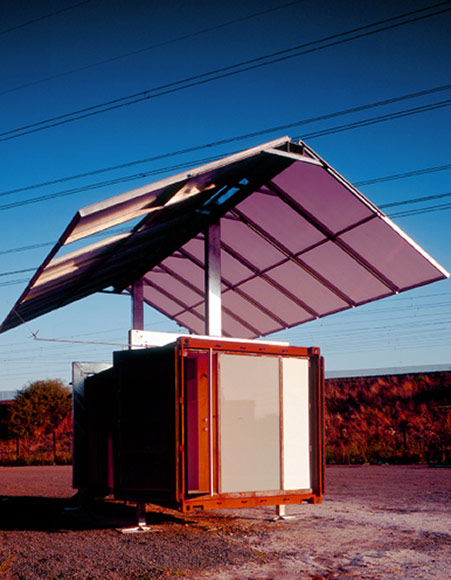
If each of the 28 panels in the Sean Godsell’s Future Shack, click here for Jon’s post, was a 160 to 200 watt Photo Voltaic solar module, of the type manufactured or used by Akeena Solar

, Evergreen Solar

, First Solar , SunPower, World Water & Solar

, etc

. etc., the structure would be rated at 4.480 to 5.6 kW. In other words, it would be sufficient to power a small house – say your typical 1800 sq ft 3 bedroom single family home anywhere in the US (except the Pacific North-West).

Instant Housing and Designing for Disaster

Jenna Wortham has a piece on Wired.com – “Slideshow: Instant Housing and Designing for Disaster

.”  futureshack.jpg

Above is an image of “FutureShack,” designed by Sean Godsell.  There are eleven others, some familiar to us, others not.  We’ll try to get  more of these up – but if you have time, look at Jenna Wortham’s piece on Wired. (Wortham hs been doing excellent pieces like this, on other appropriate technology, great pieces on RFID issues – and she’s also, apparenly, Wired’s

editor in charge of evaluating haggis and other things that at least some people have trouble thinking about eating. Are we missing a connection here?

"Dirty Water = Dead Iraqis"

AcademyWingman, points out in this post the folly of interrupting or slowing chlorine shipments because insurgents have used the trucks as weapons or targets (and as targets then immediately incorporated into the weapon, so to speak), creating deadly chlorine gas.

I urge you to read WingManX’s perceptive post – and assuming you have – I’d add the following points;

–  WingmanX contends that fear itself is a force multiplier for the insurgents; well put!  ;

– in a parallel manner, the chlorine becoms a force multiplier for an IED or truck bomb;

– But – the chlorine isn’t just chlorine  it’s like a big water truck – because the entire water supply’s cleanliness – the health of the entire Iraqi people depends  on potable water. If there were water deliveries – wouldn’t we devote great tactical and strategic forces – and intellectual resources- to making sure the population gets water? This is like letting people die of thirst – but slower  – because they’re dying not from dehydration (no water at all), but water-borne diseases, like dysentery;

In other words, if the enemy can bait us into depriving the Iraqi population of water – and our role there is to protect the Iraqis, and help them to rebuild, who’s winning if the chlorine can’t get through? The bad guys win big. They’re essentially dictating our strategy.
– See also last week’s coverage of Iraq’s power grid plans. They’re doing deals with the Chinese and the Iranians – for multi-megawatt systems. Entirely susceptible to attack. Apparently no one at the energy ministry has read the NPS “Solar Eagle” proposal – or anything abotu network theory.

– Robert Baer – in See No Evil 

described that sttae of sewer and water systems in one or two large Saudi cities – where subpar binLaden family construction has left the water system at risk for leaking from the sewage

system. (I’ll get a copy of the book and a page citation tomorrow).

We owe these people an infrastructure at least as good as what we found when we got there.

Prius V Hummer – the Battle for the Streets

NYC LimosNYC DOT

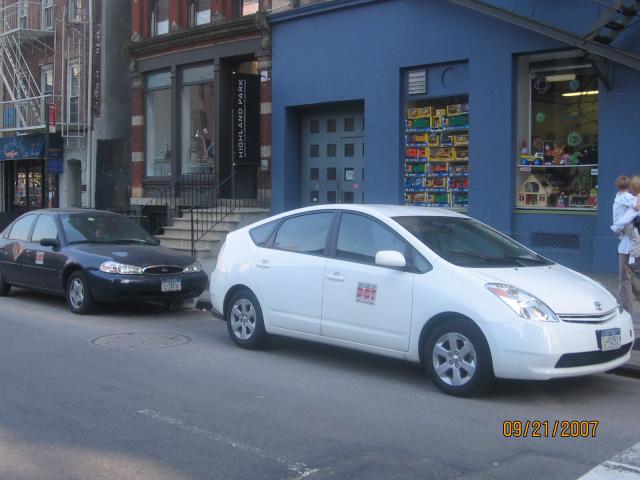
This battle is being fought, and will be won, on the streets. And in New York City the hybrids are winning. New York’s Dept. of Transportation and other agencies are replacing their Ford Taurus and Contours with Prius and Civic Hybrids, not Hummers.

As of May of this year, 375 of approx. 13,000 yellow cabs had hybrid engines. The City has mandated that by 2012, 100% of the yellow taxi fleet must be hybrids. Link to NYC press release here. The new Ford Escape Hybrids get 30 MPG. The vehicle they will replace, the Ford Crown Victoria, gets 14 mpg. Taxi drivers in NYC absorb all the operating costs, including gas. So if they can spend less money on gas – they pocket the difference, and they make more money. $9,000, assuming 80,000 miles and $3.00 per gallon.

The next step will be the 38,540 livery vehicles licensed by the Taxi and Limousine Commission, often referred to as “black cars,” the predominant model being black Lincoln Town Cars, which also get about 12 miles per gallon.

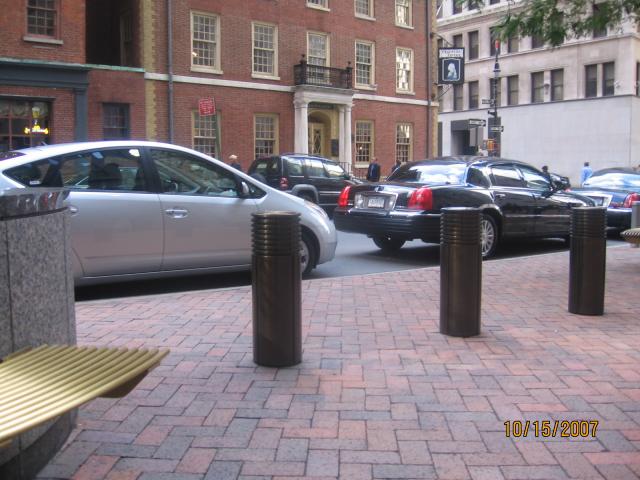
There is no government mandate to switch, however, a combination of market forces and one government incentive seems to have sparked the beginning of a change in the right direction. Outside Goldman Sachs‘ offices on Pearl and Broad, across the street from Fraunces Tavern, at any given time, you can see two or three Prius “limos” among the Town Cars. The Priuses get 40 mpg. The Lincolns get 12. The fuel costs for a Lincoln are about $20,000 per year, three and a half times higher than $6,000 for a Prius. Which translates to $14,000 more for the drivers.

The drivers love them – they pocket the cash. The passengers love them – they are a much quieter ride, they are better for the environment, and as an added bonus, they are permitted to use the High Ooccupancy Vechicle / Low Emissions Vehicle aka (Clean Pass) lanes. In New York rush-hour traffic, this could cut some trips in half – and cut from half an hour to an hour off of a rush-hour trip to Newark or La Guardia.

They’re also good enough for the United States Army’s Special Operations Command, which includes the Special Forces, and would include the Delta Force, if it officially existed.

For other large groups of vehicles – the Postal Service, the New York City Police Department, our ambulances – using hybrid engnes isn’t even part of the public discussion, yet. But it will be. Write your Rep in Congress. Senate – Click Here , House, Click Here.

Prius v Hummer – The Battle for the Brains


Another HummerPrius

An outfit called CNW Market Research, which advertises “Clarity Context Vision” like Fox News uses the phrase “Fair and Balanced,” published a “study” claiming that the Hummer H2 has less of an environmental impact than the Prius. You can look for the 450 + page report here.

CNW asserts that the per mile cost of the Hummer H2 is $3.027 and the Prius is $3.249.

Heidi Hauenstein and Laura Schewel of the Rocky Mountain Institute analyzed CNW report concluded that CNW’s mathematics was flawed. You can find the their report on the web pages of EV World. They said that IF CNW’s methodology is correct, the Prius has a significantly lower impact on the environment than the Hummer. And, by the way, they question CNW’s methodology.

Dr. Peter Gleick of the Pacific Institute also weighed in on the debate. (Click Here) He stated “the report’s conclusions rely on faulty methods of analysis, untenable assumptions, selective use and presentation of data, and a complete lack of peer review. Even the most cursory look reveals serious bias and flaws: the average Hummer H1 is assumed to travel 379,000 miles and last for 35 years, while the average Prius is assumed to last only 109,000 miles over less than 12 years. … “Dust to Dust” has already distorted the public debate.”

So here’s what I think.

According to Edmunds, the MSRP of the 2007 Hummer H2 is $54,100. The Prius is $22,175. I assume the vehicles have a lifetime of 100,000 miles and the price of gas is $3.00 per gallon. I know that the EPA estimates for the Prius are 50, and the H2 is so big and so heavy that it is exempt from EPA milage estimates, but I use 40 mpg for the Prius – because that’s what limo drivers who use the Prius in NYC get – and 8 mpg for the Hummer. GM Hummer claims that the Hummer H3 gets 20 miles per gallon on the highway. Maybe they put a hybrid engine in it. Maybe that’s rolling downhill, outfitted for sail, with the engine in neutral and running at a low rpm.

My back-of-envelope reckoning based on EPA milage concludes that the Hummer will burn 12,500 gallons and the Prius 2,500 as they are driven those 100,000 miles.

That’s a difference of 10,000 gallons of gas. At $3.00 per gallon, fuel will cost $37,500 to drive the Hummer and $7,500 to drive the Prius. That’s $30,000 bucks. And if the average price of gas is $4.00 over the life of the vehicle, it’s $40,000.

Ignoring the purchase cost of the vehicle, and assuming $3.00 per gallon, the fuel cost is 38 cents per mile for the Hummer, and 8 cents per mile for the Prius. Factoring the costs to purchase the vehicle, and the cost of oil changes every 3000 miles, (34 oil changes at $25 each) the costs to drive a Hummer H2 are $92,460 while the costs to drive a Prius are $30,525. This works out to 92 cents per mile for the Hummer H2 and 31 cents per mile for the Prius.

So the bottom line is I don’t care what CNW says, altho it would be nice if their arguments were logical, coherent, and based on fact. Regardless, my next new car will be an aerodynamic hybrid.

Hummer v. Prius
Item 2007 Prius 2007 Hummer H2
MSRP $22,175 $54,100
Lifetime Miles 100,000 100,000
Mileage Estimate 40 8
Gallons of gasoline 2,500 12,500
Cost of Gasoline at $3.00 per gallon $7,500 $37,500
Oil Changes 34 34
Cost at $25 each $850 $850
Subtotal, Gas and Oil $8,350 $38,350
Subtotal, MSRP plus Gas and Oil $30,525 $92,450
Cost per mile $0.31 $0.92

Pornography, organized crime and the military-industrial complex (is pornography's business model threatened by new websites?)

Reverse Cowgirl

– the ever-perceptive Ms. Breslin – has posted about a Claire Hoffman piece in Conde Nast’s Portfolio.com which notes precipitous declines in revenue at commercial porn sites, occasioned by the emergency of three free-download sites, in the nature of YouTube: Megarotic (megarotic.com), YouPorn (youporn.com), and Pornotuben (pornotube.com) (note links broken due to the positive correlation between porn sites and computer viruses and the negative correlation between porn sites and computer security. Ed.)

Link to Claire Hoffman’s piece on Portfolio.com.

WNYC’s On The Media– ran an excellent piece in 2002

interview with Jonathan Coopersmith, Douglas Rushkoff, and others making the case that pornography is often the driver of new communications technologies.

For my part, I’d put porn on a plane with two other markets which have different, but no less intense, needs for innovative advantage: illicit markets, and military/law enforcement uses. More my area of knowledge – I can easily name examples:

  • There’s no end to examples of military organizations as first adapters of new technologies: two -way radio, the fax machine (during WWII – before the War Department figured out what to do with telecopiers, they used them for a while over radio – placed in vehicles in the States – sending new information to soldiers and officers who were in vehicles, driving around, making death notifications to the families of service members who had been killed) ((Personal conversations with the late Jack Fitzstephens, whose first military assignment in WW II was in “graves registration” – following behind troops, clipping dog tags, preparing bodies for burial. But not so far behind that he didn’t get shot at)).
  • As soon as there were phones, organized crime (bootleggers, gamblers) used hijacked phone lines – called “cheeseboxes” in New York – so that when authorities followed a phone line to an address – they’d find an empty apartment – with a wired connection to another phone line – sometimes appearing in another apartment or nearby building – which redirected the calls. They could shut the line down, of course – but by the time the connnections got sorted out – targets and evidence had been moved away.An NYPD source has provided me with an explanation of “Cheesebox” as the name – one of the early such setups was hidden in a closet – the wiring then hidden in what had been a shipping crate for cheese.
  • The first mobile telephone I ever saw or used was in law enforcement. (The person I had personal knowledge of using a car-based “radio telephone”was a United States Attorney General; this may be public record now, but not when I came by the information, so we’ll hold the name for the moment, it not being necessary to make the point);
  • Let’s not forget what immediate use urban illicit drug-selling organizations made of pagers and then mobile phones;
  • The first reported use (that I’m aware of) of a “silent,” vibrating pager was by Richard Helms, then DCI, who was reported in the early 1970’s as been “paged” at dinner parties by the then state-of-the-art “beeper.”
  • The FBI was using portable audio recorder hard drives before anyone thought to add “i” to “pod.” Well

before.

Sex, drugs, and espionage in the same piece. We’ll try to keep connecting these things as often as possible.

I’m not sure, though – about the extinction of porn as a business – perhaps this is a just a lull before some newer, better porn medium – with some sort of DRM – makes people willing to pay more for better.

Design for the other 90%

The show we missed at the Cooper-Hewitt, the museum with the highest ration of cool-to-anonymity in New York City. Perhaps it’s actually a secret, classified facility – an “undisclosed cultural location.” Here’s what Design for the other 90% is about:

Of the world’s total population of 6.5 billion, 5.8 billion people, or 90%, have little or no access to most of the products and services many of us take for granted; in fact, nearly half do not have regular access to food, clean water, or shelter. Design for the Other 90%

explores a growing movement among designers to design low-cost solutions for this “other 90%.” Through partnerships both local and global, individuals and organizations are finding unique ways to address the basic challenges of survival and progress faced by the world’s poor and marginalized.

Designers, engineers, students and professors, architects, and social entrepreneurs from all over the globe are devising cost-effective ways to increase access to food and water, energy, education, healthcare, revenue-generating activities, and affordable transportation for those who most need them. And an increasing number of initiatives are providing solutions for underserved populations in developed countries such as the United States.

This movement has its roots in the 1960s and 1970s, when economists and designers looked to find simple, low-cost solutions to combat poverty. More recently, designers are working directly with end users of their products, emphasizing co-creation to respond to their needs. Many of these projects employ market principles for income generation as a way out of poverty. Poor rural farmers become micro-entrepreneurs, while cottage industries emerge in more urban areas. Some designs are patented to control the quality of their important breakthroughs, while others are open source in nature to allow for easier dissemination and adaptation, locally and internationally.

Encompassing a broad set of modern social and economic concerns, these design innovations often support responsible, sustainable economic policy. They help, rather than exploit, poorer economies; minimize environmental impact; increase social inclusion; improve healthcare at all levels; and advance the quality and accessibility of education. These designers’ voices are passionate, and their points of view range widely on how best to address these important issues. Each object on display tells a story, and provides a window through which we can observe this expanding field. Design for the Other 90% demonstrates how design can be a dynamic force in saving and transforming lives, at home and around the world.

They’ve got a promising blog – which is particularly cool – we take as a sign that the Cooper-Hewitt means to keep this dialogue going notwithstanding the closing of the physical exhibit.

We’ve got the crack Popular Logistics “fixers”

trying to persuade the press office at the Cooper-Hewitt that just because we’re a blog, we’re still part of the “press” for purpooses of showing our readers some images along with further posts about Design for the other 90% . Stay tuned for more.

Dog survives fire by hiding in tub; clever maneuver demonstrates intelligence greater than the combined intelligence of U.S. Legislators

Fire. Dog hides in tub. Not for water – but to breathe air through drainpipe

.  An old firefighter’s trick, apparently.

Coverage via neatorama.  We made up the part about Congress. Our libel counsel told us not to lose any sleep over it; truth is, after all, a defense.

Original Newsday article.

Via Arbroath (to Neatorama).