Author Archives: L J Furman, MBA

About L J Furman, MBA

Analyst here and Director of Information Technology with an MBA in Managing for Sustainability.

Senator Kerry: “We need to invest in our infrastructure.”

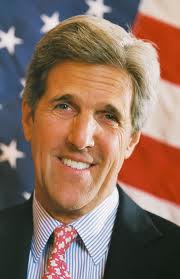
Senator John Kerry

Senator John Kerry

I met Senator John Kerry at the Harvey Nash Inc. Leadership Breakfast at the Plaza Hotel in NYC on Friday, March 2, 2012. He spoke unequivocally about infrastructure, energy, mass transit, and foreign policy, saying,

We need to invest in our infrastructure. The people who talk the loudest about ‘American Exceptionalism’ are destroying America.

Sending our children to college is competitiveness, not elistism.

“The American Infrastructure Financing Authority,” Kerry said, “would generate revenue by loaning money to people to build infrastructure. It has bi-partisan support. It should be a slam-dunk. But we can’t get it passed because of Republicans intransigence. The American people have to force the Republicans to compromise and force the Democrats to stand tall.

In the ’70’s we were #1 in college graduates; now we’re 16 th. We were #1 of the G 20, now we’re 5th.

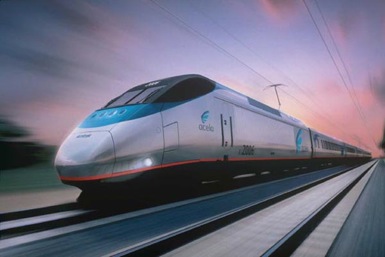
The Acela can go 150 mph – and it does for about 18 miles between New York City and Washington, DC. It can’t go 150 mph over the Chesapeake Bay bridge because in doing so it may wind up in the Chesapeake. It can’t go 150 mph in the Baltimore tunnel because the vibrations may damage the tunnel.

Acela

The Acela

Editor’s note: The Acela runs it’s top rated speed for 16 miles on a 220 mile trip – about 7.3%. The trip on regular Amtrak is 4 hours. The trip on Acela is 3 1/2 hours. That’s about 62.9 mph.If the tracks would allow the train to make the run at it’s design speed of 15o miles per hour the trip would take an hour and a half, not 3 1/2 hours. Average 125 mph, it would take about an hour and 45 minutes.

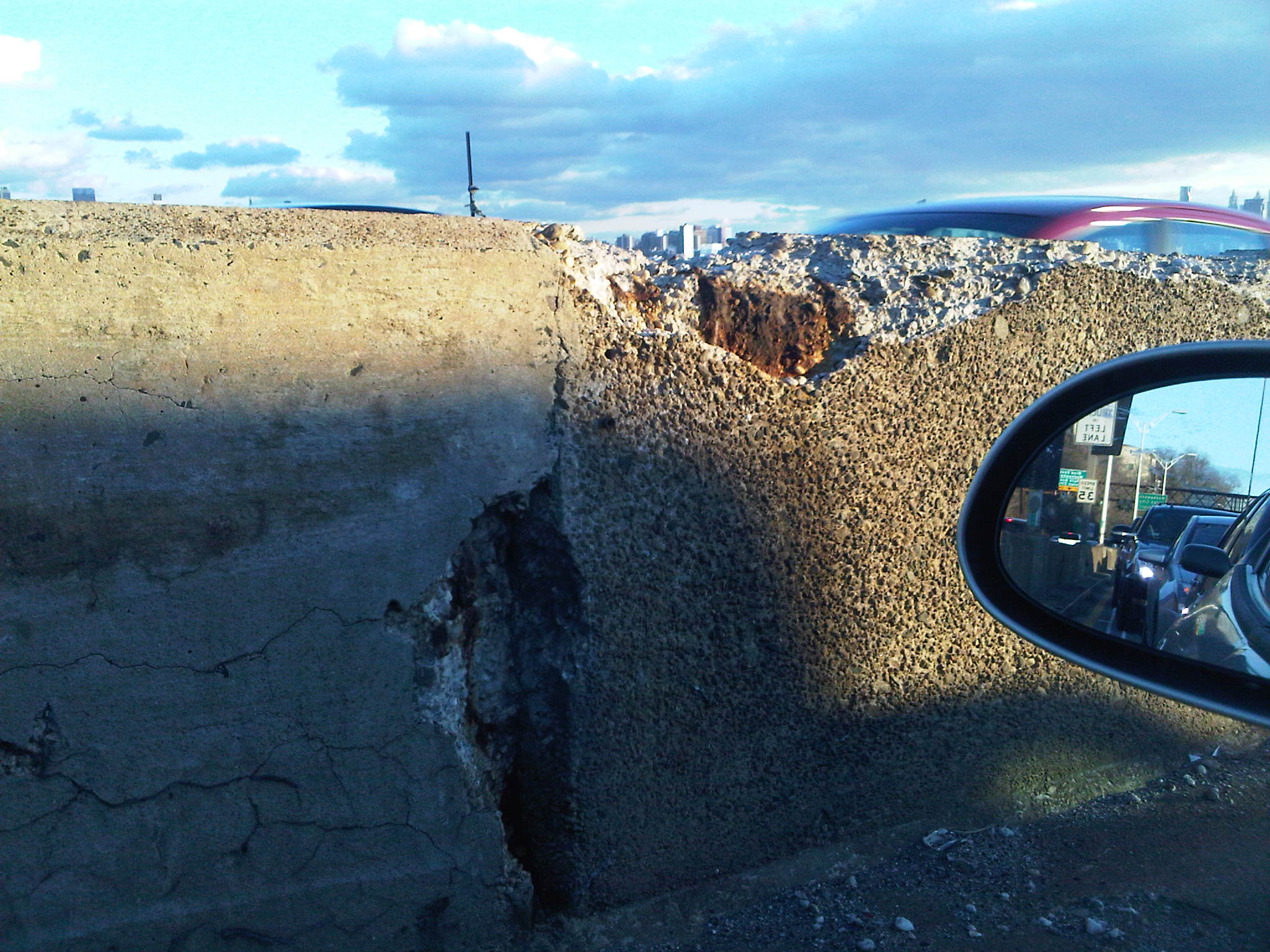
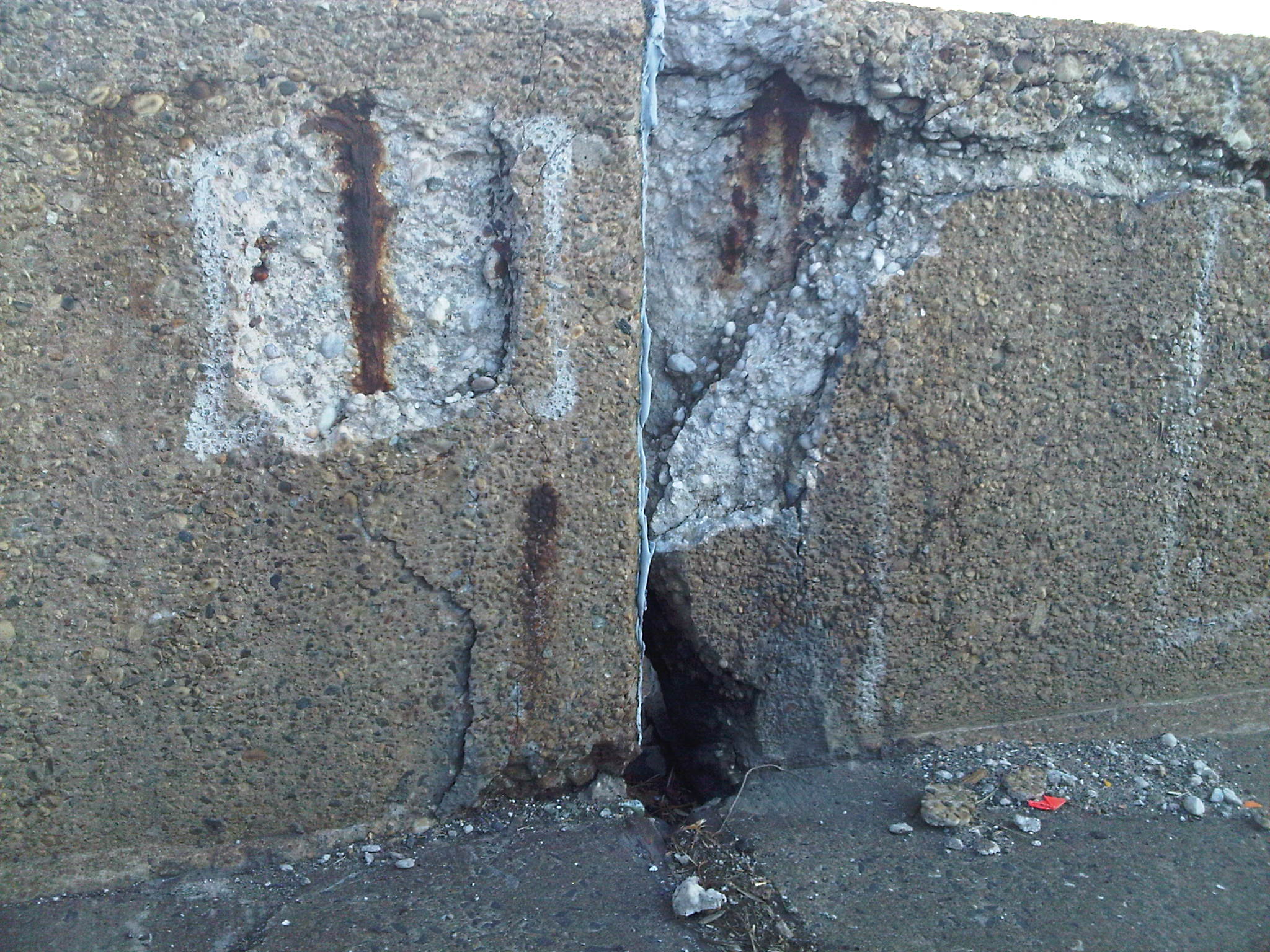
Image of wall of Bridge to the Holland Tunnel

A few years ago we were first in manufacturing solar energy. Now China has taken over that industry.

China spends 9% of GDP on infrastructure. Germany spends 5%. We spend less than 2%.

We are using the infrastructure that our parents and grandparents built. And it’s crumbling!

Wall of the bridge leading to the Holland Tunnel

Wall of the bridge leading to the Holland Tunnel

In order to compete we must rebuild our infrastructure – and send our children to school.  (And sending your children to school is not elitist.)

Kerry spoke like a Keynesian:

Saving GM and Chrysler saved about 1 million jobs. Had they been allowed to fail Ford and all the suppliers, and all the clothing stores, food stores, delis, diners, restaurants – all would have failed. Saving the American auto industry saved the midwest from a Depression. That’s not socialism; that’s what government is for. And Ford, GM, and Chrysler are profitable!

Editor’s note: Ford did not take TARP money. GM, Ford and Chrysler are building cars people want to buy, and people are buying them.  The following chart shows market capitalization, stock price, earnings per share, price earnings ratio and net profit margin for GM and Ford. Chrysler is not included because it is privately held.

Company Valuation Stock Price EPS P/E Ratio Net Profit
(Billions) (3/2/12) Margin
Ford $48.4 $12.72 $5.01 2.54 14.84
General Motors $41.4 $26.45 $4.58 5.77 4.06

According to San Francisco Chronicle / Bloomberg, here,

U.S. auto sales accelerated to the fastest pace in four years …  a 15.1 million seasonally adjusted annual rate, exceeding the 14.2 million pace that was the average of 17 analysts’ estimates… the best since February 2008 when U.S. sales ran at a 15.5 million rate,

GM deliveries rose 1.1 percent to 209,306 cars and light trucks, beating analysts’ estimates for a 4.8 percent decrease. Chrysler sales increased 40 percent to 133,521 and Ford Motor Co.’s climbed 14 percent to 178,644. Toyota Motor Corp. and Honda Motor Co. deliveries each gained 12 percent, while Nissan Motor Co. sales rose 16 percent.

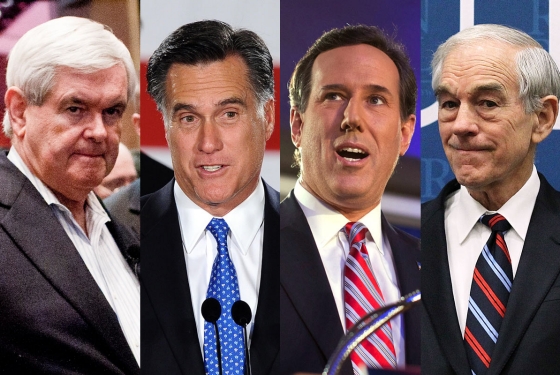
Yet Romney, Santorum, Gingrich and Paul persist in the lunacy that bailing out GM and Chrysler was a mistake.  If they don’t want to govern, why do they want to be President?

Kerry also said:

Successful businesses today have a lot of cash. But the executives are reluctant to invest because the economic climate is too uncertain. That’s why government must step in.

This statement could have been made in 1932 by Franklin Delano Roosevelt or John Maynard Keynes.

Kerry criticized Santorum. “Saying my grandfather was a coal miner, so I could go to college, go to grad school, get an MBA and a JD, then get elected to the Senate, then make millions lobbying, and tell you not to send your kids to college…” If that’s not elitism and demagoguery I don’t know what that is.

The current political climate in Washington is terrible, that’s why Olympia Snowe is leaving the Senate. The Republicans are intransigent, they refuse to compromise; they are focused on destroying Obama’s Presidency – and will sacrifice America to do it. When G W Bush was President it took 30 days to get a judge approved. Today it takes 100 days, maybe 200 days. There were two (2) filibusters in the 19th Century, and another two (2) in the 20th before WW II. Strom Thurmond’s filibuster of civil rights legislation, a few more in the 60’s. Today there are 100 filibusters per session.

And “do the math, folks, we can’t balance the budget on the backs of our poor and our seniors. We must raise revenues. The Bush tax cuts on the wealthiest 1% and 2% must end.”

Kerry spoke about money in politics, and the disaster that was the Citizens United decision.

He also noted that Congress has an approval rating of 8%. I know why. Or at least, why I have disgust and contempt for most of the members of the House and Senate. The Republicans won’t compromise; they are beholden to “King” Grover, aka Norquist the Zeroth, and Democrats are too willing to compromise.

However, he ended on a positive note. He is confident that President Obama will be reelected, and is also confident that America’s best days are yet to come. All we have to is take the money out of politics, force the Congress to change, reelect the good incumbents and throw the bums out.

Question for John Kerry

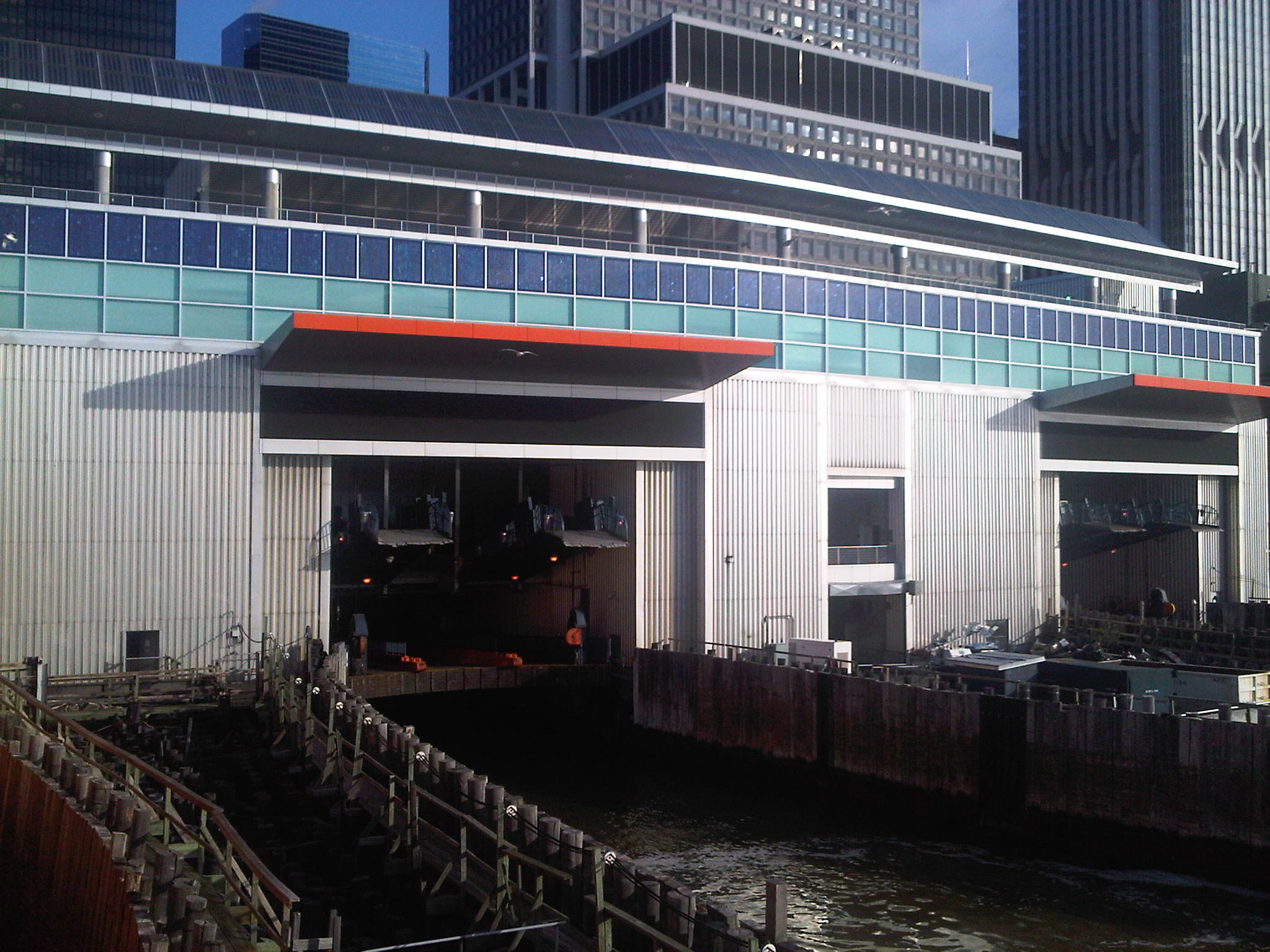
40 KW Solar array on Whilehall St Ferry Terminal

40 KW PV Solar Array on SI Ferry Terminal

While Chinese subsidies of their solar energy industry have decimated the manufacturing base of the American solar industry, solar energy continues to expand across the country.

What if we stimulated the solar industry with a public works program?

What if we decided to deploy a 40 kilowatt photovoltaic solar array on each of the approximately 90,000 public schools in the country?

The best kept secret in NYC may be found on the Staten Island Ferry, or more precisely, on the south roof of the Whitehall Street terminal. It’s a 40 kilowatt photovoltaic solar array.

Taxpayers pay the electric bills of the ferry terminal, which today are much lower because of the energy the system produces. Taxpayers also pay the electric bills of public schools, courts and other municipal, state and federal office buildings – and the externalized costs of pollution and “health effects” related to mining coal and uranium, drilling oil or frakking gas.

I met Senator John Kerry at the Harvey Nash Inc. Leadership Breakfast at the Plaza Hotel in NYC on Friday, March 2, 2012. At the conclusion I asked him to consider a 40 kw photovoltaic solar energy system on each of the approximately 90,000 public schools in the US.

At $5.00 per watt, which is less than the cost of new nuclear and much less than coal with carbon sequestration, these 90,000 systems would cost $18 billion. They would produce electricity without burning fuel, creating wastes, or creating targets for terrorists, and would pay for themselves in eight to 15 years, depending on the market price of electricity. They would also produce energy for 25 to 40 years – paying for themselves several times over.

This kind of a public works project would create jobs. Even if we didn’t mandate that these used products made in American factories, which I think we should, installation and maintenance would have to be local.

It would also lessen our dependence on fossil fuels.

And each solar energy powered building could be designed to generate electricity during the day during an emergency which shuts down the grid, further enhancing our emergency response capability.

Senator Kerry responded that this would be a perfect project for the Infrastructure Bank that he wants to create. However, the political climate is such that it can’t get done.

No More Fukushimas: From Coal, Oil, and Nuclear to Sustainable Energy

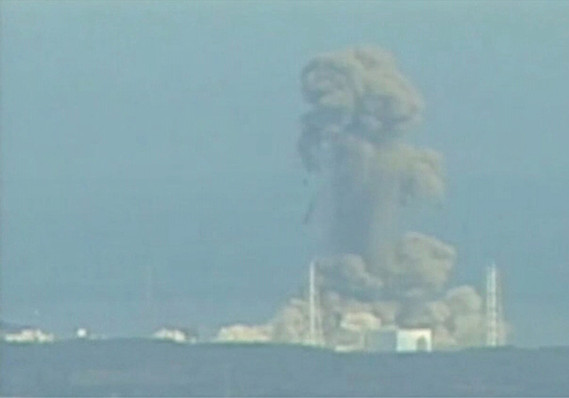
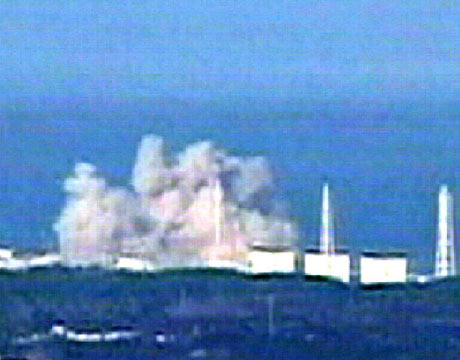
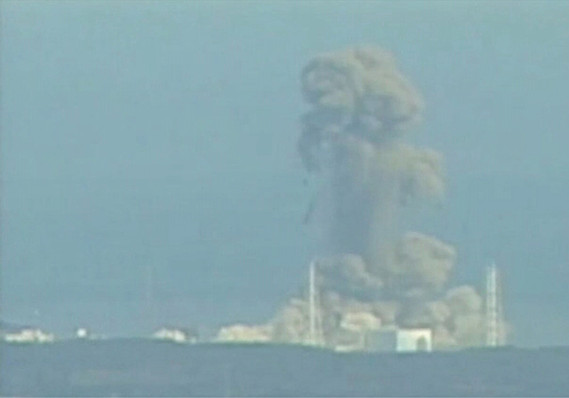
Smoke from three meltdowns and other fires

Fukushima reactors, after tsunami

On March 11, 2011, the Fukushima nuclear disaster shocked the world. Sadly, the thinkers in the anti-nuclear world were not complete surprised. We were startled, but we know that disasters, while unpredictable, are inevitable. Disasters are built into the nuclear power system. The best engineers are fallible. (Anyone who drives a car or uses a personal computer knows this.) We can engineer nuclear reactors to be “reasonably” safe – but that costs a lot of money. That’s why ALL nuclear reactors leak “acceptable” levels of tritium – it is too expensive to capture all the tritium.

We also know

  • While the probability of an accident may be low, the probability is very high that an accident, if it occurs, will be
  • In Three Mile Island, in 1979, Chernobyl, in 1968, and Fukushima, in 2011, we have four melt-downs and one partial melt-down since the Price Anderson Act was first signed into law in 1956. That’s four melt-downs in 56 years. While it’s a too small to give a precise statistical measure, it offers empirical data to suggest a high probability of a catastrophic accident every 14 years.

In command economies, such as existed in the Soviet Union, or exists in Iran and North Korea, it is illegal – and dangerous – to question the government. In market economies, such as exist in the United States, Europe, and Japan, there are strong incentives to cut corners.

But back to Fukushima – following the disaster, nearly all of Japan’s 54 Nuclear Plants have been shut down due to pressure by the Japanese people.

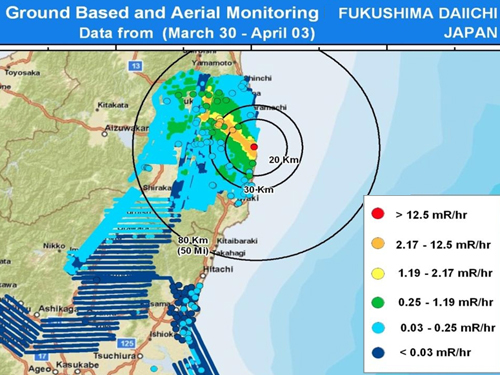
The disaster deposited radioactive fallout on a semicircular area of Japan with a radius of 50 miles. It caused the permanent displacement of 160,000 people. An unknown amount of radioactive materials have been flushed into the Pacific Ocean.  TEPCO, the owners of the reactors, have a $100 Billion liability (that will probably be absorbed by Japanese citizens over the next 20 or 50 years).

So after Fukushima, the question that we ought to be asking is not: “Can solar, wind, geothermal, marine current and other sustainable technologies meet our energy needs?”

The question is: “HOW can solar, wind, geothermal, marine current and other sustainable technologies meet our energy needs?”

I will be speaking on Monday, March 5th, at 6:00pm, at the Unitarian Universalist Meeting House on West Front Street in Lincroft, NJ. This will be part of a series of discussions along a 250 mile walk from Oyster Creek, in Ocean County, NJ to Vermont, Yankee, in Vernon, Vermont.  I will make a statement similar to the talk at the Space Coast Green Living Festival, reported here.

A group of Japanese Buddhists, Fukushima eye-witnesses and US citizens will be walking over 250 miles from Oyster Creek to Indian Point to the Vermont Yankee Nuclear Power Plants to bring awareness of the terrible risks of nuclear power. The “No More Fukushimas Peace Walk” is being led by Jun Yasuda.

Scheduled events open to the public:

Friday March 2nd, 7pm, “Implications of the Fukushima Nuclear Disaster for the U.S and continuing Japanese crisis”
Little Theatre, Georgian Court University, 900 Lakewood Ave, Lakewood N.J.

Speakers:

  • Sachiko Komagata, P.T., Ph.D, and Associate Professor & Chair, Department of Holistic Health & Exercise Science
  • Rachel Dawn Fudim-Davis, New Jersey Organizer, Food & Water Watch
  • Jeff Tittel, Director of Sierra Club, NJ Chapter
  • Sister Mary-Paula Cancienne, RSM, PhD.

Hosts:  Sister Mary Bilderback, Mary Paula Cancienne
For information Kasturi DasGupta, PhD 732-987-2336

Saturday, March 3, 6:00 pm,
Sky Walk Cafeteria, 2nd Floor, 129 Hooper Ave, Toms River, NJ (Connected to parking garage)
Speakers:

  • Sky Sims, Sustainable energy specialist;
  • Joseph Mangano, Executive Director of Radiation and Public Health Project;
  • Ed M. Koziarski and Junko Kajino, Filmakers

For information Burt Gbur, 732-240-5107

Sunday, March 4th, 6:00 pm,
Murray Grove Retreat Conference Center, Lanoka-Harbor, NJ Church Lane and US Highway 9
Speakers:

  • Willie DeCamp, Save Barnegat Bay,
  • Greg Auriemma, Esq., Chair, Ocean County Sierra Club,
  • Peter Weeks.

For information Matt Reid, 609-312-6798

Monday, March 5th, 6:00pm,
Unitarian Universalist Meeting House, West Front Street, Lincroft, NJ

Speakers:

  • Larry Furman, “Beyond Fuel: The Transition from Fossil Fuel and Nuclear Power to Sustainable Energy.”
  • Japanese walkers share their post-Fukushima experiences in Japan

For Information:.  Elaine Held (732-774-3492).

Thursday, March 8, 6:00 pm
Puffin Foundation, 20 Puffin Way, Teaneck, N.J.

Speaker:

  • Sidney Goodman, Author ‘Asleep At the Geiger Counter: Nuclear Destruction of the Planet and How to Stop It’, ISBN: 978-1-57733-107-0, available from Blue Dolphin Publishing, and elsewhere.

For information Jules Orkin, 201-566-8403

The walk will start at 10am on Saturday, March 3rd near the Oyster Creek area, and end at 129 Hooper Ave, Toms River. Starting times and places for March 4th and 5thwill also be announced on February 27th.
————————————————–
The mission of the Walk:  

A plea for the people of New Jersey, New York and New England to recognize the grave dangers that nuclear energy poses to our lives, property, and all life on the planet.

We walk together in love and solidarity for a nuclear free future, and a more just, sustainable, and compassionate world built on respect for all living beings.

JOIN THE WALK FOR AN HOUR OR A DAY.

Edith Gbur   732-240-5107
Christian Collins 413-320- 2856
Cathy Sims  732-280-2244

Apple, Google, IBM – the way forward

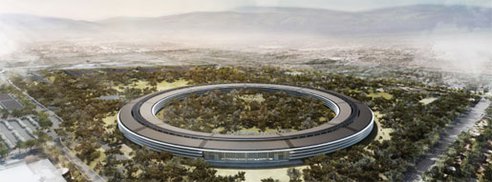
Apple HQ, in Cupertino

Apple HQ, Cupertino, California

Back in 1965, IBM CEO Thomas J. Watson, Jr, wrote, in IBM’s Basic Beliefs & Principles,

“We accept our responsibilities as a corporate citizen in community, national, and world affairs; we serve our interests best when we serve the public interest…. We want to be at the forefront of those companies which are working to make the world a better place.”

Today, IBM says “Sustainability is no longer an option. Sustainability is an imperative.” IBM is focused on making data centers and supply chains more efficient, and providing their customers with tools to become less unsustainable (IBM green blog). The European Commission awarded IBM for energy efficiency at 27 data centers (IBM Press Release).

However, it looks to me that Google and Apple are one or two steps ahead of IBM. Google has invested $915 Million in solar arrays, which should be 1.0 to 1.5 MW. Apple is putting a 5MW solar array on the roof of it’s headquarters in Cupertino, pictured above, and described here on Treehugger and here on 9to5mac. Apple is also using solar and biofuel to power it’s new data center in South Carolina (article in Renewable Energy World). Essentially:

  • A 100-acre, 20 megawatt (MW) solar array, supplying 42 million kWh of energy each year.
  • A 5 MW biogas system to come online later this year, providing another 40 million kWh of 24×7 baseload renewable energy annually. Apple claims this will be the largest non-utility-owned fuel cell installation in the US.
  • Combined, that’s 82 million kWh/year of onsite renewable energy generation at the facility.

For more details, see the 2012 Apple Facilities Report.

Apple’s building may be a derivative design of the Widex headquarters, in Allerød, Denmark, described on Widex home page,  here. The Widex building is a ring that surrounds a large atrium courtyard to be planted with grass, flowers and trees and is according to Widex,”designed to be both pleasant to look at and be in…. and environmentally friendly

Heat for the building will be supplied by a geothermal system, where groundwater is used like a heat reservoir; excess heat in summer can be stored and used when needed during winter. Our ambition is to reduce energy consumption by 75 percent compared to traditional technology.

Apple, Google, and IBM report high profits. Their stock prices are also high, perhaps demonstrating the correlation between doing well and doing good.

Outsourcing – A Communist Plot? Remember Khrushchev?

Image of DEC VAX chip, showing Cryllic inscription "When you care enough to steal the best."

CVAX ... When you care enough to steal the very best

Mark Landler and Edward Wong, covering Chinese Vice President Xi Jinping’s trip to the US, in the New York Times, Feb 14, With Edge, U.S. Greets China’s Heir Apparent, wrote,

“On the list of American concerns, Mr. Biden said, were China’s artificially depressed currency and conditions imposed by the Chinese that require foreign companies to turn over technology in return for doing business in China. He raised the issue of jailed Chinese dissidents and … Syria”

In Inflaming Trademark Dispute, Second City in China Halts Sales of the iPad, published in the NY Times, Feb. 14, 2012, Michael Wines wrote:

“The authorities in a second Chinese city have begun seizing iPads from local retailers in an escalating trademark dispute between Apple and Proview Technology. … The seizures follow a ruling in December in which a court in Shenzhen dismissed Apple’s contention that it owned the iPad name in China. … Proview has also made a filing with the General Administration of Customs in China putting Apple on notice that the company could seek to block the export of iPads, should Proview’s ownership claims be upheld. … the seizures and the filing are warnings by Proview of the havoc it could wreak unless Apple agrees to pay a large fee to settle the trademark fight. … Paradoxically, China’s intellectual property laws are so sweeping that they allow the government to ban the worldwide sale of any made-in-China product that is found to violate a Chinese patent, trademark or other protection.”

Remember back during the cold war, when Soviet Premier Nikita Krushchev said “Whether you like it or not, history is on our side. We will bury you.” ( various quotes by Kruschev).

And later when the American computer company DEC, in response to reverse engineering of VAX computers by Soviet computer scientists inscribed, in Russian,“CVAX, … When you care enough to steal the very best” on the CVAX microprocessors. (Links: TRAILING EDGE.com, CNET, FSU.edu.)

Suppose Khrushchev had called John Kennedy, on the occasion of John Glenn’s orbit in the Friendship 7, February 20, 1962,  here, or Leonid Brezhnev had called Richard Nixon, after Neil Armstrong, Buzz Aldrin, and Michael Collins returned from the moon in Apollo 11, July 24, 1969, Apollo 11, or Mikhail Gorbachev had answered Ronald Reagan’s call to “tear down this wall,” and said

“Mister President, I have business proposition for you: Let us to build your consumer goods. We have factories with skilled laborers. Our workers are like children, so eager to please. (Ok, they are children.) We can more or less match your quality control. We can deliver on time. And we do this for pennies on the dollar – pennie!

“All we ask is you give us designs for the products, and computer software source code for computers and telecommunications de-wices we assemble. It will be great Soviet / American partnership.”

Presidents Kennedy, Nixon, and Reagan would have said

“Give you our designs? Our software? That’s our intellectual property? Are you nuts? That would be crazy!”

Premiers Khrushchev, Brezhnev, and Gorbachev might have answered,

“But our labor costs are much lower than yours. We have workers in factories, happy workers in the ‘Worker’s Paradise.’ Why. workers in our factories in Siberia work 7 days a week. And for little more than food and water. Go on strike? Never! (If they did we would shoot them.) You won’t have to pay them union scale or retirement benefits.”

Presidents Kennedy, Nixon, and Reagan would still have said

“Give you our designs? Our software? Our intellectual property? So you can use children and slave labor to build our consumer goods? That would destroy our middle class. That would be nuts.”

And they would have been right.

So how exactly are the Chinese communists different from the Soviet communists?

We wouldn’t outsource to the Soviet Union. Why are we outsourcing to China?

Nuclear Industry in Japan – Not Unlike the Nuclear Industry in the USA

Map of Japan showing US and Japanese evacuation zones

Fukushima Nuclear sites and Evacuation Zones. Courtesy, National Post.

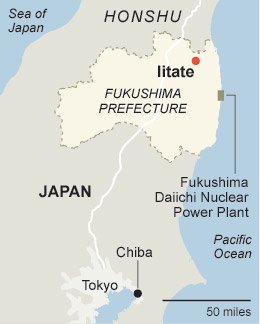
Map of Japan showing Fukushima Prefecture

Fukushima Prefecture. Courtesy NY Times.

I drew four conclusions after reading Hiroko Tabuchi’s article, A  Confused Nuclear Cleanup, in the NY Times, and looking at the US Government’s evacuation map, pictured above (obtained at the National Post, here.

  1. The Fukushima disaster is bad, really bad.
  2. The Japanese want to clean it up; but don’t know how.
  3. The nuclear industry in the USA is just like the nuclear industry in Japan – and that’s also really bad.
  4. In a market economy there may to too much pressure to increase shareholder value to spend enough on safety. (In a command economy, such as existed in the Soviet Union and exists in China, North Korea, and perhaps, Iran, it is illegal to criticize the government and therefore likely that necessary investments in safety will not be made.)

Here are the essential facts, as reported:

The Japanese government wants to clean an 8,000 sq mi area near Fukushima [about the size of New Jersey] to allow residents to return to their homes.

A day laborer wiping down windows at an abandoned school nearby shrugged at the work crew’s haphazard approach. “We are all amateurs,” he said. “Nobody really knows how to clean up radiation.”

The Japanese government awarded the first contracts to three giant construction companies — corporations that have no more expertise in radiation cleanup than anyone else does, but that profited hugely from Japan’s previous embrace of nuclear power.

“We are building expertise as we work,” said Fumiyasu Hirai, a Taisei spokesman.  [Taisei is one of the three companies.] “It is a process of trial and error, but we are well-equipped for the job.”

“It’s a scam,” said Kiyoshi Sakurai, a critic of the nuclear industry and a former researcher at a forerunner to the Japan Atomic Energy Agency, which is overseeing this phase of decontamination. “Decontamination is becoming big business.”

The cleanup contracts, Mr. Sakurai and other critics contend, are emblematic of the too-cozy ties they say have long existed between the nuclear industry and government.

“The Japanese nuclear industry is run so that the more you fail, the more money you receive,” Mr. Sakurai said.

Though big companies have won the main contracts so far, the actual cleanup — essentially a simple but tedious task of scrubbing and digging — is being carried out by numerous subcontractors and sub-subcontractors, who in turn rely on untrained casual laborers to do the dirtiest decontamination work.

This tiered structure, in which fees are siphoned off and wages dwindle each step down the ladder, follows the familiar pattern of Japan’s nuclear and construction industries.


Fukushima coverage on Popular Logistics:

Nuclear Power – or Un Clear Power

The Nuclear Regulatory Commission, NRC, has voted to allow Georgia Power to spend $14 Billion of ratepayer monies to build two reactors, Vogtle 3 and 4 near Waynesboro, Georgia. These would be the first new nuclear plants in the US in 35 years. Opponents say “we don’t need the power, but the utility wants the revenue stream.” Supporting this allegation Georgia Power plans to charge ratepayers – customers – for the costs of construction WHILE BUILDING THE PLANTS – BEFORE THE ARE ONLINE. see Georgia Power – Nuclear – Recovering Financing Costs.

Scott Peterson, of the Nuclear Energy Institute, was quoted on Morning Edition on Friday, 2/10/12, here, ” saying,

Nuclear plants, because they are very large, 24/7 power producers, really anchor the entire U.S. grid for electricity,”

He also said,

“Gas prices are unpredictable, and so is energy from wind and solar.”

He’s wrong on all three counts.

  1. Gas prices are rising. They may be difficult to predict on a day to day basis, but the trend is upward.
  2. Similarly, solar and wind are also predictable. The Department of Energy, DoE, knows precisely how much wind and sun passes over every square inch of the United States, and how much sunlight hits every square inch of the United States over the course of a year. And how much electricty a wind turbine or a photovoltaic solar energy system will produce anywhere in the US. The PVWatts solar calculator, for example,here, http://www.nrel.gov/rredc/pvwatts/,  tells you how much power a solar array will produce over the course of a year.
  3. And nuclear is not 24 x 7. While the waste is 24 hours by 7 days per week by 365 days per year by ten thousand years, nuclear plants are not 24 by 7 days by 365.  They are more like 24 by 7 by 350; they are shut down for about a month for refueling every 18 months. Nuclear plants are also shut down unexpectedly due to events like hurricanes, earthquakes, floods.

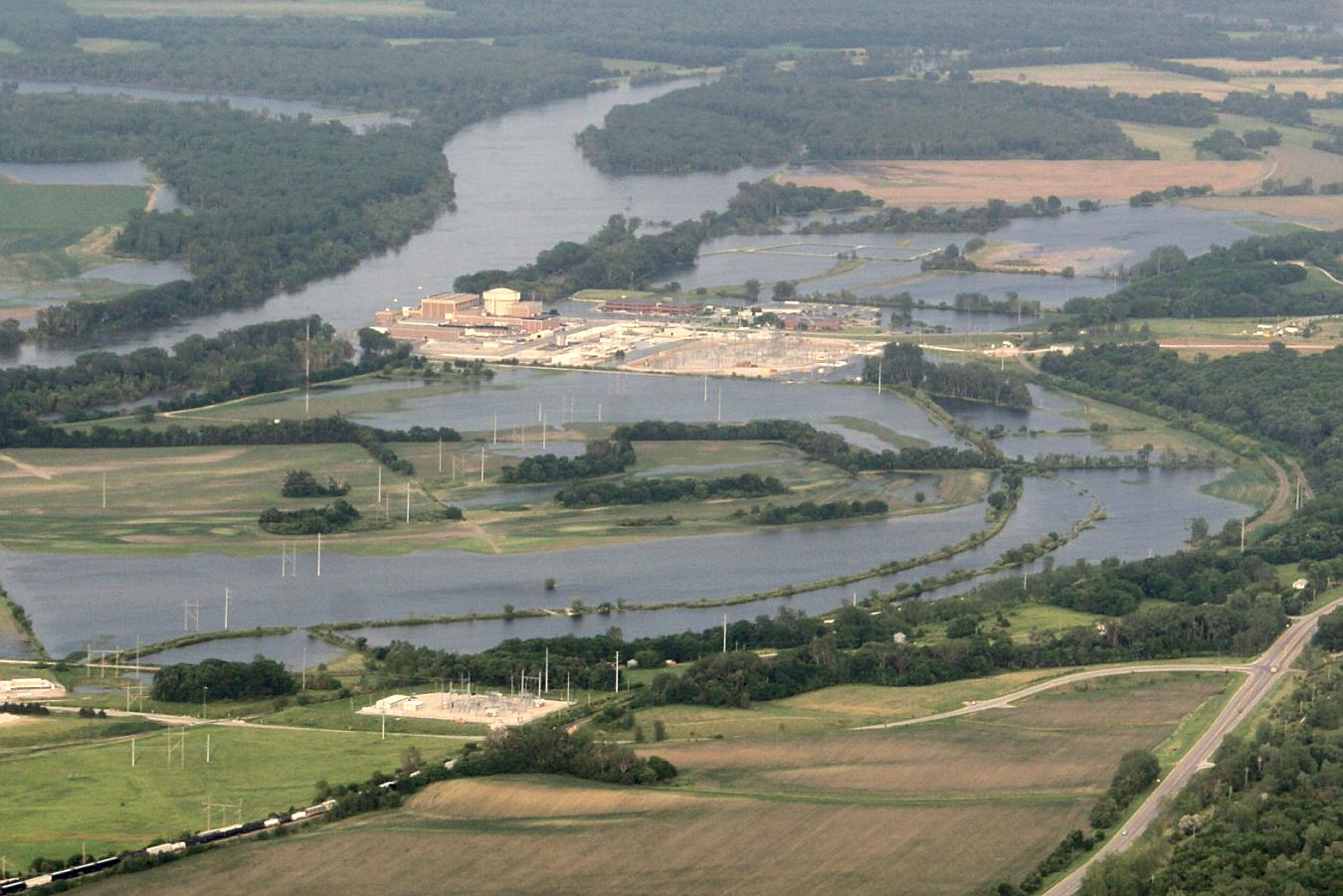
The Fort Calhoun reactor, on the Missouri River in Nebraska was shut down for refueling in May, 2011 . It stayed shut down due to flooding. It was offline throughout the summer and fall, (my coverage here and here) and as far as I know it is still offline.  According to David Lochbaum, of the Union of Concerned Scientists, the shutdown cost the plant’s owners $1 million per day – $100 million if it was brought back online in September, $250 million if it is still offline. And I would hazard a guess that the owners asked for and received permission to charge the ratepayers those $1.0 million per day. (As far as I know the plant is still offline. I will update this post when I have more information.)

Regarding the Vogtle plants … the plan is to build two Westinghouse AP 1000 pressurized water reactors, here. Theses are 1154 MWe plant, that, according to Westinghouse,

“use the forces of nature and simplicity of design to enhance plant safety and operations and reduce construction costs.”

They are forecast to cost $14 Billion. $14 Billion divided by 2,308 MWe is $6.065 per MWe. That does not include the costs of security, fuel or waste management

Solar and wind costs less, takes a lot less time to deploy, do not require fuel, do not produce dangerous toxic wastes, do not present a target to terrorists and do not require special security infrastructures.

Pulling Water out of Thick Air – The Vapour Inc PURE WATER GENIE

Earth

Earth from Space

Beduins in the Sahara, Mexico

Beduins in the Sahara, Morocco


While water covers 73% of the earth’s surface, clean water is, in many parts of the world, a scarce and expensive resource, and is increasingly becoming more scarce and more expensive. It is common in the eastern and central parts of the US, however, even here we experience water shortages. Frakking, coal processing, cooling nuclear power plants, and other industrial processes require clean water, and produce dirty water, and water shortages are predicted in 36 states over the next 5 years.

Yet water is in the air. It’s easier to pull water out of a river or a stream, or even out of the ground, where it exists in the liquid state, than to condense water vapor out of the air, but this is about to change. And water vapor in the air is cleaner than water on the ground.

The Vapour Inc Pure Water Genie ™ condenses water out of the air, and uses about 1 kwh per gallon, depending on humidity and air temperature. The units come in various sizes for personal or office applications to embassy scale sizes.

My friends at Vapour Inc, call it the “Pure Water Genie.” I would call it a “Cloud Machine,” or a “Box of Rain.”

Consider the American Embassy in Damascus, or Tehran, or a military base in Afghanistan. The Vapour Pure Water Genie is a source of pure water in hostile territory. If the American Embassy in Tehran had it’s own discrete and independent water supply back in 1979, our military could have been better able to secure the site. If remote military bases in various operating theaters have their own discrete and independent water supplies, then we don’t have to allocate resources to move water in hostile territory; our logistics positions are stronger. If we can pull water out of thick air, we don’t need to burn fuel or risk lives transporting it. If it’s coupled with a solar energy system then our embassies we don’t need fuel for generators in countries like Egypt, Iraq, Syria, Pakistan, Russia and China, which are either unstable, potentially hostile, have limited supplies of clean water, an unstable energy supply and distribution system.

The Vapour Genie uses electricity to pull water out of air without plastic and fuel used to bottle and transport bottled water. The water is chemical-free, with purity second only to distillation. This is unmatched by bottled water, and in some cases tap water. The six-stage filtration includes: Sediment, Sterilize, Carbon Block, TCR, UF, UV.  As fuel prices go up, so will the cost of transporting bottled water. As the costs of “disposing” and recycling plastics increases, so will the cost of bottled water. But while fuel prices and plastic recycling costs will go up, solar energy systems will be stable or drop due to advances in engineering. (See my post from Dec. 17, 2011, “Moore’s Law Applied to Solar Power,” here.)

The Pure Water Genies perform optimally in 70% to 80% humidity and temperatures between 75 F and 84 F (24 C and 29 C). We can’t control ambient humidity, but we can control temperature. In Kabul, Afghanistan, for example, in a controlled room with 78 F, the humidity will range from 33% in August to 77% in February. The Water Genie 5000 will produce 600 liters per day in August and 4650 liters per day in February.

These could replace water coolers in offices across the United States – and according to John at Vapour Inc., there are 12 million today.  And these could provide a secure water supply for our embassies and for service personnel on missions around the world.


Unemployment Drops Slightly in January, 2012

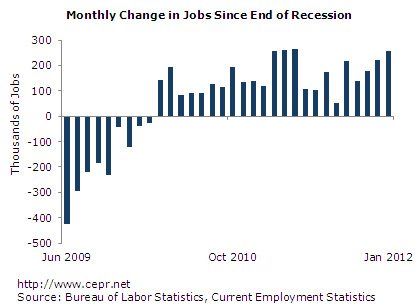
In Jobless Rate Fell To 8.3% in January, 2012, as, according to the Bureau of Labor Statistics, approximately 243,000 new jobs were added in the economy, here. This is good. But an unemployment rate of 8.3% means there are 13 million people out of work and looking for jobs. That doesn’t count the millions that are out of work and not even looking. We need 13 million new jobs – 52 months of 243,000 new jobs per month.

On NPR’s Morning Edition, Friday, Feb. 3, 2011, here, Renee Montagne interviewed Yuki Noguchi on the Bureau of Labor Statistics January jobs report, the Employment Situation Summary, here, on jobs in the economy. Early on, at about 1 minute 30 seconds, Ms. Montagne asked, “What about government jobs?”

Ms. Noguchi replied, “Government job loss is minimal.”

This is a critical piece of the puzzle. Toward the end of the segment, at about 3 minutes, 14 seconds, Ms. Noguchi said “let’s say the hiring stays at this level, with nearly 13 million people unemployed, it would take nearly four years for all those people to find jobs. And that number doesn’t count people who are not even looking.”

President Roosevelt and John Maynard Keynes proved that during economic times such as these, while business owners are capable of hiring, they are reluctant to hire because they are reluctant to risk capital. The only entities that are both willing and able are agencies of the government and not-for-profits such as schools, hospitals, etc. This is because they serve their stakeholders, not their stockholders.

Keynes wrote his seminal General theory on Employment, Money, and Interest During the Depression. He looked at the classical theory which said, essentially, the Depression can’t be happening, and at the empirical data which said “It is happening” and concluded that if the theory is out of sync with the facts, then the theory must be flawed. His theory is described by Paul Krugman, here, and Aaron Schwartz, here.

21 of 2011 – Most Significant Events of the Year

Tweet Follow LJF97 on Twitter  While it ain’t over till it’s over, 2011 is over. A lot that could have happened, didn’t.  Obama didn’t resign, Donald Trump didn’t throw his hat into the ring or divorce his current wife and marry one or more Kardashians.  Newt Gingrich threw his hat into the ring, but also didn’t divorce his current wife and marry one or more  Kardashians. These are the most significant events of 2011.

  1. Japan, March, 2011 . Nebraska, June, 2011. An earthquake triggered a tsunami which slammed Japan with a 30 foot wave, which shut down twelve nuclear reactors at three sites, triggering melt-downs in three reactors at the Fukushima Dai-ichi site. We now see radioactive particles in food and soil in Fukushima Prefecture. The United States government recommended an evacuation of a 50 mile radius from the plant – this is a semi-circular no-man’s land of 3,927 square miles. It would be 7,854 square miles but the plant was on the coast and therefore half of this radioactive no-man’s land is in the Pacific Ocean.  The environmental ramifications of radioactive materials spreading over Japan and flowing into the Pacific Ocean are not known (Popular Logistics click hereherehere), however, liabilities to TEPCO and Japan are estimated to $100 Billion (click here). In the United States, two nuclear power plants on the Missouri River, the Fort Calhoun and Cooper plants, were shut-down when the Missouri River flooded (Popular Logistics, here). Eight nuclear power plants from South Carolina to Connecticut were shut down in the aftermath of the earthquake that struck with an epicenter in Virginia August 23, 2011, and Hurricane Irene a few days later (Popular Logistics, here). In the words of Mycle Schneider, describing the World Watch Institute report he authored, “The industry was arguably on life support before Fukushima. When the history of this industry is written, Fukushima is likely to introduce its final chapter,” (click here). However, the three melt-downs at Fukushima, coupled with the melt-down at Chernobyl in 1986 and the partial melt-down at Three Mile Island in 1979, suggest a probability of one melt-down every 14 years.
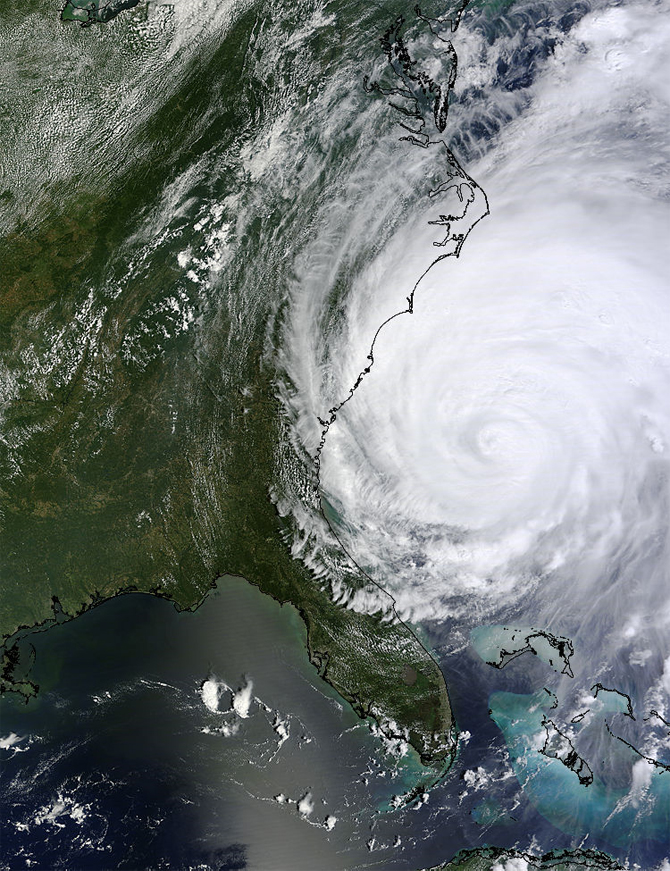
  2. South Carolina, North Carolina, Virginia, Maryland, Delaware, New Jersey, Pennsylvania, New York, Connecticut, Massachusetts, and Vermont, August, 2011. Hurricane Irene covered an area of approximately 170,000 square miles, or about the size of California.”Hurricane Irene, August 26, courtesy of NASA
  3. Washington, DC, December. 2011. After 4,000 Americans were killed, about 50,000 were wounded, and $1 trillion was spent over 8 years, President Obama ended the American mission in Iraq that Congress authorized in October, 2002, President Bush started in March, 2003 and declared “Accomplished” in May, 2003 (for a timeline, click here).
  4. Washington DC, Abbottabod, Pakistan, May, 2011, American soldiers, on orders from the White House, found and killed Osama bin Laden in a compound in Pakistan (NY Times, click here).
  5. Yemen, In summer, 2011, American military forces, using a drone aircraft piloted from the ground via remote control, from the ground, targeted and killed Anwar al Awlaki, an American born Al Queda operative in Yemen (NY Times, click here).
  6. The hacking group “Anonymous” broke into the computers of the security consulting group “Stratfor” and found 44,188 Encrypted Passwords, of which roughly 50% could be easily cracked. 73.7% of decrypted passwords were weak” (NPR, click here).
  7. The “Stuxnet” computer worm virus, harmelss on PC’s runing MS Windows, Mac OS X, and Linux, and other computers, appears to have targeted centrifuges used in the Iranian uranium enrichment facilities.  While the viruses were discovered in 2010, they became understood in 2011. The virus caused the centrifuges to spin out of control, wrecking themselves (NY Times, here, NPR here, CNET here, Wikipedia here). Continue reading

Apple, Blackberry, and Classical Physics

In “The World Will Not End, and Other Predictions for 2012,”  I wrote “Apple and IBM will continue to thrive. Microsoft will grow, slightly. Dell and HP will thrash. A share of Apple, which sold for $11 in December, 2001, and $380 in Dec. 2011, will sell for $480 in Dec. 2012.”

Apple has already spiked to 427.75. If I’m proven wrong it may be because I underestimated Apple’s projected future value.

What about Research in Motion, RIMM? They invented mobile e-mail, with the first “Blackberry” in ’98 or ’99. When you got paged, you could write a response, send it, and it would be received almost immediately. It was tied to email, integrated with Microsoft Exchange or Lotus Notes. I remember it well. As a database administrator on Wall Street I carried one for two years. In my current professional role I have carried one for six and managed a Blackberry Enterprise Server, along with other servers. In the late 90’s it was basically a pager with a keyboard and software that did e-mail. Today, you can also take pictures, browse the web – gives new meaning to the word ‘crawl’-  listen to music, make phone calls.

But what will be the value of Research in Motion next year? Still around $8.5 B? Down to $6.2 B? Back up to about $30 B? If they don’t change, I imagine the value will be $4.0 to $6.0 B, or they will be a division of another company, such as AT&T, NorTel, Winstream, HP, or a private equity firm.

Here’s the basic financial data on the companies:

Basic Data on Apple and Research in Motion
Stock Price Mkt Cap EPS P/E 52 Wk Low 52 Wk High
AAPL 419.81 390.18 27.67 15.17 310.5 427.75
RIMM 16.17 8.47 4.24 3.81 12.45 70.54
Table 1

At first glance the company looks like a tremendous investment: RIMM is a $8.7 Billion company with no debt, earns $4.24 per share (EPS), has a Net Profit Margin of 17.13, and the stock only costs $16.17 per share (as of close of trading Friday, January 13, 2012). The ratio of stock price to earnings (P/E) is 3.81. Their network is secure and robust. A Blackberry handheld should be on the belt of every first responder. They are lighter and probably as secure, more reliable, more robust than the Motorola units carried today, and they also do instant messaging, virtually instant e-mail, and come with a built-in camera. They don’t belong in your “go-bag;” they belong on your belt.

At second glance, an analyst put the intrinsic value at $22.00 per share or $12 billion (up from $16 per share and $8.7 Billion) saying “the network is worth $12.50 per share, their patents are worth $7.50 per share, and they have $2.00 per share in the bank.

Compare this to Apple. A $390 Billion company, Apple has no debt, EPS of 27.67, NPM of 23.95, and the stock only costs 419.81 per share. The P/E is 15.17.  Apple also makes an instant communications device, but it doesn’t have it’s own network. Research in Motion does. So if the AT&T, Verizon, or other network is down you will still be able to send a “PIN to PIN,” “BBM” or E-Mail with a Blackberry, but not with an iPhone. On the other hand, there is an iPhone app that turns the camera flash into a flashlight.

These are summarized in Table 1, “Basic Data,” above and Table 2 “Other Financial Information,” below. (Note: all data are from Google).

Other Financial Information
Debt to Assets Return on Avg Assets Net Profit Margin
AAPL 0 27.06 23.95
RIMM 0 29.56 17.13
Table 2

The data also show that Apple, with a price of $419.81 is close to it’s historic 52-week high of $427.75, while, at $16.17 RIMM is close to it’s historic 52-week low of $12.45. Looking at the chart from last year, Apple was steady from January to July (and you could have lost money by investing in it at $360 in January and selling at $310 in July) but increased after July. Research in Motion, on the other hand, dropped pretty steadily from February 17, 2011 to December 20, 2011.

What’s next for APPLE and Research in Motion? What was it that Newton said? “A body in motion tends to stay in motion unless acted upon by an outside force.” I have a lot of confidence in Apple. It’s in motion. Rumors about the iPad 3 are that it will be lighter, faster, and have better graphics. They will make improvements on the iPads, iPhones, iPods, iMacs, Mac Books, iOS, OS X, the applications software, and who knows, they may even get Apple TV right this year. (They will, sooner or later.)  As far as Research In Motion; some of their products – the Blackberry hand-helds and Blackberry Enterprise Server software are terrific. However, I would have a lot more confidence in the company’s future if I was an “Outside force” hired to act upon the body. (I would also kill to work at APPLE.)

Reality, Pseudo-Reality, and China

Does Freedom of Speech imply the responsibility to speak honestly – even when what is not what people want to hear?  John Ehrenfeld, on his blog, in discussing the US Presidential Campaign, noted (here),

“[M]y concerns and consternation at the virtually complete absence of truth from [a GOP debate in New hampshire]. Not only was the truth gone, but the participants appeared almost gleeful about speaking freed from the constraints that truth-telling creates…. I recall an interview with Eric Fehrnstrom, Mitt Romney’s campaign manager, who said, in response to a question about the untruths being uttered by Romney, that this was none of his concern; it was up to the media to provide the facts.”

I addressed this in a wry manner with “Ridin’ the Magic Carpet” on XB Cold Fingers.

Richard Seireeni, on the Chelsea Green site (here), suggests that our biggest challenges, perhaps threats, come from outsoucing manufacturing of American branded consumer goods to China.

And in the New York Times, Paul Krugman explains how America is not a corporation (here).

For one thing, there’s no simple bottom line. For another, the economy is vastly more complex than even the largest private company.

Most relevant…, however, is … giant corporations sell the great bulk of what they produce to other people, not to their own employees — whereas even small countries sell most of what they produce to themselves, and big countries like America are overwhelmingly their own main customers.

Yes, there’s a global economy. But six out of seven American workers are employed in service industries, which are largely insulated from international competition, and even our manufacturers sell much of their production to the domestic market.

And the fact that we mostly sell to ourselves makes an enormous difference when you think about policy.

Consider what happens when a business engages in ruthless cost-cutting. From the point of view of the firm’s owners (though not its workers), the more costs that are cut, the better. Any dollars taken off the cost side of the balance sheet are added to the bottom line.

But the story is very different when a government slashes spending in the face of a depressed economy. Look at Greece, Spain, and Ireland, all of which have adopted harsh austerity policies. In each case, unemployment soared, because cuts in government spending mainly hit domestic producers. And, in each case, the reduction in budget deficits was much less than expected, because tax receipts fell as output and employment collapsed.

Ehrenfeld, observing the irony in a GOP Debate on the day of Vaclav Havel’s death, wrote about truth;

Havel’s signature accomplishment [was] pointing out that people have to live in truth or lose their freedom…

Truth, as Havel says, is essential to our existence as a free people at all times, but perhaps even more now as we become ever more aware of the complexity of the world we live in. Ideologies are the epitome of denial of the interconnectedness of this world, where ties grow more in number and strength everyday. Actions here have effect in places and times we do not expect or ignore. Are we really going to bomb away the so-called threat of Iranian nuclear weapons with no other consequences? Will freeing the market from all government oversight and restraints create wealth for everybody when the results of the last few decades show us the exact opposite? Ideologies, either from the left or right, are all dangerous, but our two-party system and the means their leaders communicate with us pushes themes into ideological positions frequently compressed into tiny sound bites or political ads….

There are many, many truths out there that are getting clobbered. If any of these men (no women left) are elected, they will be expected to act in accordance to these statements, ignoring what they find. Obama was faced with a financial crisis and its fallout on the economy as he moved in. He certainly was not the creator of these problems. It is interesting and ironic that the name Bush, on whose watch these problems started to arise, has been barely mentioned during this campaign, and not at all during these recent “debates.” I continue to put quotes around this word as real debates require some depth in discussing issues and solutions. Truthfulness would require putting the current messes into context, a least attempting to do so. I admit that would be difficult because the big messes are all a result of our failures to recognize complexity and act accordingly.

Richard Seireeni on the Chelsea Green site (here) wrote:

In the run up to the Republican Convention, we’ve heard everything and nothing. We’ve heard Newt, Mitt and Ron go on about issues that have little if any impact on jobs and national security, but not a single word about the real reason we have massive and permanent unemployment….In 2010, we imported 364 billion dollars in goods from China while we exported only 91 billion to them. That is nearly a 4 to 1 trade imbalance….

The Chinese people have become admirable competitors, but their hybrid Totalitarian-Capitalist government is not our friend. They don’t share our philosophies on human rights, labor rights, or geo-political issues, like containment of Iran’s nuclear ambitions. In fact, China is a major importer of Iranian oil, in opposition to U.S.-sponsored trade restrictions, and has probably received access to our recently downed drone aircraft as a reward.

While GOP candidates are preoccupied with Terrorism and Obamacare, the People’s Liberation Army has been quietly developing a new advanced stealth fighter, Predator-style drones, the first in a planned fleet of blue water aircraft carriers, an advanced rocket and space program, and a growing nuclear arsenal. Those cheap consumer products have turned China into a super power one purchase at a time. Every time an American patriot buys a Made-in-China product at Walmart, he or she is investing in China’s military expansion, which forces us to invest more in our military to counter the threat.


Sustainability v Globalization

Olive Trees

“Think Global, Act Local,” – Anonymous.

“Re-localization is a critical step in moving toward sustainability. The “global economy” is one of the culprits of our present mess,” – John Ehrenfeld.

“Sustainability is the possibility that human and other life will flourish on the planet forever,” – John Ehrenfeld.

Ehrenfeld, author of “Sustainability by Design,” here,   lectures at Marlboro College in its MBA in Managing for Sustainability.

In “Italy’s accordion Industry: Tiny and Thriving“, NPR’s Morning Edition, on 1/9/12, discussed globalization in the context of the accordion industry in Italy. The piece began: “More than 70% of Italy’s gross domestic product comes from small businesses – and they’re not growing. Economists are worried that this will make it impossible for Italy to climb out of it’s massive $2.6 Trillion debt.”It concluded “But until more small companies [coalesce into giants like Prada] things in … Italy will stay out of tune with the global eonomy.

But the piece also reported that the Italian accordion makers focus on quality. They don’t make many instruments – make about 20% of what they made in their heyday, one company makes 180 to 200 per month, but they make the Ferraris of the accordion world.  More accordions are made today are by China, Inc., but those are cheap, low quality things.  The Italian instruments sell for up to $50,000 each, to professional musicians such as Bjork  and “The Decemberists.”

The story also asks about the long term consequences of 70% of a nation’s GDP coming from small businesses?

But it doesn’t ask:

  • What is the standard of living and quality of life for craftspeople in Italy? Are people happy? Fulfilled?
  • What is the wage and income differential between the workers and the owners? Between the manufacturers and the suppliers?
  • How interconnected are the local economies? Are they using locally sourced materials? Is the economy local?  How much of the economy is local?
  • Aside from Italy’s debt, is their economy sustainable? Another way of asking this is “Could Italy service the debt with a 30 or 50 year payment schedule, with interest set at 2.5% or 3.5%? According to the CIA Factbook, (here) Italy has a population of about 61 million people. While NPR puts the Italian debt at $2.6 Trillion, according to CNN Money, (here) Italy’s debt is about $262 Billion. That’s a per capita debt load of about $4300, according to CNN Money, and $41,995. $4,300 doesn’t seem too bad. Even $42,000 isn’t too bad, over a person’s lifetime. In the United States, $43,000 buys one or two years of college at the undergraduate level.

As noted, the piece ended with “But until more small companies [coalesce into giants like Prada] things in … Italy will stay out of tune with the global eonomy.”  This leads me to my final unanswered questions:

Is it a bad thing for Italy to be out of tune with the global economy? and

Is Italy really out of tune with the global economy?

The first two things that come to my mind when I think of “The Global Economy” are China, Inc. / WalMart, and oil. (I see China, Inc. and WalMart as one thing, but that’s another story). I see environmental degredation, poverty of mind, body, and spirit, and working conditions that equate to slavery.Personally, I’d rather be making accordions for a living wage in Italy, where I have a chance to open my own shop, than in China where conditions are equivalent to slavery.

Bjork, a singer from Reykjavík, Iceland, and the Decemberists, from Portland, Oregon, are buying Italian accordions. They would rather spend $50,000 on accordions from Italy than $399 on accordions from China.  This suggests that the Italian accordion makers are, in fact, in the global economy, albeit on a different scale of that of the Chinese and one that economists don’t understand.

This brings me to the olive trees pictured above. Olive trees take a long time to mature – 35 to 150 years. But they live, thrive, and produce olives – for a very long time – hundreds of years, thousands of years with luck and proper cultivation. (Achaia Olive Groves).

And just as I would rather be making accordions that sell for $50,000 than those that sell for $399, I would rather sell 200 units for $50,000 each than 25,063 units for $399.

How to Deal With Iran: Sanctions? Bomb? Rescue?

USS Kidd & Iranian fishing vessel

While the editors of Popular Logistics understand that it is important to prepare for emergencies – and carry flashlights, per the 911 Commission, we also understand that it is important to avoid emergencies.

We also note that President Theodor Roosevelt once said “Speak softly but carry a big stick.”

ABC News reports the statements made by the candidates for President in regards to Iran’s nuclear ambitions. Most agree that Iran wants nuclear power and nuclear weapons.

ABC, Quoting Candidate Barack Obama, from 2008 as saying, “In confronting these threats, I will not take the military option off the table. But our first measure must be sustained, direct and aggressive diplomacy…. I will always keep the threat of military action on the table to defend our security and our ally, Israel.”  The article did not mention the Stuxnet attack on the Iranian Nuclear program, which has been reported to have slowed the development of nuclear technology in Iran. While the origin of the computer virus is unknown, it is reported to be American or American and Israeli.

Newt Gingrich supports regime change in Iran, and using military action if necessary “as a last recourse.” (ABC News).

Jon Huntsman: “Realistically, you’ve got to have all options on the table. You’ve got to be prepared to use all elements of national power.” (ABC News)

Ron Paul: “Why do we have to bomb so many countries? Why are we [having] 900 bases in 130 countries and we’re totally bankrupt? . . . We need a strong national defense . . . and we need to only go to war with a declaration of war.” Paul has called sanctions against Iran an “act of war” that could damage the global economy by impeding the flow of oil. “I think they solution is to do a lot less a lot sooner, and mind our own business, and we wouldn’t have this threat of another war.” (ABC News)

Mitt Romney: ‘Ultimately, regime change is what’s going to be necessary,” says Romney, who believes both “covert and overt” actions should be used to stop Iran from developing nuclear weapons. He said the U.S. should develop military plans, though he hoped they were never put into effect. “But the Iranians will understand that we have prepared credible military options, that they’ll know there is a consequence of becoming nuclear.” (ABC News)

Rick Santorum: “‘Yes, that’s the plan,’ said Santorum, when asked if he would order air strikes on Iran if they were going to obtain nuclear weapons. The conservative dark horse … is the most bellicose of the GOP contenders when it comes to Iran. In an interview with Glenn Beck, he said Iran’s regime was worse than al Qaeda, and that an attack on Iran would prevent war.” (ABC News).

As noted, President Theodore Roosevelt once said “Speak softly but carry a big stick.”  Huntsman and Obama are speaking softly. Paul is whining. Gingrich, Romney and Santorum are waving their sticks. Santorum went as far as to say “an attack would prevent war.” That is “War prevents war.”

Iran, like Syria, is unstable. The people want food and a healthier economy. They also want change. Gingrich, Romney, and Santorum are saying what the Ayatollahs and Ahmadinejad want to hear. Their bellicose statements unify the people behind the Ayatollahs and Ahmadinejad. But rescuing fishermen – this is the last thing the Ayatollahs and Ahmadinejad want us to do.  It shows that they cannot protect Iranians against Somali pirates. It unifies the people of Iran against the government of Iran. And it unifies the people of Iran behind the United States.

It also begs the question – “Why is piracy so common in Somalia?”

Shakespeare, Sorkin, and The American Presidency

Mallard, common to North AmericaMandarin duck

“If it looks like a duck, walks like a duck, smells like a duck, and quacks …  it’s a duck” – anonymous

“What’s in a name? A Rose by any other name would smell as sweet” – Shakespeare, “Romeo and Juliet.”

“Being President of this country is entirely about character.” – Aaron Sorkin “The American President” /screenplay  / YouTube.

Santorum, Gingrich & Lobbying

Since he lost his reelection campaign in 2006, the Honorable former Senator, Rick Santorum, has been consulting, primarily to companies which benefited from legislation he pushed as a Senator. He earned over $1.0 Million in 2010. Like the Honorable Mr. Gingrich, we know Mr. Santorum is not a “Lobbyist” because he has not REGISTERED as a “Lobbyist.” (NY Times article by Mike McIntire and Michael Luo here and Op-Ed by Maureen Dowd here.)

However, as reported (here) by ABC News, the non-profit “Citizens for Responsibility and Ethics in Washington” (CREW) filed a complaint with the U.S. attorney in D.C. and the FBI in which it claims Gingrich repeatedly met with or called members of Congress to pressure them to pass a contentious 2003 Medicare reform bill — legislation from which members of a Gingrich-founded group may have directly profited and Gingrich himself may have indirectly benefitted. (Press Release, here).

These men may try to sell us the Brooklyn Bridge. Or they may try to lease it to someone else, who will in turn erect toll booths and charge us to drive, bike, or walk across.

Continue reading