Cracks in the Fuselage

on the ground after an emergency landing 4/1/11.
Tweet
 What Conservatives and the Tea Party get right, and what they miss.
Anyone who looks closely at “Business as Usual” inside the Beltway or at local government can find waste and corruption. So it’s easy for conservatives, members of the Tea Party, liberals and progressives to rail against and rally around fighting waste, corruption, and abuse of power.
While liberals and progressives tend to focus on government corruption and the abuse of power, conservatives and the Tea Party tend to focus on what they see as waste in government. They advocate a laissez faire model of government – that government is best which governs least. It is difficult to argue against this. The United States is founded on freedom of expression and free enterprise. American citizens, residents, and guests are free to do what they want, as long as those actions don’t infringe on the rights of others.
However, this lack of infringment on the rights of others is a reasonable and restrictive qualifier which opens the door to regulations and enforcement. Simply put, just as we are free to pursue happiness, we are justified in establishing police forces to protect us from others whos pursuit of happiness infringes on our rights. Self-regulation is ineffective: a fox guarding a henhouse is going to eat chicken. Similarly, regulation without enforcement is pointless. Enforcement consisting of a slap on the wrist, a wink, and a martini sets up a positive feedback loop that reinforces the action rather than a negative feedback mechanism that changes the behavior. Continue reading
21 Century Energy or Business As Usual?
NY Times Special (Business As Usual) Energy Section
Clifford Krauss’ “Can We Do Without the Mideast?” sets the tone for the “Special Energy Section” in the NY Times, March 31, 2011. “The path to independence – or at least an end to dependence on the Mideast – could well be dirty, expensive and politically explosive.” Is this an April Fool’s Day joke? The path to sustainable energy requires vision and hard work. a solar array on every roof and insulation in every wall and every attic. It will be better for the economy, better for the environment, and better for ourselves, our children, and our grandchildren. Continue reading
Sustainable Investing
To paraphrase Warren Buffett and Charlie Munger, “Buying a good company at a good price is a good idea. Buying a great company at a bargain price is better.” But to note this in light of L’ Affaire Sokol – Lubrizol, “Buying a great company at a good price when a stick-picker on my staff just bought it for his account is a really stupid idea. And making excuses is even stupider.” (See this article by Joe Nocera at the NYTimes.)
Buffett claims to practice “Value Investing” as defined by Ben Graham, Phil Fisher, Ken Fisher, Joel Greenblatt, Bruce Greenwald, and others. I see “Sustainable investing” as a subset of “Value Investing.” Value Investing seeks to find companies that are currently undervalued by “Mr. and Ms. Market” but that are really effective at delivering Shareholder value. Sustainable Investing would seek to find companies that are currently undervalued but that are really good at delivering Stakeholder value. Continue reading
Nuclear Power and Cocaine
Asking a nuclear engineering professor “Is radiation bad?” is like asking Charlie Sheen “Is cocaine bad?”
On “Morning Edition” today, 3/30/11, Renee Montagne did just that when she interviewed Professor Peter Caracappa, a member of the faculty of the nuclear engineering department of RPI (Interview / nuclear engineering at RPI). As is typically the case, what was left out of the conversation could have been more interesting than what was in the conversation. My questions for Professor Caracappa are below: Continue reading
Michigan Cuts Jobless Benefit by 6 Weeks – NYTimes.com
Excerpted from Michael Cooper of The New York Times, “Michigan Cuts Jobless Benefit by 6 Weeks,”
Michigan, whose unemployment rate has topped 10 percent longer than that of any other state, is about to set another record: its new Republican governor, Rick Snyder, signed a law Monday that will lead the state to pay fewer weeks of unemployment benefits next year than any other state.
It’s not easy to figure out a fair way to describe a policy reaction so grossly unfair, and so inarguably unwise.
It’s cruel in the first instance to the families who lose those benefits, a distinct an identifiable group; the following wave of suffering is distributed across everyone else in Michigan who has to worry about car payments, uninsured medical bills, a mortgage – – which is to say most of the population except the very fortunate — who may, and can afford to, view this as as a social experiment whose outcome, it is hoped, will prove John Maynard Keynes wrong: don’t help the unemployed, it just makes them lazier.
Mr. Cooper of the Time also caught some other interesting details. Our emphasis is red/bold.
Democrats and advocates for the unemployed expressed outrage that a such a hard-hit state will become the most miserly when it comes to how long it pays benefits to those who have lost their jobs. All states currently pay 26 weeks of unemployment benefits, before extended benefits paid by the federal government kick in. Michigan’s new law means that starting next year, when the federal benefits are now set to end, the state will stop paying benefits to the jobless after just 20 weeks. The shape of future extensions is unclear.
The measure, passed by a Republican-led Legislature, took advocates for the unemployed by surprise: the language cutting benefits next year was slipped quietly into a bill that was originally sold as way to preserve unemployment benefits this year.
The original bill was aimed at reducing unemployment fraud and making a technical change so the state’s current long-term unemployed could continue receiving extended unemployment benefits from the federal government for up to 99 weeks — benefits that would have been phased out next week without a change in the state law to make the unemployed in the state eligible to continue receiving benefits. Republican lawmakers amended it to cut the length of benefits starting in January.
Mr. Snyder issued a statement after signing the bill trumpeting the fact that it would preserve the extended benefits this year — and making no mention of the fact that it would cut state benefits beginning next year. “Snyder Signs Bill to Protect Unemployed,” was the headline of the news release that his office sent out. “Now that we have continued this safety net, we must renew our focus on improving Michigan’s economic climate,” he said in the statement.
Sara Wurfel, a spokeswoman for Mr. Snyder, said in an e-mail that he signed the bill because 35,000 Michiganders would have lost their extended benefits this week, and an additional 150,000 would have lost them by year’s end, if the state’s law had not been altered. She said that about 250,000 people collected more than 20 weeks of benefits in 2010.
Advocates for the unemployed called it a bad trade. “We have a temporary change to help some jobless workers that is imposing an indefinite or permanent cost on future jobless workers,” said Rick McHugh, a staff lawyer for the National Employment Law Project, which opposed the law. “And that does seem doubly unfair when the temporary help for current jobless workers is almost totally paid for by the federal government.”
Michigan Cuts Jobless Benefit by 6 Weeks – NYTimes.com.By Michael Cooper,a s noted above dated March 28th, 2011
What in our view makes this piece particularly disturbing is that Governor Snyder’s pres statement – headed “Snyder Signs Bill to Protect Unemployed,” not be a lie. It may be what West Point cadets refer to as “quibbling.” And it certainly seems country mile away from “telling the truth.”
Nuclear Power: What Future?
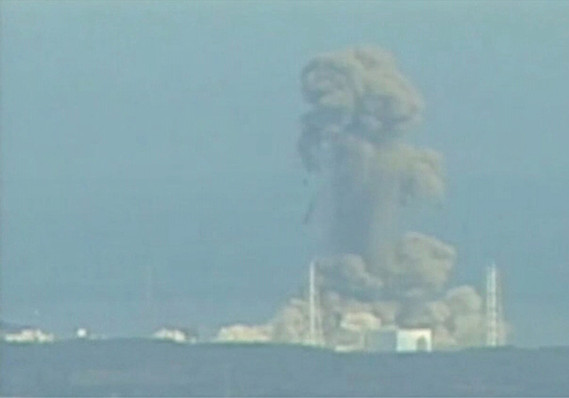
Smoke from nuclear plant. (C) Reuters
The men and women who design, build, and work at nuclear power plants are bright, dedicated people who work hard so that when we flip a switch the power flows, so we can use our computers, watch our tvs, refrigerate our food, microwave our dinners and our popcorn, heat, cool, and vacuum our homes, and jam on our electric pianos and electric guitars when we want to. The drive, dedication and service of the engineers at Fukushima is heroic.
Under normal conditions, nuclear power emits less pollutants than coal, and the waste from nuclear power is regulated. The wastes from coal are not.
Yet, radioactive materials are an intrinsic property of nuclear power; consequently meltdown and disaster are inherent dangers. The disasters at Fukushima Dai-ichi, Fukushima Diaini, and Onagawa, while not predictable, were not unexpected. We’ve seen Chernobyl in ’86, Three Mile Island in ’79. We’ve had fires at Brown’s Ferry. We have had, and continue to have leaks of radioactive material at Oyster Creek, Indian Point, Vermont Yankee, the Hanford Nuclear Reservation and every other nuclear facility in the United States, Japan, France, and I am sure, the rest of the world.
And we learned what? To ‘harden’ the plants? To spare no expense in a fanatical devotion to safety and maintenance?
No. To cut corners and to defer maintenance. To extend to 60 years the life of plants designed to last 40 years.
2011 Jerusalem bus stop bombing – Wikipedia, the free encyclopedia
first battery-swapping station in Israel
The first battery-swapping station in Israel for electric cars is inaugurated; over 1,000 charging stations for the cars are already in place. (The Jerusalem Post)
via Portal:Current events – Wikipedia, the free encyclopedia.
U.S. Oil companies paid part of Libyan terrorism settlement
Corruption and kleptocracy seem fairly predictable in Libya, although it’s a fair journalistic effort to confirm or refute what may be common knowledge. Perhaps an example of that is The New York Times publishing confirmation of what most New Yorkers knew in the early 1970’s – that the New York City Police Department was a corrupt institution, incapable and/or unwilling to police itself. (See, e.g., the books Serpico by Peter Maas, Prince of the City by Robert Daley).
Now, three of the Times’ heavy hitters, Eric Lichtblau, David Rohde and James Risen, have reported that – in addition to whatever passes for routine corruption in Libya, some – but not all – foreign companies operating in Libya complied with Qaddafi’s demand that they contribute to the $1.5 billion settlement for its responsibility in the bombing of Pan Am Flight 103 (the Locherbie bombing) and other attacks.
Does this make these companies accessories after the fact? excerpted from Shady Dealings Helped Qaddafi Build Fortune and Regime:
In 2009, top aides to Col. Muammar el-Qaddafi called together 15 executives from global energy companies operating in Libya’s oil fields and issued an extraordinary demand: Shell out the money for his country’s $1.5 billion bill for its role in the downing of Pan Am Flight 103 and other terrorist attacks.
If the companies did not comply, the Libyan officials warned, there would be “serious consequences” for their oil leases, according to a State Department summary of the meeting.
Many of those businesses balked, saying that covering Libya’s legal settlement with victims’ families for acts of terrorism. The episode and others like it, the officials said, reflect a Libyan culture rife with corruption, kickbacks, strong-arm tactics and political patronage since the United States reopened trade with Colonel Qaddafi’s government in 2004. As American and international oil companies, telecommunications firms and contractors moved into the Libyan market, they discovered that Colonel Qaddafi or his loyalists often sought to extract millions of dollars in “signing bonuses” and “consultancy contracts” — or insisted that the strongman’s sons get a piece of the action through shotgun partnerships.
“Libya is a kleptocracy in which the regime — either the al-Qadhafi family itself or its close political allies — has a direct stake in anything worth buying, selling or owning,” a classified State Department cable said in 2009, using the department’s spelling of Qaddafi. was unthinkable. But some companies, including several based in the United States, appeared willing to give in to Libya’s coercion and make what amounted to payoffs to keep doing business, according to industry executives, American officials and State Department documents.
Peter Grier/CSM: Japan nuclear crisis: Why are the spent-fuel pools so hard to control? – CSMonitor.com
By Peter Grier, CSMonitor.com, dated March 22, 2011. Japan nuclear crisis: Why are the spent-fuel pools so hard to control? – CSMonitor.com:
As workers struggle to bring the Fukushima I nuclear plant back under full control, spent-fuel pools appear to be a source of continuing problems. On Tuesday morning, one pool was so hot that its remaining water was either boiling or close to it, according to the Associated Press.
Emergency crews dumped 15 tons of seawater into the pool to cool it to about 105 degrees F., Japanese authorities said later in the day.
If heat in the pool continues to build and water boils down and fuel rods stored in the pool are exposed, more radiation might escape into the atmosphere.
Yet firetrucks and other water-pumping equipment have been shooting streams of water at these pools for days during the Japan nuclear crisis. Why are they so proving so difficult to manage?
The pools at the Fukushima complex are just that – open basins resembling swimming pools. Six are perched on a sort of mezzanine above and adjacent to reactor containment vessels. They’re about 40 feet long by 30 feet wide by 36 feet deep, though they vary in size.
In total they can hold about 1,300 to 1,400 metric tons of water, serving as both a shield to keep radiation from escaping and a coolant to lower the residual heat that spent fuel rods generate.
The pools contain anywhere from 400 to 700 fuel-rod assemblies, according to data compiled by the Union of Concerned Scientists. These assemblies sit on racks just above the pool floor. During normal operation, the water level in the pools is kept about 30 feet above the top of the assemblies.
But these are not normal times. Though electric lines have now been hooked up to all six reactor units, the pumps that circulate cooling water inside reactor buildings are not yet working. Some have been damaged and will need to be replaced.
Temporary pumps and firetrucks are doing what they can to keep water in the pools. A powerful cement-pumping truck that will be used to shoot water, greatly increasing pumping capacity, arrived at Fukushima on Tuesday, according to Japanese authorities.
But Fukushima workers “don’t have the array of pumps they might otherwise have,” said David Lochbaum, director of the nuclear safety project at the Union of Concerned Scientists, in a Tuesday phone briefing for reporters.
It’s possible that the workers are thus practicing triage, disconnecting pumps from fuel pools in order to rush water through reactor cores, or an adjacent pool that is in greater danger, said Mr. Lochbaum.
Boiling water by itself is not a danger, he pointed out. The problems would begin if water boiled away, exposing fuel rods. If a pool is fully filled, that would take some time.
“That might be a strategy that they are employing, based on the limited array of equipment they have at the moment,” he said.
It is also possible that one or more of the pools is leaking. t is also possible that one or more of the pools is leaking. The sides of the pools have doors, which open to allow cranes to move fuel-rod assemblies from the reactor to the pool. These doors have inflatable seals that guard against leakage.
a Japan nuclear crisis: Why are the spent-fuel pools so hard to control? – CSMonitor.com.
Fukushima warnings ignored
Hirolo Tabuchi, Norimutsu Onishi and Ken Belson of The New York Times report that only one month before the Tsunami, the Fukushima reactors’ operation was extended beyond its planned operation, notwithstanding safety concerns. See Japan Extended Reactor’s Life, Despite Warning:
TOKYO — Just a month before a powerful earthquake and tsunami crippled the Fukushima Daiichi plant at the center of Japan’s nuclear crisis, government regulators approved a 10-year extension for the oldest of the six reactors at the power station despite warnings about its safety.
The regulatory committee reviewing extensions pointed to stress cracks in the backup diesel-powered generators at Reactor No. 1 at the Daiichi plant, according to a summary of its deliberations that was posted on the Web site of Japan’s nuclear regulatory agency after each meeting. The cracks made the engines vulnerable to corrosion from seawater and rainwater. The generators are thought to have been knocked out by the tsunami, shutting down the reactor’s vital cooling system.
The Tokyo Electric Power Company, which runs the plant, has since struggled to keep the reactor and spent fuel pool from overheating and emitting radioactive materials.
Several weeks after the extension was granted, the company admitted that it had failed to inspect 33 pieces of equipment related to the cooling systems, including water pumps and diesel generators, at the power station’s six reactors, according to findings published on the agency’s Web site shortly before the earthquake.
Regulators said that “maintenance management was inadequate” and that the “quality of inspection was insufficient.”
Less than two weeks later, the earthquake and tsunami set off the crisis at the power station. Continue reading
New Yorkers Crossing East River Lose Water Taxi for the Winter – New York Times
The new year ushers out two of New York City’s ferry services and welcomes a new one.
As of Tuesday, commuters who live near the riverfront in Queens and Brooklyn will no longer be able to skip the subway and cross the river on scheduled boat service. New York Water Taxi suspended service on the East River until May 1, saying wintertime ticket sales would not cover its costs of operation.
The company will continue to operate ferry service on the Hudson River, between Lower Manhattan, Haverstraw and Yonkers, through the winter.
The shutdown on the East River put a damper on the holiday for some commuters who have come to depend on the water taxis for access to Manhattan.
“We’re certainly going to miss it,” said Kirk McDonald, a financial analyst who moved in August with his roommate, Steven Schey, from Murray Hill in Manhattan to Schaefer Landing, a condominium complex in Williamsburg, Brooklyn.
“I use it every day,” said Mr. McDonald, who was returning by water taxi from running errands in Manhattan with Mr. Schey on Monday. “The idea of taking the subway is not appealing in the least.”
Mass transit that would pull up to the dock out back was an important “incentive to buy here,” Mr. Schey said of Schaefer Landing, which is on the former site of a Schaefer beer plant.
To lure the water taxis, the developer agreed to make monthly payments to subsidize the service for the residents, said Tom Fox, president of New York Water Taxi. Only about 60 residents regularly ride the boats, and even with the subsidy, their tickets do not cover the rising fuel costs and other expenses, Mr. Fox said.
“We’ve been losing money for too long now,” Mr. Fox said, adding that his fuel costs had risen by $1 a gallon, or about 30 percent, since last winter.
<span class="pullquote">Why doesn't the market bring solar boats in?</span>
He suspended the service two winters ago, but resumed it last winter because city officials were considering doing more to support intracity ferry service. But the city has not decided to subsidize ferry service, choosing instead to build large terminals.
Still, city officials have left untouched about $4.4 million in federal funds that Congress appropriated in 2005 for building a network of water taxi docks in the city, said Representative Carolyn B. Maloney, a Democrat. One of Ms. Maloney’s staff members met with city officials two weeks ago in an effort to persuade them to spend some of that money, she said Monday.
“It’s been on a priority list of the city to have water service, but they haven’t moved on it,” Ms. Maloney said. The city has said it still has the matter under consideration.
Joan Libby, another resident of Schaefer Landing, organized a rally over the weekend to protest the shutdown, but she lamented that “between Christmas and New Year’s, it’s hard to mount a campaign.”
Tuesday also marks the end of more than a half-century of ferry service to the Statue of Liberty and Ellis Island by Circle Line Downtown. The National Park Service, which operates the two monuments, chose a California-based company, Hornblower Yachts, to succeed Circle Line last year.
After some delays, Hornblower was making preparations Monday to take over the service on Tuesday morning with a small fleet of mismatched boats that it bought or rented in the last few months. Hornblower plans to buy Circle Line’s fleet, but the two sides are still mired in a dispute about the price.
One of its boats, the Freedom, arrived early Friday morning after a 41-day, 6,550-mile journey from San Francisco by way of the Panama Canal.
“We really made very good time,” said Edward Jerbic, who captained the Freedom and slept in a tent on its deck.
Terry MacRae, the chief executive of Hornblower, said his new staff of about 100 people would be ready to start on time, but he added that he was hoping for light demand on the first day.
“We hope they’ll give us a few days to warm up and get good,” he said.
via New Yorkers Crossing East River Lose Water Taxi for the Winter – New York Times.
New Police Radio System in New York State Draws Scrutiny – New York Times
A $2 billion emergency radio network intended to connect all emergency agencies and local police and fire departments in New York State has failed its first major test, prompting concerns from some state officials and causing the state’s second largest city, Buffalo, to opt out of the system.
The contract to build a network of wireless transmission towers that would allow tens of thousands of police officers, firefighters and other emergency personnel statewide to communicate was awarded in 2005 to M/A-Com, a division of Tyco International. The system was supposed to be in operation in Buffalo and surrounding Erie County and neighboring Chatauqua County by last June.
After the network’s rollout in Buffalo, however, the city’s top fire official said its problems were so severe that the radios did not work in roughly half the city.
“West of the center of the city we had zero reception,” Fire Commissioner Michael Lombardo said last week. In the areas that did receive transmissions, he said, “it sounded like a guy was talking in a tin can.”
He says Buffalo now intends to upgrade its own radio system, which will then be able to connect with the statewide system.
Under the current state emergency radio system, large areas of the state are unreachable, and many police and fire departments cannot talk to each other. After receiving complaints from federal and state lawmakers, the State Office of Homeland Security is considering hiring an independent company to conduct its own tests on the M/A-Com network.
“We are strongly considering the advantages to hiring an outside company with technical expertise,” said Michael A. L. Balboni, the deputy secretary for public safety, who is Gov. Eliot Spitzer’s top homeland security aide. “If those glitches are still present when the system is presented to the state for acceptance and then payment, that will be a very large concern.”
He added that if the problems persisted, they could derail the project.
Officials from M/A-Com expressed confidence the issues could be addressed, and said problems in Buffalo had been caused by interference from other radio transmissions. The system has been tested in neighboring Chatauqua County, which is mainly rural, and officials there had no complaints, said Victoria Dillon, an M/A-Com spokeswoman.
The gaps were “localized in a few sites, like cell carriers, a TV station in Canada,” Ms. Dillon said.
Michael R. Mittleman, the state official overseeing the project for the Office of Technology, agreed.
“We believe that when we get back to the testing out there in February that the problem will be resolved,” he said.
Mr. Mittleman said that he hoped the system would be operating in the two counties by April, and that the state would decide at that point whether to accept the network. That makes the tests in Erie and Chatauqua counties especially critical.
An upgrade for the state’s antiquated emergency radio network had been in the planning stage since the 1990s, but the project took on new urgency after the Sept. 11 attacks. The project, known as the Statewide Wireless Network, will be designed so that even cities that do not directly participate in the project, like New York City, will be able to connect with the system.
The contract drew criticism when it was awarded by the Pataki administration, with some lawmakers questioning whether M/A-Com had the track record to handle the job.
The company hired former Senator Alfonse D’Amato, a close ally of former Gov. George E. Pataki, as its lobbyist, and telecommunications companies lobbied aggressively for the contract.
The project has encountered challenges. Recently, the senior state police official assigned to oversee the construction of the network said in an e-mail message obtained by The New York Times that the state’s Office of Technology had not been demanding enough of M/A-Com, and called the Erie County effort a “debacle.”
The official, Thomas J. Cowpers, a staff inspector, left the project after friction with M/A-Com and the Office for Technology officials.
Mr. Cowpers wrote in the e-mail message that his role had been curtailed “due to my incessant criticism of M/A-Com management and my constant frustration with O.F.T.’s unwillingness to hold them accountable. ‘’
Mr. Cowpers declined to comment, and Lt. Glenn Miner, a state police spokesman, said the state police would not comment on the e-mail message. “From everything I am told, we remain very positive about it,” Lieutenant Miner said.
Officials in Erie County, however, said the problems were serious.
Michael R. Summers, president of the union representing sheriff’s deputies in Erie County, said he thought the system might have been pushed into service too soon. He said the radios worked in some areas but received no reception in others.
“There were spots where we could not communicate with each other,” he said. “We would move 10 feet up the road, and it would work.”
According to a report from the state comptroller’s office last December, the state was scheduled to have the new radio system running in Erie and Chautauqua counties by last June.
Ms. Dillon said the company now expected the system to be operating in the two counties by the end of the first quarter of 2008. After that, the state will have 45 days to accept or reject M/A-Com’s work. If the state rejects the system, Ms. Dillon said, it will not have to pay anything.
The entire network is scheduled to be finished in 2010.
When M/A-Com won the contract, critics raised questions about the company’s handling of a wireless contract for Pennsylvania. That system, expected to be finished in 2001, was more than three years late and cost more than double the original projection. But in a statement last week, New York officials said the delays in the Pennsylvania contract were caused by problems unrelated to M/A-Com.
The total cost of New York’s system were slow to emerge. When it was first proposed, state lawmakers were told it would cost more than $1 billion, but far lower than the $3 billion bid by M/A-Com’s competitor, Motorola. By the time the contract was signed in 2005, the final cost was $2.1 billion.
via New Police Radio System in New York State Draws Scrutiny – New York Times.
When "just-in-time" ordering is actually too late

HAZMAT Class 7 Radioactive U.S. DOT
Irwin Redlener has pointed out that, in the event of a serious influenza outbreak – “pandemic” – which means that the high incidence of a given illness is greater than normal not only in one community (an epidemic) – but in a wider area than would normally be expected – we would be in sudden need of many more mechanical ventilators ((These ventilators are descendants of the “Iron Lung” and the 1928 “Drinker respirator.” See Wikipedia entry for “Mechanical Ventilator.”)) than are normally needed.
For instance, one credible – but not worst-case – scenario of avian influenza would leave New York State short 50,000 ventilators, and another with a nationwide shortfall of 700,000. The International Business Times has reported that a physician on the faculty at Stanford has developed a high-quality, low-cost ventilator.
The low-end model, called OneBreath, was designed by a team of researchers led by Matthew Callaghan, MD, at Stanford Biodesign, a training incubator in medical technology that brings together multidisciplinary teams of medical, engineering, law and business school students to address unmet medical needs with innovative approaches.
Callaghan says that the idea struck him first at a planning meeting at a hospital that was trying to formalize criteria to decide which type of patients would receive life support from the limited number of ventilators in the hospital should a scenario arise when emergency demand outstrips supply. Later, an alarming piece of statistics – that the United States would fall short of 700,000 ventilators in the event of a moderate-to-severe influenza pandemic – triggered the thought of commercialization of the innovation. Continue reading