Brownwashing Wind Power

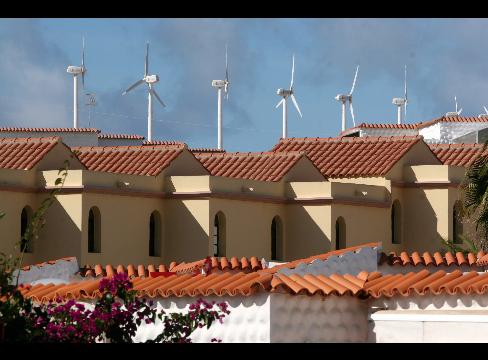
PSEG, one of New Jersey’s electric utilities, and a member of  the consortium that is building Garden State Offshore Energy,  the 350 megawatt (MW) wind farm in the Atlantic, 18 miles south east of Atlantic City. Their ads on billboards, buses, etc., have a picture of an offshore wind farm,

Offshore Wind Farm

and copy that reads:

We’re putting these where they generate electricity, not controversy.

At PSE&G we’re pursuing the development of wind energy 17 miles from the New Jersey coast. Far offshore, where it won’t be an eyesore. This 350-megawatt wind farm will be virtually invisible from land. After all, our commitment to the environment is only matched by our commitment to the communities we serve. It’s just one of many renewable energy in consumer conservation programs we are developing. Our state has aggressive goals for reducing greenhouse gases and has passed legislation that recognizes the important role of utilities in meeting them. At PSEG., we welcome the challenge. We’ve long been dedicated to providing our customers with safe, reliable electric and gas service. Today were equally dedicated to promoting a sustainable energy future, and providing it. To learn more about what we are doing, and what you can do, visit PSEG.com/windfarm.

They seem to be saying “we know this stuff is ugly, but you won’t see it.” Do you think they may be trying to nudge the public – saying ‘look at this; it doesn’t really spoil the view.” Especially if you think about the alternatives – nuclear and fossil fuels.

Continue reading

Simple, clear navigation on Frederick County website

Frederick County, Maryland, uses a very simple red/green system on its website.  The only navigation buttons with a colored circle relate to emergency preparedness. In normal times – the button is green:

Non-emergency mode
(Non-emergency mode)

But, for emergency – including dangerous weather – notifications – the same button will be red and flashing. From the Frederick County website:

When this bar is on the homepage with a flashing red light, an emergency
condition exists. Clicking on this bar will lead to the Emergency/Weather Notices webpage, with information from emergency officials.

(Used during emergencies)

I assume that they’ve got a macro – or some other one-step process to substitute the red navigation button for the green.

It’s a nice touch – the feature – and the website – were designed by CivicPlus, a Kansas-based outfit that designs websites for governments and schools. Here’s a link to their portfolio.

Wind Power Is Low Cost Electricity

f

Gianluca Baratti, writing for Bloomberg Press notes “Because their fuel is free, wind turbines undercut traditional generators that burn coal, natural gas and oil.” I would point out that wind turbines Use No Fuel – there is no resource that is consumed when a turbine, spinning in the wind, generates power.

Feb. 6 (Bloomberg) — Spanish windmills owned by Iberdrola SA and Endesa SA may generate a record amount of electricity next week, slashing local power prices to three-year lows.

Spanish Windscape

Spanish Windscape, copyright (c) Bloomberg, 2009

An Atlantic Ocean storm is forecast to blow winds averaging 17.4 miles an hour across the peninsula. Lighter winds, at 13.6 miles an hour, were enough to set the previous record output three weeks earlier. The extra supply then cut power prices 11 percent.

“This will push the spot market lower next week,” Manuel Palomo, a Citigroup Global Markets analyst in Madrid, said about the storm. Palomo covers Spanish generators Iberdrola, Endesa and Acciona SA, which operate most of the country’s wind farms.

Spain and Germany, the world’s biggest wind-energy markets after the U.S., have changed the dynamics for wholesale power trading by forcing sellers to read weather reports. Because their fuel is free, wind turbines undercut traditional generators that burn coal, natural gas and oil.

Baratti can be reached via email to gbaratti “at” bloomberg.net.

Quantitative Peace: Bayes x Rumsfeld = Lewis Carroll?

Going through Jeff Gill’s Bayesian text book

when I came across the line:

From the Bayesian perspective, there are two types of quantities: known and unknown. (43)

This seems to be from the pre-9/11 school of thought as Rumsfeld* has us living in a more complicated world:

I guess technically I should exclude unknown knowns – that is, those things we did not know that we already knew.  I also have written the words “know” and “known” far too many times that it no longer appears to be a real word anymore.

*“Reports that say that something hasn’t happened are always interesting to me, because as we know, there are known knowns; there are things we know we know. We also know there are known unknowns; that is to say we know there are some things we do not know. But there are also unknown unknowns — the ones we don’t know we don’t know.” ~ Donald Rumsfeld, quote recently appropriated from one of Aparna Kher’s dissertation chapters.

Michael A. Allen, Bayesian Statistics engages in Pre-9/11 Thinking….

, published September 23, 2008 at The Quantitative Peace.

Clean Energy: Johnny Appleseed Would Approve. And It's The Law.

I published this in Business Week Online Feb. 4, 2009. While I like my headline better, and there is a nuance – or maybe a paradigm shift – in “alternative fuels” vs “alternatives to fuel” – I like their edits – Common Sense for the Common Good – And their headline is more powerful, imperative, and succinct.

Green Energy: Our Future Depends on It

BusinessWeek reader L.J. Furman sees alternative fuels as common sense for the common good

Continue reading

Popular Mechanics: Penn dairy farmer saves $60k/year by capturing methane

Jennifer Bogo, Science Editor at Popular Mechanics, published Poop Power: U.S. Farms Save Big Turning Manure to Kilowatts (October 8, 2008; web only):

If I’d driven up Kingwood Road here two years ago, there’s a very good chance that I would have smelled Hillcrest Saylor Dairy Farm long before I reached its gravel driveway. But as I open my car door on Monday not 100 yards from the would-be offenders—approximately 600 Holsteins—the only odor that drifted my way was that of the freshly compacted corn silage that feeds the cows. Harnessing bacteria to generate energy from waste is not a new concept: According to the National Renewable Energy Lab, the first digestion plant was built at a leper colony in Bombay, India, in 1859. But for all practical purposes, the first farm-based digesters in the United States were introduced during the 1970s. Since then, farmers have relied on three basic designs. After visiting several and seeing them in action, Saylor decided to combine the most desirable features of each design into his own, based on the needs of his farm.

{NB: , the capture of methane from sewage systems seems to date to the work of the Scottish engineer John Duncan Watson in the 1920’s.]

To introduce me to the biodigestion process, Saylor suggests that I start at the beginning-with the ladies of the hour. As we walk through the milking parlor, 40 cows released from their paddocks amble to the barn. A sudden gush of murky water flows past their hooves, flushing waste toward metal grates where it enters a gravity system that leads to the digester.

I was standing on the digester before I realized what it was: a 70-ft.-dia. concrete tank, 16 ft. deep, capped by a lid and covered with sawdust so that it appears to be solid ground. The digester’s influent tank, on the other hand, is inside an adjacent building and hard to mistake: The stench of concentrated cow poo makes it tough to breathe, let alone formulate astute journalistic questions. Even so, I ask Saylor what the old system was like. “It ran straight to the pond,” he said, referring to a body of water just past his shoulder. “You’d see a two-ft crust floating down there that you could pretty much walk across. The odor was unbelievable!”

That made me newly grateful for the present tank, where the manure-and the occasional truckload of peels from the local potato chip factory-is mixed in a thick slurry of water then disappears on a 16-day journey inside the digester. Anaerobic bacteria break down organic matter as the slurry makes its way around a dividing wall and produces a biogas that is about 65 percent methane. The gas fills the foot of airspace underneath the lid, and then is piped to a 40-ft.-dia. rubberized bubble for temporary storage. Gas from the bubble drives a natural gas CAT engine, which in turn runs a 130-kw generator.

“I’ve been to some digesters where they had a solid top, but no storage for gas, so with any fluctuation in the digester you either have to back off the generator, and you’re not making electricity, or you’re making too much gas and wasting it,” Saylor says. “The bubble buffers me for a couple days. I can just run the generator at 100 percent all the time.”

Last year the system produced 1.2 million kilowatt-hours of electricity, enough to power the farm and several nearby homes, and to provide their heat and hot water-a savings of about $60,000. “It’s covering everything and there’s still some left over,” Saylor says. “We had 100,000 kilowatt-hours last year that we didn’t use.” There was also leftover biogas. Saylor built his system to be modular, so with another grant from the state of Pennsylvania he plans to install a second 130-kw generator this winter-all of the electricity from that generator will go into the grid.

The project is paying dividends in other ways, too. Waste heat from the engine heats both milking parlors and water for the farm, as well as water that runs through pipes inside the biodigester to maintain the temperature. Other byproducts include a liquid fertilizer that’s less acidic than straight manure and a soft bedding material that harbors less toxic bacteria than the previous bedding, sawdust.

For an example of the risks associated with handling, See 38 Die in Methane Blast at a Coal Mine in Siberia, The New York Times, May 25 2007; David Barstow and Robin Stern, California Leads Prosecution Of Employers in Job Deaths,December 23, 2003.

Negligence at KBR Killed Americans

KBR, through negligence, kills Americans in Iraq. Staff Sgt. Ryan Maseth, 24, of Pittsburgh, serving in Iraq was killed while taking a shower in his barracks in Baghdad . (Military.com.

An Army investigation called the electrocution death of a U.S. Soldier in Iraq a “negligent homicide” caused by military contractor KBR Inc. and two of its supervisors

Sgt. Maseth was one of several soldiers killed by electrocution in the shower. 

KBR, the firm once owned by Haliburton, the oil services firm once run by Dick Cheney, built the barracks, installed the shower, and apparently connected the electrical wiring to the plumbing, in violation of building codes and common sense and without oversight.

Q: Why is an oil services firm supporting a military operation? 

A: Because, according to Alan Greenspan, it’s a war for oil (click here).

Q: Will KBR be held accountable?

A: I certainly hope so.

Shell Shock or PTSD

George Carlin observed that what they called “Shell Shock” in World War I, was called “Combat Fatigue” in World War II, “Operational Exhaustion” during the “Korean Conflict” and Post Traumatic Stress Disorder” in Viet Nam.  It’s now called “PTSD.” Carlin also observed that the words we use to describe a thing influence the way we react to it.  “Shell Shock” is vivid.  When you hear someone suffers from “‘Shell Shock” you want to help, provide first aid. The Boy Scout training kicks in. Someone’s in shock. Find a blanket. Keep him or her warm. Elevate their head. When it’s “Combat Fatigue” it’s  like they are tired. They just need some rest. No big deal.  When it’s “Operational Exhaustion” it’s abstract. Tired of the operations. OK, what’s your point? Really tired. OK. What’s your point?  When you hear someone has “Post Traumatic Stress Disorder” your reaction is different.  It’s out of my hands. It’s a disorder. They need a therapist, not first aid. Now of course, it’s “PTSD” and it’s totally devoid of any emotional triggers or context. Which means we don’t have to worry about it. We can let the experts handle it. 

But as Carlin observed, if we still called it “Shell Shock” we would want to treat poeple who have it, and maybe even try to prevent it. Maybe he was on to something. Maybe we should call it what it is. Shell Shock, and try to help people, and prevent it.

On Failure

“There’s no success like failure, and failure’s no success at all.”

– Bob Dylan, “Love Minus Zero, No Limit.”

Failure is not only an option; it is a fact of life. But giving up is not an option. When you’re ready to give up, it’s time to retire or better yet, go work for the competition. So understand that sometimes you will fail. And when you fail, try something else. Because failure to succeed, and then failure to try something else; that’s giving up.

MOORE'S LAW DOES NOT APPLY TO CARBON DIOXIDE

Moore’s Law, “The number of transistors that can be placed inexpensively on an integrated circuit doubles every two years” has held for transistors, integrated circuits, and even hard disk drives since his observation in 1965. However, it does not hold for Carbon Dioxide, which is governed by the Ideal Gas Law. This can be expressed as  PV = nrT and means the volume of a given quantity of a gas is directly related to its temperature and inversely related to pressure under which it is stored. In economic terms, we might call it Yogi’s Corollary, “Storing a Gas Costs Money,” or Furman’s Observation, “Moore’s Law Does Not Apply to Carbon Dioxide.”

This means that Carbon Sequestration technologies are not going to drop in price very far or very quickly.

The good news is Moore’s Law should  and probably will apply to photovoltaic solar modules, once the solar economy gets moving.

How to Strengthen the Grid, Minimize the Impact of Power Failures and Save Money

Stress related power failures, like the one that knocked out power in the northeastern United States and southeastern and central Canada in August 2003, are more likely to occur in the summer because of the additional air conditioning load. Storm related power failures in this part of the world are perhaps more likely in the winter because of cold weather and ice storms. In the south-east Atlantic states and the Gulf States – from North Carolina to Texas, weather related power failures are likely to follow hurricanes, and thus are more likely during late summer and autumn. Power failures caused by human action, whether accidental or willfull, i.e. terrorist, can occur any time. The only predictor is Murphy’s famous observation, “whatever can go wrong will, usually at the worst possible moment.”

There are some simple steps we can take to strengthen the grid, to minimize the probability and impact of weather related, accidental, and human triggered power failures, and to save the taxpayers and ratepayers money. Continue reading

Nathan Yau at Flowing Data – compendium of data visualization blogs

Nathan Yau, a doctoral candidate at UCLA in statistics, is the proprietor of Flowing Data, an excellent blog about data visualization. My guess is that it would be fair to say that there’s a greater emphasis on quantitative data viz, rather than instructional or other non-quantitative work. In any case – it’s excellent.

semaphore (Sierra - "S")Came across Yau’s April post – “Data Visualization Blogs You Might Not Know About” which, in and of itself, is an excellent list. Add to that the contributions of the commenters, including the always excellent Jorge Camoes.Camoes added  anoyhrt 15 listings; Tom Carden added over a dozen more; and a handful of people added one or two links. (As it happens, I’m trying to work out what for me is a visual representation of a complex argument – so I’m searching for a spot-on or really close analogy – hence my particular delight in finding such a collection). Take the post and comment together – and it’s much more than a starting point.

Here’s a link to Jorge Camoes’ charts blog; to Tom Carden’s blog (Random, etc.) – but if the subject is of interest, be sure to check out Nathan Yau’s work at Flowing Data.(this started as a somewhat longer post – but due to the vagaries of this particular WP 2.7 install – well, brevity is the soul of wit).

Reblog this post [with Zemanta]