Extreme How-To has an excellent piece by Monte Burch on solar tubes – essentially skylights without straight lines:A Tunnel for the Sun | Extreme How To, DIY – Do it Yourself, Home Improvement, Home Decorating.
How to Strengthen the Grid, Minimize the Impact of Power Failures and Save Money
Stress related power failures, like the one that knocked out power in the northeastern United States and southeastern and central Canada in August 2003, are more likely to occur in the summer because of the additional air conditioning load. Storm related power failures in this part of the world are perhaps more likely in the winter because of cold weather and ice storms. In the south-east Atlantic states and the Gulf States – from North Carolina to Texas, weather related power failures are likely to follow hurricanes, and thus are more likely during late summer and autumn. Power failures caused by human action, whether accidental or willfull, i.e. terrorist, can occur any time. The only predictor is Murphy’s famous observation, “whatever can go wrong will, usually at the worst possible moment.”
There are some simple steps we can take to strengthen the grid, to minimize the probability and impact of weather related, accidental, and human triggered power failures, and to save the taxpayers and ratepayers money. Continue reading
Nathan Yau at Flowing Data – compendium of data visualization blogs
Nathan Yau, a doctoral candidate at UCLA in statistics, is the proprietor of Flowing Data, an excellent blog about data visualization. My guess is that it would be fair to say that there’s a greater emphasis on quantitative data viz, rather than instructional or other non-quantitative work. In any case – it’s excellent.
Came across Yau’s April post – “Data Visualization Blogs You Might Not Know About” which, in and of itself, is an excellent list. Add to that the contributions of the commenters, including the always excellent Jorge Camoes.Camoes added anoyhrt 15 listings; Tom Carden added over a dozen more; and a handful of people added one or two links. (As it happens, I’m trying to work out what for me is a visual representation of a complex argument – so I’m searching for a spot-on or really close analogy – hence my particular delight in finding such a collection). Take the post and comment together – and it’s much more than a starting point.
Here’s a link to Jorge Camoes’ charts blog; to Tom Carden’s blog (Random, etc.) – but if the subject is of interest, be sure to check out Nathan Yau’s work at Flowing Data.(this started as a somewhat longer post – but due to the vagaries of this particular WP 2.7 install – well, brevity is the soul of wit).
Sustainability: Harnessing a Process
The classic definition of sustainability, “providing for society’s needs today without compromising society’s ability to meet those needs tomorrow” originated in the Brundtland Report, 1987 and can be found quoted by the Canadian Lawyers Abroad, Genentech, and elsewhere.
The authors of the Brundtland Report must have been lawyers not engineers. Their definition is good, but abstract. When you ask the canonical engineering question: ‘How do we make it work?’ The answer is:
Sustainable systems harness a process, rather than consuming a resource. Solar panels transform the energy in sunlight. Wind turbines transform the kinetic energy in wind. Geothermal systems use the heat of the earth.
The sun will shine and the winds will blow regardless of the presence or absence of solar panels and wind turbines. And the core of the earth will stay hot for a very long time – on the order of five billion years.
Timeline of Doctors Without Borders
, created in XTimeline, a chrono-information tool.
graphic tool Good use of the timeline graphic – and a good primer on doctors without borders.
Emergency Preparedness, Israel, & Gaza
At Popular Logistics, while we believe in preparing for emergencies; we prefer to avoid emergencies, especially war.

Kassam in Sderot, Israel
As we see it, Peace is up to the Palestinians. The proof is Israel’s withdrawal from Gaza in 2005, and Hamas’ subsequent kidnapping of Gilad Shalit and launch of approximately 4,000 to 7,000 rockets like the one pictured above into Israel. We feel that the factories in Gaza would better serve the people of Gaza by building solar panels or wind turbines rather than guns, bullets, and Kassam rockets.
We would like to see Israel withdraw from Gaza and the West Bank and an end of Palestinian terrorism; a bilateral cease fire between Israel and the Palestinians. We see de facto states in the West Bank and Gaza; we would like to see de jure states that recognize the rights of all; male, female, gay, straight, Buddhist, Christian, Hindu, Jewish, Moslem, and athiest. And that Palestinian state or those Palestinian states, along with Iran, Saudi Arabia, and Syria must recognize Israel.

Rationale – software to aid critical thinking
Austhink, an Australian software firm, makes a package called Rationale, which makes it easy to create diagrams of rhetorical and decision-making processes. ![]()
I downloaded a trial version last-night – and immediately started using it to map risk risks associated with energy production. I plan on using it in my work here at Popular Logistics and elsewhere. Which is to say – I think I’m already using it for an off-label purpose.
It’s as easy to use as any graphics program – outputs to a variety of graphic formats. And so far, I’m quite impressed. Since we test software principally to recommend them to community-based groups on zero budgets – we’ve got a strong bias for free software – but at $69 USD this may be an exception.
The people at Austhink think this is an educational tool. They’re right about that – it could be used from grammar school on up. And certainly in law school. But I think it’s got applications in planning and risk assessment.
Worth a look. Learned about this at Social Source Commons.
RECYCLED LAPTOP PROJECT
Popular Logistics needs several laptops and laptop drives. We need Macs running OS X, Linux machines, or netbooks running Windows or Linux. Non-operational machines that can be used as spare parts are also of interest. If you would like to donate, e-mail Larry at “L Furman 97 ‘@’ gmail . com”. Donations to Popular Logistics are not tax deductible.
As Economic Activity Declines, China’s Energy Consumption Follows
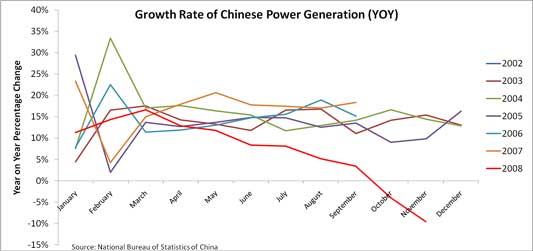
Andrews S. Revkin reports on Dot Earth that Chinese energy use has declined more or less following economic activity.

Good news or bad? Depends on what’s happening with Chinese energy infrastructure while its economy contracts. Our guess – and it’s a guess – is that high energy prices provide an incentive to switch to clean, sustainable energy. Air quality, of course, is inversely proportional to the use of fossil fuels and nuclear power.
The Dot Earth Project (at our hometown paper) – and Mr. Revkin’s work– are supported in part by the John Simon Guggenheim Project. We’ll try to keep up with it.
Clean Coal, My Ash
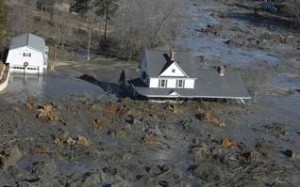
On Dec. 22, 2008, a billion gallons of sludge covered 300 acres, and spilled into the Clinch and Emory Rivers when the retention pond burst at the Tennessee Valley Authority’s Kingston Steam Plant. That’s 1,000,000,000 gallons of toxic soup containing Arsenic, Lead, Mercury, Selenium and other toxics and carcinogens. Tennessean.com, Knoxvillebiz.com.

View of what had been the James Home, Copyright (c) 2008, Knoxville Biz . com
Robert F. Kennedy, Jr.’s law firm, Kennedy, Madonna, LLP, and the Levin Papantonio Law Firm have joined to investigate the Tennessee Coal Spill on behalf of property owners living in the impacted area. For more information call 888-435-7001 or click here.
According to TVA spokesman Gilbert Francis, “Most of that material is inert. It does have some heavy metals within it, but it’s not toxic or anything.” However, according to the EPA, coal fly ash and sludge contains carcinogens and high concentrations of heavy metals. Furthermore, “concentrations of arsenic to which people might be exposed through drinking water contaminated by fly ash could increase cancer risks several hundredfold” AP, NYTimes, Yahoo.
Invasion of the Red Lionfish
The Red Lionfish, Pterois volitans, Smithsonian is a poisonous tropical fish native to southeast Asia. The fish is invading the Atlantic from Florida and the Bahamas to Rhode Island, and wreaking ecological havoc. The big problems with non-native species are a lack of natural predators and a lack of natural defense on the part of the prey.

- Image courtesy of New England Acquarium, neaq.org, Used with permission.
Sharks, Groupers and other predators keep the populations in check in south-east Asia. Red Sea Cornetfish (Fistularia commersoni) are natural predators of Pterois miles, a related species of scorpaenidaea. Importing south-east Asian sharks or red sea cornetfish would probably be a stupid idea, one where the cure may be worse than the disease. I wonder, however, if we can train dolphins or sea lions to hunt or trap the Red Lionfish? Continue reading
The Bahamas, New Jersey, Recycling, & Clean Energy
People say “all politics is local.” People in The Bahamas, New Jersey, Europe and California have more or less the same solution – re-usable shopping bags – to the same problem – plastic bags in landfills. Personally, I favor charging for plastic bags, which rewards people for doing the right thing and penalizes them for doing the wrong thing. It seems fair, given that we are paying, in our taxes, for burying the plastic bags. I would also like to see more cellulose based plastics.
Another common problem is converting our electric grid to run on electricity generated from clean, sustainable systems. Based on our brief conversation, it seems that the U. S. has four advantages over the Bahamas: Net Metering, Economic Incentives, Rulings in the Supreme Court, and possibly, our President-Elect, Barack Obama.
1 Pound of Gasoline = 3 Pounds of Carbon Dioxide
) which is approximately 360 billion pounds of gas (each gallon of gas is 5.8 to 6.5 pounds).
Water isn’t normally thought of as a pollutant. Up till November 13, the EPA refused to think of carbon dioxide as a pollutant, but big storms and rising sea levels are among the problems associated with global warming. Storms, very simply, are water vapor in the air condensing and falling to the ground. More on this next time.
Data in this post came from Bill McKibben, author of Deep Economics, and one of the driving forces behind 350.org. Data on Gasoline came from Mad Sci Network and California Energy Quest.
Information on the chemical make-up of gasoline came from Wikipedia.
State to State comparisons – CERT team numbers by population
Our first experiment at displaying data in this way. NB: ((Nota Bene, or “take note” – Lat.))
- This is data reported to FEMA by the states – or directly by local administrators;
- We know nothing from this data of size, effectiveness, equipment, capabilities of CERT teams
- Other volunteer organizations – volunteer ambulance corps, fire departments, and other groups, like The 3 Steps – wouldn’t be reported here anyway.
With those caveats – based on current FEMA data:
| State | Population served per team |
| New Jersey | 20,437 |
| Wyoming | 29,046 |
| Mississippi | 31,726 |
| North Dakota | 31,986 |
| Rhode Island | 36,477 |
| Maine | 36,589 |
| Utah | 37,790 |
| South Dakota | 39,811 |
| Missouri | 41,108 |
| Massachusetts | 46,401 |
| Vermont | 47,789 |
| Total | 31,161 |
| Idaho | 55,533 |
| Texas | 57,325 |
| New Hampshire | 69,254 |
| Oregon | 76,479 |
| Kansas | 81,647 |
| Iowa | 85,373 |
| North Carolina | 87,971 |
| Florida | 89,030 |
| Kentucky | 90,244 |
| Washington | 95,124 |
| Connecticut | 103,009 |
| Oklahoma | 106,392 |
| Montana | 106,429 |
| Tennessee | 111,940 |
| West Virginia | 113,252 |
| Louisiana | 116,033 |
| Ohio | 118,216 |
| South Carolina | 119,127 |
| Michigan | 122,827 |
| Arkansas | 123,252 |
| Indiana | 129,496 |
| Arizona | 132,057 |
| Alaska | 136,696 |
| California | 145,052 |
| Minnesota | 157,504 |
| Alabama | 159,581 |
| Nebraska | 161,325 |
| Virginia | 175,275 |
| Georgia | 207,495 |
| Colorado | 231,501 |
| Maryland | 255,379 |
| New Mexico | 281,416 |
| Nevada | 285,042 |
| Illinois | 313,477 |
| Hawaii | 427,796 |
| New York | 438,585 |
| District of Columbia | 588,292 |
| Pennsylvania | 592,038 |
| Puerto Rico | 657,063 |
| Wisconsin | 800,234 |
| Delaware | 864,764 |
Many thanks to Dannny Sanchez and his excellent table-to-html tool, Tableizer.
35 MM TO JPG
Remember slides? The 35 mm slide was a key presentation technology of the 50’s to the 90’s. Some scanners, including the Epson 3590, can scan slides, and do it well. It’s a time consuming and a labor intensive operation. But it can be fun.