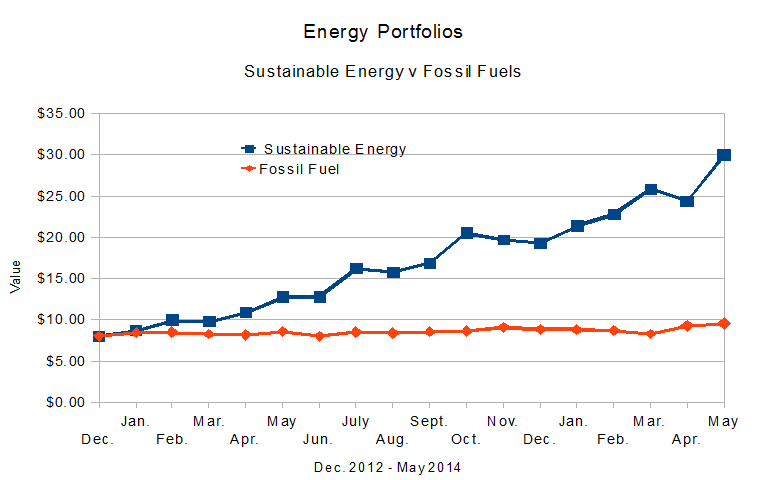
 The Dow Jones Industrial Average is up 26.29% from 12/21/12.
The S&P 500 is up 32.03%.
The Fossil Fuel Portfolio is up 18.52% from Dec. 21, 2012.
The Sustainable Energy Portfolio is up 211.6% from Dec. 21, 2012. Continue reading
Category Archives: Connecting the Dots
Energy Portfolios, 16 Months: Sustainable Energy up 204.25%, Fossil Fuel up 15.38%
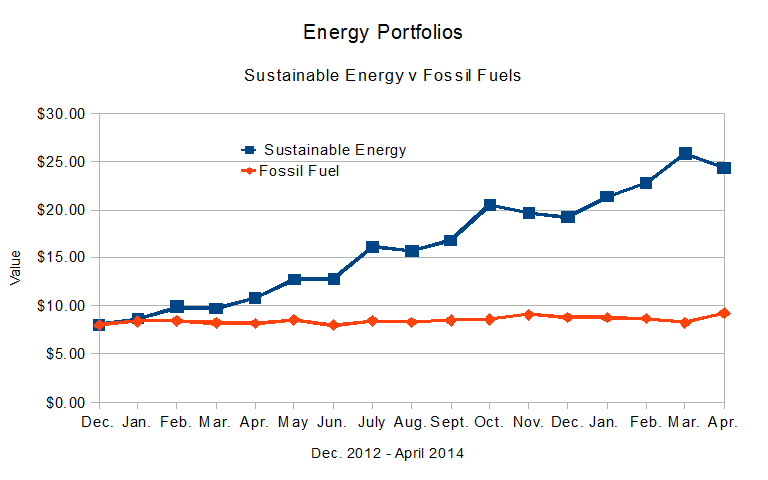 On Dec. 21, 2012, I put $16 Million imaginary dollars in equal imaginary investments in 16 real energy companies; Eight in the Sustainable Energy space and eight in the fossil fuel space. The results:
- The Dow Jones Industrial Average is up 24.54% from Dec. 21, 2012.
- The S&P 500 is up 30.56% from Dec. 21, 2012.
- The Fossil Fuel Portfolio had a great month, however, it continues to dramatically underperform the reference indices. It is up 15.38% from Dec. 21, 2012.
- The Sustainable Energy portfolio had a bad month, however, it continues to dramatically outperform the averages, and is up 204.25% from Dec. 21, 2012
Energy Portfolios: 15 Months: Sustainable up 222.6%: Fossil Fuel up 7.3%
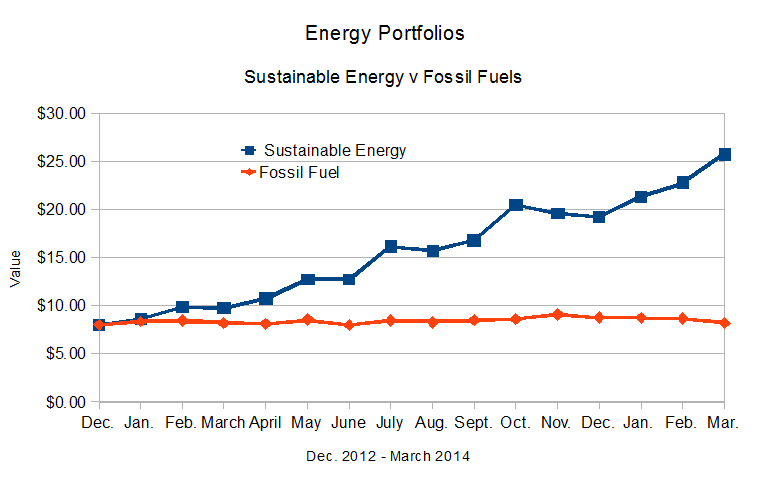
On Dec. 21, 2012, I put $16 Million imaginary dollars in equal imaginary investments in 16 real energy companies; Eight in the Sustainable Energy space and eight in the fossil fuel space. The Sustainable Energy portfolio is composed of Cree and Lighting Sciences in the LED space, GTAT, which at the time made solar ovens for cooking PV wafers, and today is diversifying, First Solar and Sunpower in the solar space, Vestas, a wind company, Solazyme a biofuel company and Next Era, a utility. The fossil fuel companies are the oil companies BP, Chevron Texaco, Conoco Phillips, Exxon Mobil and RD Shell, the coal company Peabody Coal, and Haliburton and Transocean, companies in the offshore oil and oil and gas drilling service industries.
Energy Portfolios: 14 Months: Sustainable up 184.4%: Fossil Fuel up 8.7%
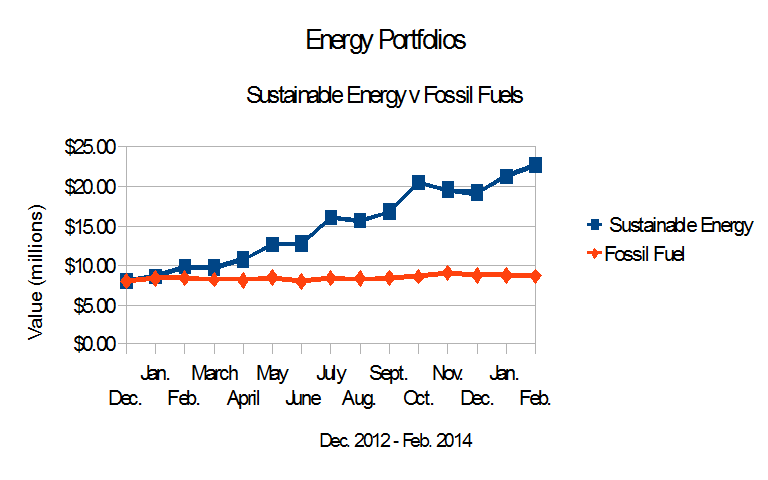 The Dow Jones Industrial Average is up 23.01% from 12/21/12 to 2/21/14.
- The S&P 500 is up 28.39%.
- The Fossil Fuel Portfolio continues to dramatically underperform the reference indices. It is up 8.7% from Dec. 21, 2012.
- The Sustainable Energy portfolio continues to dramatically outperform the averages, and is up 184.41% from Dec. 21, 2012.
Note that the Sustainable Energy portfolio does not include Solar City, SCTY, or Tesla Motors, TSLA. Solar City’s stock price is up 713.0%, from 10.73 on December 21, 2012 to 75.86 at the close of trading Feb. 21, 2014. Tesla is up 614.5% from 34 to 209.60.
Energy Portfolios: 13 Months: Sustainable up 167.4%: Fossil Fuel up 8.92%
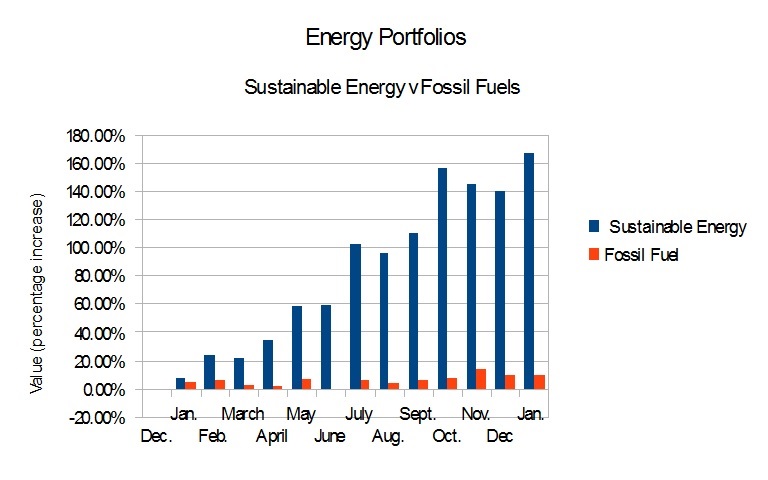 Figure 1, above, shows the relative performance of my hypothetical investments in sustainable Energy and Fossil Fuels, since Dec. 21., 2012.
- The Dow Jones Industrial Average is up25.38% from 12/21/12.
- The S&P 500 is up28.95%.
- The Fossil Fuel Portfolio continues to dramatically underperform the reference indices. It is up 9.44% from Dec. 21, 2012, and down slightly from Dec. 20, 2013.
- The Sustainable Energy portfolio continues to dramatically outperform the fossil fuel portfolio and the averages, and is up 167.37% from Dec. 21, 2012.
As described in the earlier posts in this series, in Dec., 2012, I read that MidAmerican Energy was buying large scale solar electric generating stations being built by First Solar and Sunpower, and being financed by GE. This got me thinking … Continue reading
Virtualization: 20% Lower Cost to Build; 70% Lower Costs for Power, Cooling & Operations
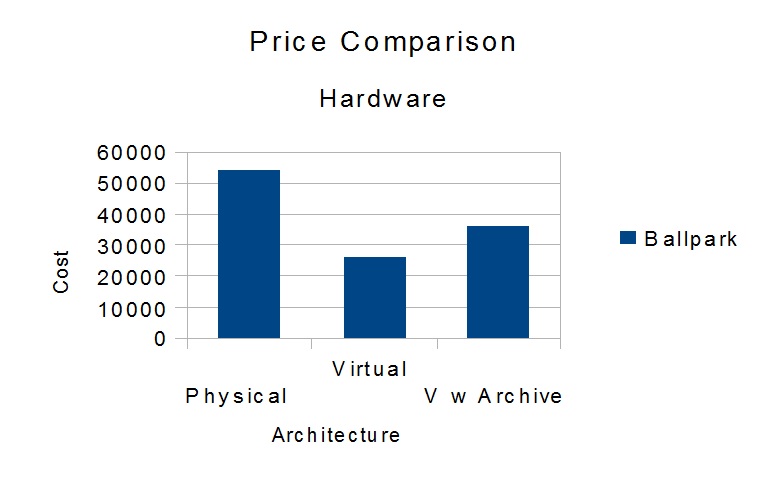
Imagine an small to mid-sized enterprise which needs accounting, document management, e-mail, a central file repository, centralized printer management, and a central anti-virus console. These services can be put on discrete servers, along with, using Microsoft’s authentication model, a redundant pair of machines described as “Domain Controllers.” Add an “Intranet” and a central backup system and you’re looking at 10 servers, at a cost, as shown in Table 1, below, in the neighborhood of $54,000.
The advantage of discrete servers for discrete functions is that maintenance on one system does not effect any others. By wrapping the logical functions – accounting, e-mail, etc – into “virtual machines” we get the same advantages – maintenance and upgrades to one system do not effect other systems – while reducing the total number of physical machines.
This can be “Virtualized” onto two or three servers at a cost, as shown in Table 2, below, in the neighborhood of $26,000 to $36,000. These are summarized in table 0, below.
| Price Comparison | |
| Item | Ballpark |
| Physical | $54,000.00 |
| Virtual | $26,000.00 |
| V w Archive | $36,000.00 |
| Table 0 | |
This savings also scales. Larger enterprises, which require more servers, may realize a 10 to 1 server consolidation.
Energy Portfolios & Reference Indices, 2013 Summary
If a picture is worth a thousand words …
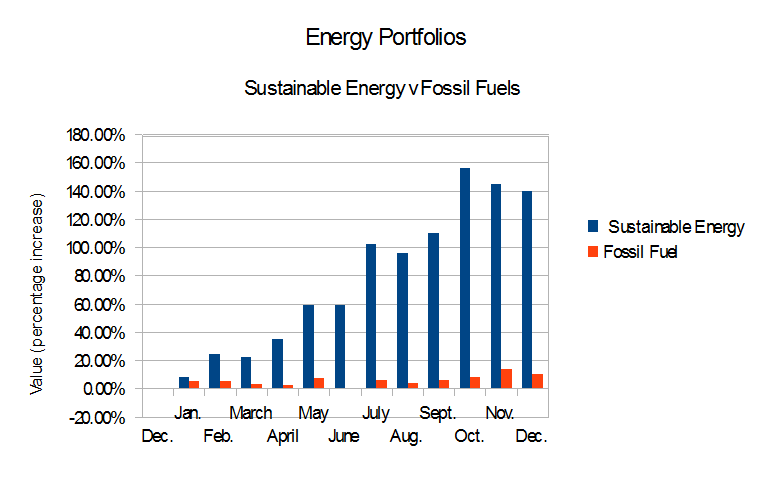
here are two thousand words on Sustainable Investing in 2013.
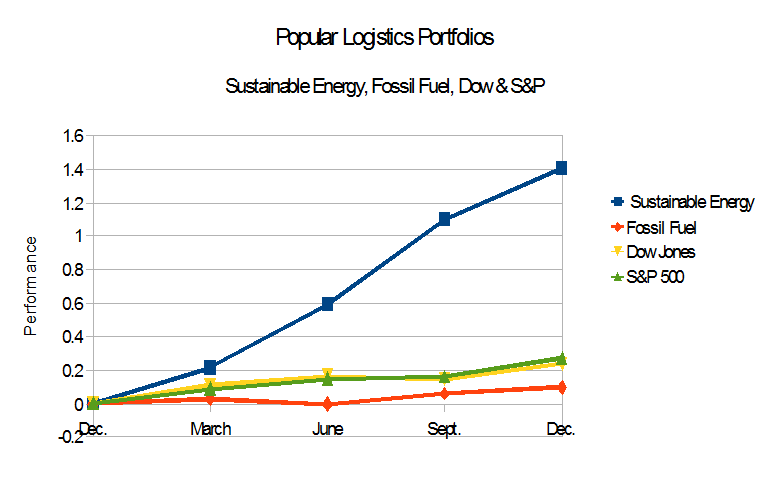
While the data may suggest that a “correction” may be in progress for the “Sustainable Energy” portfolio, and while the actions or inactions of various governments can dramatically effect performance of these portfolios, the Sustainable Energy Portfolio outperformed the Dow Jones Industrials and the S&P 500, both of which outperformed the Fossil Fuel Portfolio.
As the professional say, “Past performance is no guarantee of future performance.”
Energy Portfolios At One Year: Sustainable Energy up 140%, Fossil Fuel up 9.85%
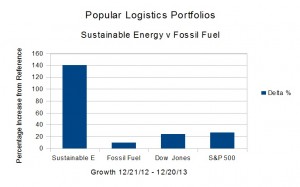
On Dec. 21, 2011, reading that MidAmerican Energy was investing in utility scale solar energy generation, I looked at First Solar and Sunpower. Then I looked at six other companies in the sustainable energy world. I created a model portfolio. To make things interesting, I looked at eight companies in the fossil fuel industy and invested $16 Imaginary Million in these 16 companies, $1.0 Imaginary Million in each. As of the close of trading one year later, Friday, Dec. 20, 2013,
- The Dow Jones Industrial Average is up 23.91% from 12/21/12.
- The S&P 500 is up 27.13%.
- The Fossil Fuel Portfolio continues to dramatically underperform the reference indices. It is up 9.85% from Dec. 21, 2012.
- The Sustainable Energy portfolio continues to dramatically outperform the averages, and is up 140.31% from Dec. 21, 2012.
The data are summarized beginning in Table 1, below.
Energy Portfolios: Minor Corrections, Overall Results In Line with the Trend
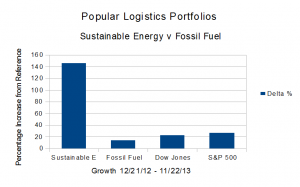 On Dec. 21, 2011, with $16 Imaginary Million, I created an investment simulation. I invested $1.0 Million in imaginary money in each of eight fossil fuel companies and eight sustainable energy companies. As of the close of trading 11 months later, Friday, Nov. 22, 2013, the trend, clearly evident after three months, in March of this year, continues.
- The Dow Jones Industrial Average is up 22.72% from 12/21/12.
- The S&P 500 is up 26.22%.
- The Fossil Fuel Portfolio, dramatically underperforming the reference indices, is up 13.37% from Dec. 21, 2012.
- The Sustainable Energy portfolio is up 145.37% from Dec. 21, 2012.
- The Sustainable Energy Portfolio is also down 4.39% from October 18, 2013.
Note that this represents a retreat of 4.39% from the high of 156.14%, in October, 2013.
As discussed in September and October, last month, in Septermber, 2013, in “Investing for the Future,” and October, in “Sustainable Investing: Green Energy, Green Economy,” the important question is: Is this a trend or a bubble? As I wrote, I think it’s a trend.
The 2,000 pound question, after Typhoon Haiyon, Hurricanes Sandy, Irene and Katrina, after the fires of 2012 and 2013, the Missouri River Floods of 2011 – which knocked out the Fort Calhoun nuclear plant – the super-tornadoes of 2013 – one with a two mile wide contact point on land, which tore through Oklahoma (CNN / National Geographic / Zerohedge) is will we survive to make the transition to clean sustainable energy?
or rather:
- “How many of us survive to make this transition?”
- “What will be the carrying capacity of earth for humans?”
The data are summarized beginning in Table 1, below.
Oyster Creek & Nuclear Power After Fukushima
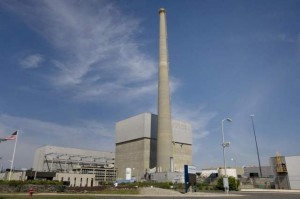
Oyster Creek Nuclear Power Plant, Courtesy Exelon
A public hearing will take place October 28, 2013, at the Clarion Hotel, 815 Route 37 West, Toms River, NJ. The subject of the hearing will be the National Academy of Sciences, NAS, study on nuclear power plants and cancer and “Lessons Learned from Fukushima.”
As I see it, the most important lessons from Fukushima are:
- Three of the Fukushima Dai’ichi nuclear reactors withstood the earthquake, the tsunami and the aftershocks. We can engineer systems that will withstand various scenarios, but this raises the cost such that nuclear cannot compete in a de-regulated energy market – see The Economist, here – and we cannot engineer against all possible events.
- The radioactive plume reached across the Pacific to North America, just as the plume from Chernobyl reached across the Atlantic to North America. An accident anywhere, when it involves dispersion of toxic materials, is an accident everywhere,
- We have seen four (4) meltdowns in the 54 years between the passage of the Price Anderson Act and the disasters at Chernobyl and Fukushima. The risk of a catastrophic accident such as a melt-down may be low, but a catastrophic accident, is by definition, catastrophic.
- The losses from Fukushima are estimated in the Trillions of Dollars. The economic value of the electricity produced by the six nuclear reactors is probably less than $100 Billion. Generating electricity from nuclear power is like taking heroin for a headache: The cure is worse than the disease.
There is a fifth lesson to be learned; this from the NJ Clean Energy Program in New Jersey and Vestas, the wind company. As noted on the NJ Clean Energy Program – Project Activity Pages, we in New Jersey now have have 1,117.5 Megawatts (MW) of grid tied photovoltaic solar electric generating capacity, almost double the 636 MW of Oyster Creek. Vestas is offering 8 MW wind turbines.
WE HAVE WIND and SOLAR: WE DON’T NEED OYSTER CREEK OR OTHER NUCLEAR POWER PLANTS.
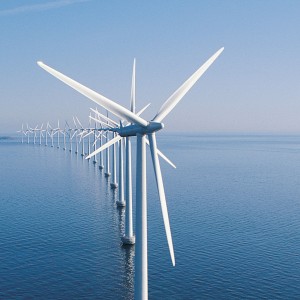
Offshore Wind Farm
In RE Carbon Dioxide – The EPA is Listening
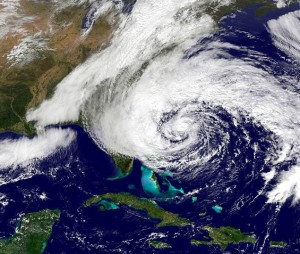
Hurricane Sandy, via satellite, 10/27/12, NOAA
The people at the Environmental Protection Agency understand the issue of increasing atmospheric Carbon Dioxide above 350 PPM. And EPA is listening. EPA has held two public comment periods in New York City on 10/23/13 and will hold nine additional public comment hearings across the country to “solicit ideas and input from the public and stakeholders about the best Clean Air Act approaches to reducing carbon pollution from existing power plants.”
| Boston, MA | 11/04/13 | Philadelphia, PA | 11/08/13 | |
| Chicago, IL | 11/08/13 | San Francisco, CA | 11/05/13 | |
| Dallas, TX | 11/07/13 | Seattle, WA | 11/07/13 | |
| Denver, CO | 10/30/13 | Washington, DC | 11/07/13 | |
| Lenexa, KS | 11/04/13 |
Click HERE to register.
And as President Theodore Roosevelt said, “Speak softly …”
Sustainable Investing: Green Energy, Green Economy
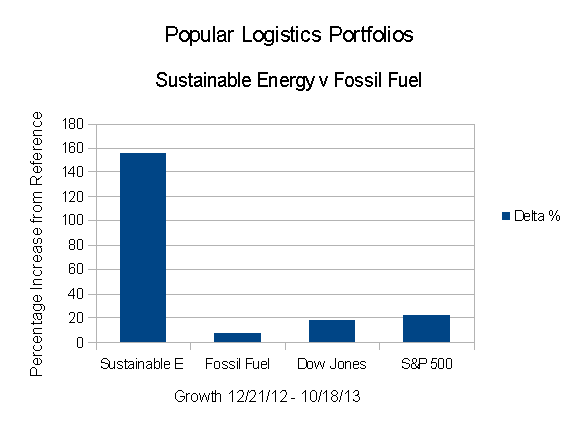
On Dec. 21, 2012, with $16 Imaginary Million, I created an investment simulation. I invested $1.0 Million in imaginary money in each of eight fossil fuel companies and eight sustainable energy companies. As of the close of trading 10 months later, Friday, Oct. 18, 2013, the trend, clearly evident after three months, in March of this year, continues.
- The Dow Jones Industrial Average is up 17.64% from 12/21/12.
- The S&P 500 is up 22.03%.
- The Fossil Fuel Portfolio, dramatically underperforming the reference indices, is up 7.47%.
- The Popular Logistics Sustainable Energy portfolio is up 156.14%.
As discussed last month, in “Investing for the Future,” the important question is: Is this a trend or a bubble? As I wrote, I think it’s a trend.
Jeremy Grantham, the “G” in GMO, invests with the expectation that all things being equal, a company’s valuation tends toward their arithmetic mean values. (Note that Mr. Grantham has not been contacted for this study.) But note that disruptive technologies are, by definition, game changers. Disruptive tech alters the landscape. If you looked at the airline, automobile and railroad industries over the 20th Century, automobiles and airlines waxed while railroads waned.
The future may be similar for Fossil Fuels and Sustainable Energy. The Market Capitalization of the Fossil Fuel portfolio is $1.13 Trillion. The Market Capitalization of the Sustainable Energy Portfolio is $0.06 Trillion ($60 Billion). The value of the companies of the Sustainable Energy portfolio is roughly 5.3% of the market capitalization of the companies of the Fossil Fuel portfolio. It can almost be described as a rounding error compared to the value of the Fossil Fuel portfolio. But if Mr. Grantham’s analysis is valid, and you aggregate the portfolios into one called “Energy” as opposed to a “Fossil Fuel” portfolio and a “Sustainable Energy” portfolio, then the shareholders of these various companies are in for an interesting few years.
Real Shutdown Increases Real Unemployment by 800,000 Real Americans. Unofficially: Unemployment Rate Now 7.82%. Actually: 1.8 Million Unemployed by Shutdown; Rate of 8.48%

Old Picture of President Obama & Speaker Boehner
The NY Times Editorial Board describes the shutdown, here, as “John Boehner’s Leadership Failure.” USA Today wrote, here,
“This shutdown, the first in 17 years, isn’t the result of two parties acting equally irresponsibly. It is the product of an increasingly radicalized Republican Party, controlled by a disaffected base that demands legislative hostage-taking in an effort to get what it has not been able to attain by the usual means: winning elections.”
On Saturday Night Live, Saturday, 10/5/13, Miley Cyrus and the cast mock-umented the GOP celebration over the shutdown with “We Can Stop (The Government).”
But Art and Politics aside, what are the effects of the Shutdown on the Economy?
The Government Shutdown increased Unemployment by 1.8 million, the Unemployment Rate increased 16.2%, from 7.31% on August 31, 2013 to 8.48% on October 2, 2013. At the same time, GDP growth dropped 20%, from 2.5% to 2.0%.
The Gold Standard – 1945 to the Recent Past
5$ and $20
“FEDERAL RESERVE NOTE”
“THIS NOTE IS LEGAL TENDER FOR ALL DEBTS PUBLIC AND PRIVATE”
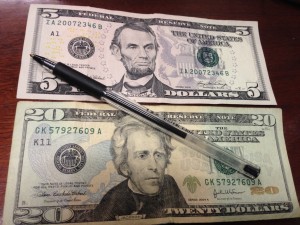
Two intertwined events took place between the end of World War II and the dawn of the 21St Century.
Energy Portfolios – Investing for the Future
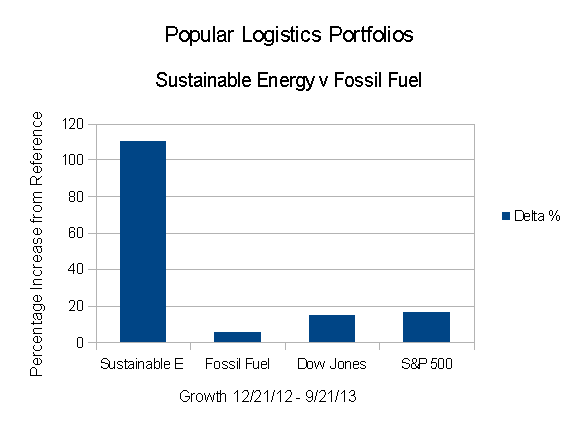
As of the close of trading Friday, Sept. 20, 2013, the trend, clearly evident by February 9, 2012 continues.
- The Dow Jones Industrial Average is up 14.66% from 12/21/12.
- The S&P 500 is up 16.36%.
- The Fossil Fuel Portfolio, significantly underperforming the reference indices, is up 5.95%.
- The Popular Logistics Sustainable Energy portfolio is up 110.10%.
 The important question is: Is this a trend or a bubble?
I think it’s a trend. While I want to think it’s a trend, utility scale solar is at or below $4.00 per watt and getting cheaper. Solar also scales from the 10 watts on a backpack to 10,000 watts or 10 KW on a rooftop to 500 million watts, 500 MW utilities are building. Wind is less expensive. Wind and solar are predictable. Continue reading