Researchers posit new disease vector: trans-oceanic airbone pathogens: NPR

Kawasaki disease affects about 4,000 children a year in the United States, but many more in Asia. As a consequence, even the best American pediatricians may have difficulty making the correct diagnosis, particularly on first impression. Now researchers have correlated wind patterns to and from Japan and the U.S. West Coast with the timing of Kawasaki outbreaks in both locations.

A Windborne Clue To A Mysterious Childhood Disease: on NPR.org – a direct link to the audio is on the page.


Hydraulic Fracturing – accumulating record not particularly reassuring

Recent reports about the effects of hydraulic fracturing. Note that a critical aspect of this issue is the pressurized disposal of wastewater, which is injected (or perhaps more accurately re-injected) rather than the initial energy (gas) collection.

Mark Drajem, correspondent for Bloomberg News, reporting Fracking Tied to Unusual Rise in Earthquakes in U.S.

A spate of earthquakes across the middle of the U.S. is “almost certainly” man-made, and may be caused by wastewater from oil or gas drilling injected into the ground, U.S. government scientists said in a study.

Researchers from the U.S. Geological Survey said that for the three decades until 2000, seismic events in the nation’s midsection averaged 21 a year. They jumped to 50 in 2009, 87 in 2010 and 134 in 2011.

Those statistics, included in the abstract of a research paper to be discussed at the Seismological Society of America conference next week in San Diego, will add pressure on an energy industry already confronting more regulation of the process of hydraulic fracturing.

“Our scientists cite a series of examples for which an uptick in seismic activity is observed in areas where the disposal of wastewater through deep-well injection increased significantly,” David Hayes, the deputy secretary of the U.S. Department of Interior, said in a blog post yesterday, describing research by scientists at the U.S. Geological Survey.

‘Fairly Small’ Quakes

The earthquakes were “fairly small,” and rarely caused damage, Hayes said.

He said not all wastewater disposal wells induce earthquakes, and there is no way of knowing if a disposal well will cause a temblor.

Last month, Ohio officials concluded that earthquakes there last year probably were caused by wastewater from hydraulic fracturing for natural gas injected into a disposal well.

In hydraulic fracturing — or fracking — water, sand and chemicals are injected into deep shale formations to break apart underground rock and free natural gas trapped deep underground. Much of that water comes back up to the surface and must then be disposed of.

There’s “a difference between disposal injection wells and hydraulically fractured wells,” Daniel Whitten, a spokesman for the America’s Natural Gas Alliance, which represents companies such as Chesapeake Energy Corp. (CHK) and Cabot Oil & Gas Corp. (COG), said in an e-mail. “There are over 140,000 disposal wells in America, with only a handful potentially linked to seismic activity.”

Let’s assume for the moment that seismic activity is linked to disposal wells, infrequently, as Mr. Whitten claims, at a rate of “a handful” for every 140,000 wells. To use round numbers, and use conservative estimates, let’s say “a handful” is five, out of a set of 100,000 (rounding 140,000 down by nearly one-third). That’s fifty seismic events per 1 million disposal wells. The United States “natural gas” ((It’s our understanding that we are, for the most part, talking about methane.)) industry is planning to rapidly and widely expand domestic exploration.

What’s the acceptable safety rate for seismic events caused by methane extraction? If we embark upon an ambitious program, and create one million new disposal wells (and fifty seismic events) per year, how long will it take for us to yield a catastrophic event?

For the moment, we will set aside the other risks: the toxic nature of methane, which is odorless, flammable, and can easily reach 2000°F (1093°C).

Popular Logistics proudly adds link to Kirk Blattenberger and RF Cafe

In one of those amazing discoveries that makes one appreciate  the thousands of years of human information (and other) technology that have led us to the internet, which, admittedly has its share of chaff, it also has some golden wheat: in this case RF Cafe, an amazing reference website which will be of great use to neophyte and expert alike, from experienced had operators to Make: Magazine readers and confirmed addicts of Instructables, by one very smart and when you’re not looking very funny electrical engineer named Kirk Blattenberger. How many bloggers can get Marconi, Johns Hopkins (he scientist, not the university named after him) onto one page and quote Chico Marx without it being a non sequitur?

Two. Us, because we told you about him, and the other is Mr. Blattenberger. For those who aren’t sure, “RF” in this context means “radio frequency.” Which  can refer to many things, depending on the context, but is the over-arching category which includes wireless communications, garage-door openers, shock collars for dogs (which, in our experience. are only rarely a good idea, but as a philosophical matter, we believe in positive reinforcement training of dogs and children and even some adults, but that’s a longer conversation for another day), two-way radios which carry voice, data, medical data, help manage air traffic control, help rescue people in all manner of situations, and even provide entertainment and education and news in more languages than we can count. Plus all manner of serious and cool remote control from Predator drones to remote control toy boats. Mr. Blattenberger has well-researched information on these topics and more, and has also written software on related topics.

He’s also got a job board;

Pages (multiple) about renewable energy resources; one generally about green energy;

another principally about photovoltaic energy (think solar turned into electricity, rather than, say, heating water);

And one entitled “Solar Power/Energy Websites;” to use Mr. Blattenberger’s own words,

Solar energy is the radiant light and heat from the Sun that has been harnessed by humans since ancient times using a range of ever-evolving technologies. Solar radiation along with secondary solar resources such as wind and wave power, hydroelectricity and biomass account for most of the available renewable energy on Earth. Only a minuscule fraction of the available solar energy is used.

Solar energy is the radiant light and heat from the Sun that has been harnessed by humans since ancient times using a range of ever-evolving technologies. Solar radiation along with secondary solar resources such as wind and wave power, hydroelectricity and biomass account for most of the available renewable energy on Earth. Only a minuscule fraction of the available solar energy is used.

RFCafe is an outstanding resource;  as we try to build our own knowledge of RF technologies and to make useful information available here on Popular Logistics, we’ll try to resist actual plagiarism and instead properly credit Mr. Blattenberger. Which may mean naming any “Radio Communications” reference pages after him.

Blast at School in Southern Italy Kills One and Injures Six – NYTimes.com

An unfortunate reminder that in counterterrorism and response preparations, we need to focus on more than just commercial aviation:

ROME (Reuters) – A bomb exploded in front of a school in southern Italy on Saturday, killing a 16 year-old girl and wounding at least six others, two seriously, authorities said on Saturday.

The explosion, near the entrance of a girls’ school named after the wife of murdered anti-Mafia judge Giovanni Falcone, occurred as pupils were preparing to enter the school at the start of the school day, which in Italy includes Saturdays.Design intended to deter bombing by making contents visible, to make finding bombs more efficient, and to limit the blast effects of fragments of a metal can.

French trashcan design to deter bombing by making contents visible

Authorities said two gas canisters appear to have been placed in rubbish containers at the school, which local media said was located near the main court in Brindisi, a port city located in Apulia, on the “heel” of Italy.

“This is a tragedy,” Mimmo Consales, the mayor of Brindisi, told SkyTG24 news television, saying that two of the injured were in a “desperate condition” while four others were less seriously hurt.A surgeon told local TV Telenorba that one of the injured girls was currently undergoing a complicated surgery.

There was no claim of responsibility and no indication of who had placed the bomb but initial suspicions were directed at the mafia.

Consales noted that the incident occurred just a few days before the 20th anniversary of the murder of Falcone and his wife, Francesca Morvillo, by a bomb in Sicily on May 23, 1992. An anti-mafia march had been planned later in the day.

“You can understand the symbolism of this and what it all signifies,” he said.

Television shots of the scene showed a cement wall blackened by fire next to the school’s entrance gate on a sunny spring day.

Schools in the region were closed and President Giorgio Napolitano issued a statement condemning the attack. A group of investigators, including the region’s top anti-mafia prosecutor, will meet later on Saturday to discuss the probe.

Continue reading

U.N. Presence Fails To Prevent Syrian Bloodshe

U.N. Presence Fails To Prevent Syrian Bloodshed

U.N. monitors in Syria leave their Damascus hotel on Wednesday on a mission. A day earlier, their U.N. colleagues were at the scene of a major clash in northern Syria that left more than 30 Syrians dead.

Enlarge Louai Beshara/AFP/Getty ImagesU.N. monitors in Syria leave their Damascus hotel on Wednesday on a mission. A day earlier, their U.N. colleagues were at the scene of a major clash in northern Syria that left more than 30 Syrians dead.

text size A A A

May 16, 2012

There was a deadly clash in northern Syria on Tuesday, but it was different than many other such episodes over the past 14 months of the Syrian uprising.

This time, United Nations monitors were watching. The monitors are in Syria to keep an eye on the government forces and the opposition, who are supposed to be observing a cease-fire and opening a dialogue.

But the trouble Tuesday began with a funeral the northern Syrian town of Khan Sheikhoun.

A man who was killed by Syrian security forces over the weekend was about to be buried. The funeral was held in a part of town that claims to be free — meaning it no longer considers itself under the control of the Syrian government.

It’s held by anti-government rebels who call themselves the Free Syrian Army. Still, the government’s army and security forces maintain checkpoints in other parts of town.

It was these checkpoints that reportedly drew the attention of the U.N. monitors. Under the U.N. peace plan, the government’s soldiers and security forces are supposed to pull out of cities and towns.

Funeral Turns Into A Protest

Residents of Khan Sheikhoun say U.N. monitors watched the funeral, which quickly turned into a protest against the government.

Emboldened by the monitors, protesters and rebels shouted insults at government soldiers.

The Syrian soldiers and security forces unleashed a barrage of gunfire. Parts of the confrontation were captured on video that has been posted on YouTube, including one that shows a tangle of bodies falling to the ground. Then the film goes blank. Activists in Khan Sheikhoun say the man who shot the video was killed.

Amid the chaos, U.N. monitors went back to their cars. Then, an explosion went off, producing a huge cloud of white dust. The lead U.N. truck was mangled by the explosion.

Other U.N. vehicles were also damaged. The vehicles speed away from the scene, at least one of them running over bodies of the injured or dead.

Like so many confrontations in Syria, there are multiple versions of this story. Residents say government security forces launched a grenade at the UN truck. The government says it was a bomb planted by what it calls terrorists.

The UN would only say that it was a homemade bomb.

Death Toll Is More Than 30

The blast and the shooting that preceded have left more than 30 people dead, many of them civilians.

Another video uploaded by activists on YouTube shows young men with gruesome gunshot wounds at a makeshift field hospital.

People who oppose the government in Syria are often too afraid to go to government hospitals.

Journalists have generally been barred from reporting in Syria, and none of the videos could be independently verified. However, residents of the village have confirmed that rebels and government soldiers clashed in Khan Sheikhoun after the explosion. An army tank was set on fire by the rebels, according to the govenrment forces.

The situation was so volatile Tuesday that the U.N. monitors could not leave Khan Sheikhoun. They ended up staying the night in the village.

Residents say the monitors were able to negotiate a halt in the fighting Wednesday and that other monitors were allowed to come and pick them up.

One final video shows the destroyed U.N. trucks being towed away while the young boys of Khan Sheikhoun look on. Residents say soon thereafter, the tanks rolled back into town and started shooting again.

The U.N. mission in Syria has found that there is no peace for it to monitor. Rather, the hope is that it can create the peace. In some parts of Syria, the mere presence of monitors has brought a lull in the violence. But not this week.

One activist in Khan Sheikhoun, speaking in an interview over Skype, said he thought the monitors should leave for good. Before they came, the town was bad, he said. Now that they’ve pulled out, Khan Skeikhoun is burning.

Lava Selo contributed to this report.

Hat to helmet in nanoseconds: Shear Thickening Fluids (STF) – nanotech liquid

Shear Thickening Fluids (STFs) may be “liquid” in a strict sense – but they’re used in fabrics. Developed by Professor Norman Wagner and his research team, including students, of the University of Delaware, as a joint project between the University of Delaware Center for Composite Materials and the United States Army Research Lab. They’re amazing – and are already in use. (Professor Wagner seems a bit shy, but very proud of his students. The website for his research group is filled with photos of his colleagues, graduate students and undergraduates – but what should be his personal page on the University of Delaware site is a dead link). STFs are added to Kevlar, making ballistic armor more effective;

D30 Labs has been making STF’s available to the civilian market. The Swiss Company RibCap has been making what look like normal knit caps – soft until subjected to a sudden force – at which time they behave like crash helmets:

At the moment not, apparently, available in the United States – but they’re available via some Canadian and British stores .Ribcap’s Swiss site here; their Canadian affiliate, DirtSurfer, also has a list of U.S. retailers.

We’d like to know more – and see test data – but if effective, these soft hats should be in every go-bag – and worn by every emergency responder who’s not already wearing protective headgear.

Via Wired (body armor) and CoolTools (RibCap).

CDC: Health Implications of Hydraulic Fracturing: Unknown

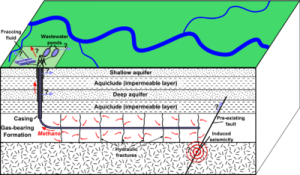
Schematic Drawing of Hydrofracturing

Hydraulic Fracturing 1, Schematic Drawing

The Centers for Disease Control, CDC, on May 3, 2012 issued a brief but unequivocal statement regarding the health implications of hydraulic fracturing here, and reproduced in it’s entirety below.

CDC / ATSDR Hydraulic Fracturing Statement:

CDC and ATSDR do not have enough information to say with certainty whether natural gas extraction and production activities including hydraulic fracturing pose a threat to public health. We believe that further study is warranted to fully understand potential public health impacts.

Image of fire from tap water with various flammable impurities

Frakking 2, Tap Water with Various Impurities

The CDC, in its 47-word statement said, “We don’t know the public health implications of hydraulic fracturing, aka ‘fracking’ or ‘frakking.’ We need to study the issue.” Perhaps the decision makers at the CDC should watch Gasland. But consider the CDC statement on hydraulic fracturing in light of picture 2 and the “Precautionary Principle,”

The precautionary principle or precautionary approach states that if an action or policy has a suspected risk of causing harm to the public or to the environment, in the absence of scientific consensus that the action or policy is harmful, the burden of proof that it is not harmful falls on those taking the action.

The Precautionary Principle is described in more detail on Commonweal (here) and Science & Environmental Health Network, SEHN (here).  Burning fuel for heat requires obtaining the fuel and releases various materials into the biosphere. We must understand the consequences and side-effects before we embark on any project. The questions in re hydraulic fracturing are:

  • Are these pictures real or imagined?
  • What are the implications for the water supply and the biosphere?
  • What are the liability insurance requirements? and
  • What are the alternatives?

Continue reading

GPS Vulnerability – What Are The Implications?

Global Positioning Systems are very useful. However, North Korea’s recent jamming of the GPS system in South Korea, while not known to have caused fatalities, demonstrates in the first place, that we need to remember how to find our way without the GPS, particularly in a crisis.

And in addition, we should consider, perhaps combinations of failures, such as:

  • GPS system outages – by government order or by sabotage, while other systems are functioning properly;
  • GPS system outage accompanied by communications system problems (such as overload – too many people using phones during a crisis or perceived crisis);
  • GPS failure + power failure + communications systems failure; widespread power failures by themselves will, of course, degrade or disable both GPS access and most communications technologies.

In other words, the GPS won’t work; there’s no way to call and get directions; mass transit is likely to be about; traffic lights may or may not work; obtaining a map via the Internet is likely to be impossible.


Six Sigma & The Law of The Hammer

The Bell Curve showing 3 standard deviations

Bell Curve showing Mean, μ & Standard Deviation, σ.

“The child who receives a hammer for Christmas will discover that everything needs pounding.”

One of my friends asked about “Six Sigma,” famously used by General Electric and Motorola to enhance the quality on their production lines, and famously used by Home Depot and 3M for short term gain and long term failure, (see “Six Sigma, So Yesterday,” on Business Week OnLine, here).

“I understand that Six Sigma means a very high quality system – with only 3.4 errors per million units,” my friend said. “What I don’t understand,” he added, “is the definition in terms of Standard Deviation and Normal Distribution. 99.99966% of the values will fall within 6 Standard Deviations of the Mean, compared to 99.73% of the values falling within 3 Standard Deviations of the Mean. What’s a standard deviation? And what’s a normal distribution?” Continue reading

Homebrew software analyzer for digital radio signals (OP25)

Under the headings of democratizing and demystifying technology, here’s a group of open-source folks making ways of receiving the digital signals with which, under what’s called “P25” (Project 2025), public safety agencies will be conducting their radio communications by the year 2025. Those handy with soldering irons and reading circuit diagrams will find this especially interesting.  Those of us with a less sophisticated understanding will, for the moment, stand in awe and admiration:

OP25 is a not-for-profit project to bring together folks that are interested in implementing APCO P25 using a software-defined radio. Our goal is to build a software-defined analyzer for APCO P25 signals that is available under the GNU Public License (GPL).

APCO Project 25 is the digital communications standard used by many police and emergency services throughout the world. Most notably the US, Canada and Australia deploy systems based on P25. Compared to existing analogue systems P25 offers improved spectrum use, coverage and flexibility. Provision is made to ensure the confidentiality of traffic, to allow the use of trunking and the provision of data in addition to voice services.

Hardware scanners such as the Uniden BCD996T offer APCO P25 functionality but software-defined radio (SDR) offers significantly improved flexibility. For example, software radio approaches can receive many channels at once, handle both voice and data (including the trunking control channel), decrypt encrypted traffic when the key is known and log traffic to disk for later analysis. With the right software an SDR is a powerful analysis tool for debugging and monitoring of P25 networks.

That’s the sales message. The reality is software-defined radio isn’t yet as simple as the plug-and-play of hardware radios. You will need a lot of patience and a fair amount of software skills to get working. To get an idea of the work involved you can check out Hardware for Your Software Radio By Stephen Cass. In that sense this really is an amateur radio project and requires the same kind of skill and dedication but we’ve a few people who will help out if you run into trouble. A project like this needs many different skills so even if you’re not technical you maybe able to help in other ways.

A short video that demonstrates OP25 transmitting audio from a PC’s microphone input, then to a USRP being received by a GRE scanner is available on Youtube.

via OP25.

Thanks to Dangerous Prototypes for the link.

Cassidian Communications has a helpful explanation of P25 in .pdf (Acrobat) form; see also their P25 Land Mobile radio page. If this subject is of interest but daunting, start with Wikipedia’s excellent Project 25 entry.

OP25 itself notes that there are other projects exploring these issues: “OP25 is only one of a number of projects in this area and you should check out  Project54,  OpenP25 and  Unitrunker for related work. “

Bird Technologies Group – TX RX Systems RF Signal Boosters: NFPA Complaint, Channelized, Mission Critical Solutions

613-8 Series, 700/800 MHz

Digital Signal Booster

61-89A Series, 806-869 MHz

RescueLine Signal Boosters

61-89A Series, RescueLine Signal Boosters

61-89A Series, RescueLine Signal Boosters

The 613-8 Series, Digital Signal Booster operates in the 700/800 MHz range with 1-60 filters available. All state-of-the-art product components are protected by a NEMA 4 style enclosure to meet the demands of the NFPA requirements. Intuitive web browser interface allows booster to be easily configured for changing RF environments. Filter bandwidth is user selectable (12.5kHz, 25kHz, 50kHz, 3MHz and 9MHz standard or custom bandwidths are also configurable).

The 61-89A Series, RescueLine Signal Boosters, are the first such signal-booster systems to fully comply with the IFC 2009 and NFPA 1 2009 codes which makes it the state-of-the-art electronic lifeline for first responders inside a new building. The RescueLine Series delivers on a key objective: ensuring that first responders have reliable radio communications in large structures.

via Bird Technologies Group – TX RX Systems RF Signal Boosters: NFPA Complaint, Channelized, Mission Critical Solutions.