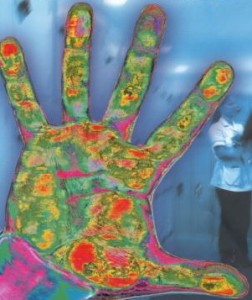
Cleaning Up In Hospitals

Germs on the hand

Germs on the Hand. Courtesy Talk is Cheap

5% of hospital patients develop an infection. And the majority of those infections are acquired from the hands of Health Care Providers.

Medicare pays 40% of the nation’s hospital bills. (This, in and of itself, is an argument for a single payer system – one single payer already pays 40% of hospital bills. And it’s the Government.) However, Medicare does not reimburse hospitals for their mistakes. It shouldn’t. If I borrow your car, and run out of gas, it’s my fault, not yours. Note that this is an example of the government doing something right.

Because of this policy decision, medical accidents went from being a source of hospital revenue to a massive financial drain. Medical institutions were forced into the business of disease prevention, at least once people were in their care.

According to the Committee to Reduce Infection Deaths statistics, (PDF) hospital acquired infections kill more people in America than AIDS, Breast Cancer and Auto Accidents combined. What is worse is that 5% of the patients in hospitals acquire infections in the hospital, and the vast majority of the patients that acquire such infections in hospitals get them from the hands of health care providers.

More details after the click.

Continue reading

Eating Any Time Soon? Brooklyn Food Conference, Sat. May 12.

An Urban Garden in Brooklyn, NY

An urban garden in Brooklyn, NY

The Brooklyn Food Coalition presents the Brooklyn Food Conference, May 12, 2012, from 9:00 AM to 6:00 PM. It will be a day of Workshops, Expo, Youth Summit Policy Roundtable, Demos, Music, Art, Meetups – and good HEALTHY food.

Where? Brooklyn Tech, 29 Fort Greene Place, Brooklyn, NY 11217. Admission is free. Continue reading

North Korean GPS jamming shows vulnerability of Army radios – Nextgov.com

While this is alarming, please bear in mind that this is a discussion of a military technology which, with respect to one feature (GPS), used a civilian-grade component. That the entire system can be easily jammed would, we think, be an unreasonable inference based on the data at hand. By Bob Brewin, writing on NextGov.com:

Korea’s jamming of Global Positioning System signals on the Korean Peninsula this week illustrates a “life-threatening” vulnerability of the Army’s Rifleman Radio, which is equipped with a nonmilitary GPS chip, a former top Defense Department official told Nextgov. The Army plans to test the hand-held radio this month at its semiannual Network Integration Evaluation exercise at White Sands Missile Range, N.M., which began Tuesday.

GPS satellites broadcast jam-resistant military signals as well as civil signals susceptible to blocking. Jules McNeff, who spent 20 years in the Air Force working on GPS, said the Army evidently decided to use a chip that receives only civil GPS signals as a “cheap and expedient” way to incorporate location information into the Rifleman Radio.

McNeff, now vice president for strategies and programs at Overlook Systems Technologies Inc., a GPS engineering firm in Vienna, Va., said any time a jamming incident occurs, “it calls into question why we are using [civil chips] in the Rifleman Radio.”

The Army plans to field 5,900 short range Rifleman Radios to infantry squads in seven brigade combat teams over the next year.

Army Lt. Gen. Ronald Burgess Jr., director of the Defense Intelligence Agency, told lawmakers on the Senate Armed Services Committee in February that North Korea has mounted high-powered Russian-made jamming devices on vehicles near the border — 40 miles north of Seoul, the South Korean capital — which can disrupt GPS signals within a 30-to-60 mile range. He added North Korea has started to develop its own GPS jammer with a greater range.

John Merrill, position, navigation and timing program manager for the Homeland Security Department, said small, inexpensive GPS jammers widely sold on the Web have proved difficult to locate. In a presentation to attendees at a National Institute of Standards conference in March, Merrill said it took DHS, the Federal Communications Commission and the Federal Aviation Administration from November 2009 to April 2011 to locate one GPS jammer in a truck traveling the New Jersey Turnpike and knocking out GPS signals at the Newark, N.J., airport. [emphasis added]

The Army has billed the Network Integration Evaluation, which runs through June, as a “real-world” exercise and McNeff said the service should include “navigation warfare” maneuvers to test the vulnerability of the Rifleman Radio and other systems to jamming.

via North Korean GPS jamming shows vulnerability of Army radios – Defense – Nextgov – Nextgov.com.

Airstrike Kills Senior Al-Qaida Leader in Yemen – NYTimes.com

Via Airstrike Kills Senior Al-Qaida Leader in Yemen – NYTimes.com.

SANAA, Yemen (AP) — Yemeni officials say an airstrike has killed a top al-Qaida leader who was wanted in the 2000 bombing of the USS Cole. The airstrike resembled earlier U.S. drone attacks, but the U.S. did not immediately confirm it.

Local official Abu Bakr bin Farid said Fahd al-Quso was killed Sunday along with an aide in an airstrike in the southern Shabwa province. The Yemeni Embassy in Washington confirmed the report.


User-Invented: the firefighter’s pole

The firefighter’s pole – now often omitted from firehouse design for safety reasons – is worthy of our consideration for a number of reasons:

  1. They perform their intended function – getting a group rapidly towards its mission in readiness with little notice. In other words, firefighters don’t have to sleep in all of their uniforms, on their trucks, and can get rest when not needed. The pole has also been used in military pilots’ ready rooms for the same purpose.
  2. They take up very little floor space;
  3. Fire poles don’t fail during power outages, and in fact require  no energy input.
  4. The fire pole was invented in the 19th century by David Kenyon, an African-American firefighter in Chicago. For a better account, see April 21, 1878: Thinking Fast, Firefighter Slides Down a Pole – by Randy Alfred on Wired.com

See also:

Fire Pole! – videos and more on Instructables.

McIntire Brassworks of Somerville, Massachusetts makes several models, and offers a safety door so that there’s no open hole for children or animals to fall through:

       Different configurations of McIntire’s Model 20

While this is clearly a technology only suited for the able-bodied with some practice, consider the evacuation of an crowded structure. Those that can descend and exit by pole, and who are not assisting others, can free up the bandwidth, so to speak, of other means of egress.

Son of missing man looks in stands for father: Bob Levinson still missing

Florida’s WSVN-TV reports that, although still missing, Bob Levinson is still in the thoughts of his family, who still hope for his speedy and safe return. As do we. Bobby, there are still a lot of people thinking about you every day.

Excerpted from Son of missing man looks in stands for father

COCONUT CREEK, Fla. (WSVN) — A South Florida teen hoping to win his high school volleyball championship is also holding out hope that he will see his father again someday soon. In 2007, retired FBI agent Bob Levinson vanished while on a private business trip to Iran. In 2010, three years after his disappearance, a YouTube video emerged, showing Bob Levinson as he pleaded for help to get back home. He is still missing. Levinson’s son Doug was only 13 when his father went missing. Thursday night, Coral Glades High played against Marjorie Stoneman Douglas High in the district volleyball finals. The now 18-year-old Coral Glades High School senior admits he still looks into the stands, hoping to see his father cheering him on. “He would just be happy that I played this long and played the sport I love,” said Doug. “Sometimes, if I hit a good ball or hit a kill, I look up and that’s it. But my mind’s gotta be on the court. It’s in the back of your head, but you’ve just got to push it out.” “He used to be in the stands for every one of our children’s games,” said Bob’s wife, Christine Levinson, “and he’s not able to be here.” Last year, Doug and his sister received college scholarships, and Doug will attend Florida State University in the fall. Levinson’s family believes he is still alive and being held against his will.

Images of London 7 July 2005 bombings

[imagebrowser id=100]

See also German authorities find new al-Qaeda documents hidden in porn files on flash drive: CNN (a related post here on Popular Logistics). The slideshow which follows is a preliminary attempt to compile a more useful visual data set of the events in London on 7 July 2005. We’ve got a few things in mind, after the jump:

Continue reading

German authorities find new al-Qaeda documents hidden in porn files on flash drive: CNN

Editor’s note: since al-Qaeda and its allied forces claim that pornography is sinful, and that Westerners are obsessed and debased by it, isn’t a flash drive which appears to contain pornography the very first object  immoral investigators would examine while conducting a search? Apparently Germany’s intellligence and law enforcement agencies aren’t so easily distracted.  From CNN’s Documents give new details on al Qaeda’s London bombings

This story is based on a 46-page internal al Qaeda document, details of which were obtained by CNN. A senior U.S. counterterrorism official told CNN that U.S. authorities have concluded it was written by British al Qaeda operative Rashid Rauf. It was discovered by German cryptologists, along with more than 100 other documents, embedded inside a pornographic movie on a memory disk belonging to a suspected al Qaeda operative arrested in Berlin last May. The German newspaper Die Zeit was the first to report on the documents.

(CNN) — Rashid Rauf was one of al Qaeda’s most capable planners, a British citizen who operated for years in Pakistan and planned some of the terror group’s most ambitious attacks. And he wrote about them in great detail.

Rauf’s detailed analysis — meant for al Qaeda’s senior leadership — shows he was intimately involved in planning the devastating attack on the London transport system in 2005, and tells the inside story of the planning for that attack and another that failed just weeks later.

Rauf’s notes were part of a treasure trove of al Qaeda documents discovered by German authorities that CNN recently obtained access to.

More: Future plots | Liquid bomb plot origins

On July 7, 2005, four suicide bombers led by Mohammed Siddique Khan, a British citizen of Pakistani descent, killed 52 people on three London subway trains and a bus.

CNN’s coverage, including references to the relevant earlier events, is outstanding, and provides critical context via internal and  external links on well-designed and easily navigable pages, including photographs coverage and video clips. Start with this  link, CNN’s Documents give new details on al Qaeda’s London bombings  (identical to the  first link above).

See also plus the Telegraph’s Al-Qaeda commander’s guide to beating MI5, also with excellent links to relevant prior and parallel coverage, by Duncan Gardham, without whom we. likely would have missed the CNN coverage.  Mr. Gardham is

The Daily Telegraph’s Investigations Correspondent. He has specialised in writing about international terrorism and espionage. Duncan has covered all the major al-Qaeda plots in Britain including the fertiliser bomb plot, the July 7 and July 21 bombings, the London and Glasgow car bombs, the trans-Atlantic airlines plot and the Manchester shopping centre plot. He has also written about counter-terrorism policy and international developments such as the death of Osama bin Laden.

We’ve been remiss in neither keeping up with his work nor directing our readers’ attention  to it. An archive of his work for The Daily Telegraph can be found at this link: Duncan Gardham.

Ferry Sinks in Assam, India

Excerpted from Assam Ferry Sinking on WikiNews:

On 30 April 2012, a ferry capsized in the Brahmaputra River in the Dhubri district of Assam state in north-eastern India.

Incident

According to officials, the incident occurred when a packed steamer carrying over 300 passengers was caught in a storm and subsequently capsized. The incident occurred near the Fakiragram village in the Dhubri district, about 350 km (220 mi) west of Guwahati.  The Superintendent of Police, Pradip Saloi, told The Hindu: “The ferry, originating from Dhubri and going towards Hatsingimari, capsized near Fakirganj. We are not sure about the actual number of passengers. We have been told that there were 250–300 passengers. However, there were reports of many swimming to safety.” Reuters reported that a police officer had said that the ferry had neither lifeboats nor life jackets and was overloaded with people and goods. Most of the passengers were farmers and farm families from the local area. Death toll According to India’s National Disaster Relief Force, bodies of 103 victims, including women and children, were recovered by the NDRF personnel and the Border Security Force near Jaleswar. Assam Chief Minister Tarun Gogoi said that the death toll was likely to rise. [3] The dead bodies have been kept at the Dhubri Civil Hospital.

Assam Ferry Sinking

Don’t wealthy Americans need emergency rooms, too?

httpv://www.youtube.com/watch?v=9H4u-trTvNk

New York City politics is often about real estate value, and distance is often measured in travel time. A hospital three miles away in suburban or rural Arizona might be reachable, on a flat straight road with no traffic, in  an ambulance with lights and sirens running, in well under three minutes. Not in New York City.

In 2010, in financial trouble after serving the sick and dying for 161 years, a deal was brokered – the details don’t matter – in which the overwhelming majority of the hospital’s grounds would be replaced by luxury housing, plus the fig leaf of an “urgent care center,” which, it was implied, was the functional equivalent of a hospital emergency department. St. Vincent’s did have, while it was in operation, a full-on top tier emergency department, with specialists, operating rooms – like, in fact, a fully accredited emergency department designated as a trauma center in a major American city.  The replacement “urgent care center” – to  be frank, this phrase as used is more deceptive than illustrative – would not, is not, and will not be able to treat gunshot wounds, heart attacks – those patients will have to be transported to the nearing hospital designated, accredited, equipped and trained as a trauma center.

So the people buying this “luxury” housing will be buying housing without one of the characteristic amenities of modern big cities: outstanding hospitals with emergency departments. Unless, of course, they’re lucky in avoiding traffic, or in good enough shape to withstand a long ride in an ambulance. It is not without some shame that we note that New Yorkers, whatever their other virtues, are inured to the signals of emergency vehicles: we don’t rapidly pull over to make way for ambulances, police vehicles, or fire trucks.  Our chronic housing shortage being what it is, people will undoubtedly buy or rent apartments on the former St.Vincent’s site anyway, but we wonder if the lack of a readily available emergency  room will affect prices.  From http://healthcarevote2013.com:

Few healthcare issues are as urgent in New York City as hospital closures.  The Year Of The Healthcare Vote 2013 was created in response to the closure of St. Vincent’s Hospital in 2010.  St. Vincent’s had served New York for 161 years, and will be replaced by luxury condominiums.  Since that time hospitals have been closing at an alarming rate throughout New York City – in particular those that serve working and middle class New Yorkers.

In 2013 New Yorkers will choose a new Mayor, 51 members of City Council, a Comptroller, a Public Advocate and five Borough Presidents.  Access to quality healthcare is a life and death concern for New Yorkers; Healthcare Vote 2013 will bring awareness and accountability to healthcare issues in New York City’s upcoming elections.

Healthcare Vote 2013 will work to advance discussions on all healthcare issues important in our communities and ask candidates to pledge to preserve publicly accessible hospitals and expand public healthcare in the neighborhoods they represent including restoring a hospital to the Lower West Side of Manhattan.

Please get involved.

Arduino RTTY – George Smart’s Wiki

Page

Discussion

View source

History

Arduino RTTY

This page contains my source code for my Arduino RTTY transmitter. This device uses an Arduino to control a DDS-60 (Analog Devices AD9851) DDS IC, which in turn creates the required frequencies to transmit RTTY at 45.45 baud (approx) with 170 Hz shift.

Source Code for AD9851 RTTY Transmitter

The code is a selection of modules glued together, but works well. See the YouTube video below for a demonstration.

via Arduino RTTY – George Smart’s Wiki.

Troubling situation at Entergy-run Nuclear Plan in Michigan

Palisades Nuclear Plant

Palisades Nuclear Plant, Lake Michegan

In A Return To ‘Safety First’ For Michigan Nuclear Plant, NPR correspondent Lindsey Smith reports,

The Palisades nuclear power plant in Michigan had five unplanned shutdowns last year. It’s one of the area’s biggest employers, and its safety record is one of the worst in the country. Now it’s trying to prove to federal regulators that it can meet their standards.

On the shores of Lake Michigan, the Palisades Power Plant is tucked in between tall sand dunes in Covert Township, Mich., at the southern edge of Van Buren State Park. Kathy Wagaman, who heads the chamber of commerce in South Haven, 7 miles north of Palisades … said  “They’ve been a very good neighbor” … “and I just feel confident that they’re taking good care of this.”

The title, however, says it all. “A RETURN to ‘Safety-First.’ Clearly, based on their record, safety has not been Entergy’s number one priority at Palisades.  Marcy, at Empty Wheel, presents a first hand report on the tritium leak of Sept, 2011, here.

Continue reading

Earth Day, 2012 or Eaarth Day, 2012

One of over 100 Tornadoes that hit Kansas and Oklahoma

One of over 100 Tornadoes that hit Kansas, Iowa and Oklahoma on 4/14/12

Kansas, Oklahoma, Earth Day, 2012, or Eaarth Day, cognizant of Bill McKibben’s observation that the planet on which we live is qualitatively different from the planet on which we were born.

Do you see your cup as half-full, or half-empty? Is it on a table, or a pile of rubble? And is it filled with clean water or a toxic soup?

Status: Over 100 Tornadoes hit the mid-west, mostly Kansas and Oklahoma on Saturday, April 14, 2011 (NY Times). The summer of 2011 was one of the hottest, with 90 days of over 100 degrees in Austin, Texas ( National Oceanographic and Atmospheric Administration, NOAA: Data, Analysis). The winter of 2011-2012 was also one of the warmest, with records set and broken across the United States.  A thorough analysis of climate science is beyond the scope of this post, but is covered in The Rough Guide to Climate Change, The Symptoms, The Science, The Solutions, by Robert Henson, ISBN 978-1-84836-579-7, Climate Change, A Multidisciplinary Approach, by William Burroughs, ISBN978-0-521-69033-1, The Climate Fix, by Roger Pielke, Jr, ISBN 978-0-465-02519-0, and An Inconvenient Truth, by Al Gore, ISBN 1-59486-567-1, Eaarth: Making Life on a Tough New Planet, by Bill McKibben, ISBN 978-080509056-7. These are available at your local bookstore, if you have one. Many Americans now understand that our weather and climate are effected by the amount of carbon we have pumped into our atmosphere in the last 200 years (NY Times). If you don’t want to understand the analysis, tune the tv to your local climate denier station, buy a gun, some ammo, and lots of food and water.

Continue reading