Arb Design (Denmark) – digital planning tool

My first thought was how intuitive and elegant an interface:

Low tech technology like index cards, colored sticker dots and a whiteboard is a fast way to visualize and change a plan. The Digital Planning Board is not meant as a replacement of this but as a tool for distributed teams, enhanced client communication and quicker storage and search functionality.

Using User Stories To Define Tasks
The work planned for an iteration is divided into tasks with a clearly defined deliverable and these tasks are represented as User Stories. User stories are represented by story cards and will not hold all information about a given task but enough information to remind involved parties what the requirements are. Ron Jeffries describes it as “The card is a token representing the requirement”.

The Basic Rules of a Planning Board
A planning board is managed using these basic rules:

  • A lane represent a person or a team.
  • Blocks represent a task
  • The size of a block displays the estimated time to complete the task.

But Arb’s designers took this many steps further – ending up with an interface which looks like this:

Demo here

. Larger explanation and further resources here.

Arb Design Main Page here .

Making Lemonade out of Fannie Mae and Freddie Mac

The government recently took over Fannie Mae and Freddie Mac, two huge mortgage lenders. I thought the government owned them all along. After all, Freddie Mac” is the Federal Home Loan Mortgage Corp. and Fannie Mae is the FederalNational Mortgage Assoc. But they were privately owned, essentially bankrupt, and in need of a bailout. For more background, see Web of Debt, by Ellen Hodgson Brown, The source of the bailout funds will be my tax dollars, and yours. This gives us the right to a voice on how to execute the bailout. I had a long conversation with Mitchell Kitroser, Esq. , an attorney based in Florida. Kitroseris focused on Real Estate, Probate, Elder Law, Medicaid Planning, Guardianship and Estate Planning.His plan willstimulate the economy,put more money in the U. S. Treasury, and helphomeowners and taxpayers.

As the old saying goes, “If you have lemons, make lemonade.” Here’s my recipe for lemonade. Let’s use the banks we just bought to get us out of the real estate mess those and other banks created, and at the same time, to help American homeowners – to help ourselves. We will stimulate the economy and provide the government – our government – the government “of the people, for the people and by the people” – with a revenue stream. We will even help homeowners stay in their homes.

Since our government just went into the mortgage business, it should start doing refinances. Every American who wants to refinance their primary residence should be permitted to do so, through our new government owned banks, Fannie Mae and Freddie Mac. These mortgages should be at very low rates – 2% or 3% per year. The savings on the traditional 30 year fixed mortgage, using a $200,000.00 at 6% interest refinanced to $200,000 at 2%, would be almost $450.00 per month. The savings would be about $225 per month on every $100,000 of debt.

Continue reading

California Reforestation – Johnny Appleseed Redoux

On a recent trip to San Francisco, along with tours of the Muir Woods, the Legion of Honor and the de Young Museums, I took a side trip off the beaten path into a redwood forest in Oakland. The redwoods and Sequoias are truly majestic, even the ones in Golden Gate Park, yet most of the hillsides are deforested, most of the trees are gone.

And U. C. Berkeley wants to chop down more trees to build an athletic field. I understand the sentiments of the “treehuggers” who are opposed to the idea, who question the relative importance of athletic fields and old growth forest. But like Treehugger.Com, I think a compromise is in order. About 10 years ago, my wife and I planted a willow and a white pine in our backyard. They grew from whips five or six feet in height and less than an inch in diameter to about 30 feet in height and 12 to 18 inches in diameter. I have a two suggestions. First, we all plant one or two trees each year. Second, for each of the trees they cut down, U. C. Berkeley plants ten trees this year and two trees per year in perpetuity. These should be Redwoods, Sequoia, Oaks and other native species, and they should be planted all over the Bay Area and northern California until the deforested areas are reforested. John Chapman – aka “Johnny Appleseed” – would be proud.

The positive environmental impact, in terms of sequestered carbon, restored animal habitat, and what in Bhutan they call Gross Domestic Happiness – GDH – would be terrific.

ELECTRICITY: 100% CLEAN AND GREEN BY 2018

The Gore Energy Challenge– 100% clean, renewable, sustainable electricity in 10 years, can be described in 3 words. Reasonable, Achievable, Visionary. Here’s how:

40% Land Based Wind = 150 GW: $300 Billion.
40% Offshore Wind = 150 GW: $450 Billion.
20% Solar = 75 GW: $375 Billion.

100% Clean Energy = 375 GW: $1.125 Trillion.
Save the Earth – Priceless.

The Stone Age didn’t end because we ran out of stones. And the age of fossil fuels is ending not because we are running out of fossil fuel, (altho we are) but because we are figuring out how better technologies. Biofuels, Geothermal, Marine Kinetic, Solar, Wind, and of course, Conservation.

Portable water container – from Toolmonger

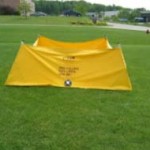
Their focus, of course, is different from ours, but Toolmonger is an incredible site – often showing emergency response/reconstruction tools we’d never hear of otherwise. Here’s one the Rol-La-Tank: (or Fol-Da-Tank, which might be the company name, or the name of the product line). They’ve got both URL’s Foldatank.com and Fol-Da-Tank – this should give interested readers enough to find them.

Thanks to Benjamen Johnson of Toolmonger.

Obama and McCain on Energy Policy

With gasoline prices between $3.38 and $4.06 per gallon, and electricity increasing 15% per year and therefore doubling every 5 years, energy is a major issue in the 2008 presidential election.

As President, McCain would focus on coal, oil, and nuclear power. Obama would focus on wind and solar, requiring U. S. utilities to get 25% of their electricity from solar and wind by 2025. McCain would require 20% by 2030. He would also reduce the “red tape” to speed construction of power plants and would build 45 nuclear plants by 2030, at which time he would be 94. Obama, who will be 69 in 2030, is concerned about the radioactive waste problem and other challenges of nuclear power. It does not seem likely that he will call for the construction of 45 new nuclear plants in the next 22 years.

McCain would give the oil companies $34 to $55 Billion over the next five years in subsidies and tax breaks (click here). He also spoke about giving drivers a $30 tax break this past summer. However, the money “given” to the drivers would have been made up in other taxes. Obama would give tax payers a $1,000 tax rebate based on a taxing “windfall” profits of the oil companies over the next 5 years.

McCain proposed a $300 million prize to the auto company that develops a next-generation car battery and would commit $2 billion annually to “clean-coal.” Obama would invest $150 billion over 10 years on low-carbon energy sources, double R&D spending on biomass, solar and wind resources; accelerate commercialization of plug-in hybrids, invest in low-emissions coal plants.

The U S Supreme Court ruled, in 2007, that the under the terms of the Clean Air Act, the EPA must regulate Carbon Dioxide. McCain favors a cap-and-trade CO2 approach. He sponsored a bill in 2007 to cut emissions by 30 percent by 2050. Obama would cut carbon dioxide emissions to 80% below 1990 levels by 2050.

Popular Logistics prefers that we accept Al Gore’s challenge

: 100% Clean and Green by 2018. The details of the McCain and Obama positions, compiled by Ayesha Rascoe and Chris Baltimore, from their web-sites Reuters and the International Herald Tribune and Friends of the Earth, are below.

Continue reading

Infographics and more: Mike Dickison

Pictures of Numbers is one of the websites run by Mike Dickison, an accomplished polymath who’s done some excellent work in information design with scientific and other information. A typical post compares two ways of looking at religious attitudes in a set of countries; his point (if I understand correctly) is that one often has options of putting much richer data into a single information graphic. His solution – entirely workable – would never have occurred to me.

[Readers will notice an uptick in information graphics posts as we are trying to prepare a number of visual aids – initially a set which tries to explain our purpose here atPopular Logistics: to examine the intersection between the sets of policy problems generally named “disaster preparedness,” “public health,” “environmental policy,” “energy policy,” “transportation policy,” “urban planning,” and “terrorism.” They’ve all got common threads – and to a surprising extent, common solutions – and that’s what we’re here to explain. But we’d like to present a richer version of these arguments – with few words and many more graphics. Hence our return to the precincts of Edward Tufte – and his books, and other information designers. So – we apologize to any readers who regard these posts as “off-topic,” but promise that, in time, we’ll make clear these connections].

The post which nearly knocked me out of my chair was Graphical Octants – how to, readably, add a third axis to a standard X/Y axis – I’ve been wrestling with how to show three variables – for instance – for disaster preparedness interventions, wanting to demonstrate:

  • Cost of intervention (in dollars)
  • difficulty of implementation (does it require many people to make big changes in behavior, do something counterintuitive, take complicated or intimidating training, or require a big rearrangement of social status likely to engender resistance). One example – a thesis I’ll be expanding on in the near future – is that the American Cold War shelter program – even after President Kennedy’s promise to make fallout or blast shelters available to the entire population – probably foundered because of resistance to the civil rights movement: any public shelters built after Kennedy’s 1961 statement would have had to be, of necessity, either segregated or not segregated. Not to mention the mixing of the rich and poor in the same shelters. Hence – any government planner who wanted to address shelter construction had to consider local reactions to such issues.
  • Time needed to implement (e.g., blast shelters are best built during initial construction, and done that way, would take many years. Encouraging the distribution of AM radios, on the other hand, could be done with public education programs, using existing social mechanisms to distribute them (local governments, religious institutions), using the market (buying large numbers to subsidize economies of scale, exempting them from sales tax).

Dickison has an elegant graphic solution to this problem in Graphical Octants . We hope to update this post with illustrations after speaking with Mr. Dickison.

Accuracy Aesthetics – visual representation of NYS Power Grid

    I’ve been creating a series of diagrams – about  systems, risks, disaster planning scenarios – and also thinking about other ways to model risks, mitigation and response strategies – the ideal solutions of course would all involve open source software. Since the government is already paying primarily no attention to building community based preparedness programs, good data solutions are critical – but so is the lowest possible prices (which is to say: Open Sourceand free. While I haven’t found or developed what I think will be sufficient, the information design community (that may not be the right name) has in it a very large propertion of very smart people. (The best, and I own every one of his books, is Edward Tufte

    . Also his dog photos are the best.

    So I thought that, as I cast about for the proper data metaphors – I’d note some of the coolest – some of which are just beautiful, clever – and may or may not provide solutions for the planners in our audience. So – for the moment – the New York State power grid

    via Accuracy & Aesthetics:

The Popular Logistics Plan for Clean, Renewable, Sustainable Energy for the United States

The Gore Energy Challenge: Clean and Green by 2018.  Visionary, Reasonable, Achievable. Ask T. Boone Pickens at The Pickens Plan, and Peter Mandelstam at Blue Water Wind.

We could meet the electric power requirements of the United States, estimated at 250 Gigawatts, GW, of generating capacity with wind turbines and photovoltaic solar arrays, for about $811 Billion in 10 years.

  • Land Based Wind: 100 GW, or 40%, at $2.0 Billion per GW: $200 Billion.
  • Offshore Wind: 100 GW, or 40%, at $2.86 Billion per GW: $286 Billion.
  • PV Solar: 50 GW, or 20% at $6.5 Billion per GW: $325 Billion.
  • Total Cost: $811 Billion. (less than has been squandered on the war in Iraq.)
  • Saving the earth: Priceless.

Key Benefits:

  • Good Jobs.
  • Healthy Economy.
  • Enhanced Emergency Response Capability.
  • Stronger National Security.
  • Clean Environment.
  • No Toxic Wastes.
  • No Mercury.
  • No Radioactive Wastes.
  • No Coal Mining Disasters.
  • Less Government Regulation.

This plan doesn’t exploit solar thermal, marine kinetic, geothermal, deep geothermal, cogen, biofuels, or conservation, which will be integrated into this plan in the near future. The plan also focuses on current electricity demand. It does not yet forecast increased electricity demand from population growth, transition from fossil fuels for heating or cooking, or increased reliance on plug-in hybrid cars.

Clean and Green By 2018!

"Swift Boat Veterans" For Wind Power

T. Boone Pickens, Oil billionaire turned wind power developer, says “oil is too expensive. The answer my friends,” to quote Bob Dylan, “is Blowin’ in the wind.” The Pickens Plan talks more about how harnessing the winds can the meet our power needs and eliminate the need to import oil – and export hard currency and wealth. Pickens talks more about money and geopolitics and less about the environmental hazards of burning fossil fuels.  While he wants to burn natural gas (which I use to heat my house) he’s not building coal or nuclear power plants.

Pickens’ Mesa Power is building an $8 Billion 4 Gigawatt (GW) power plant in W. Texas – at $2 per watt. This compares favorably to the plan by Florida Power & Light (FPL) to spend $18 Billion to build a 3.0 GW facility at the Turkey Point plant near Miami. Cost – $6 per watt. The wind farm is 1/3 the cost of a nuclear power plant.

Pickens’ Mesa Power will complete phase 1 of the wind farm, a 1.0 GW facility, by 2010. At that rate the 4 MW will be complete by 2015, the first 3.0 GW by 2013. Mesa Power will also add transmission lines to connect the system to the electrical grid, at a cost of another $2 billion, or $0.50 per GW. According to the Wall St. Journal, FPL estimates their new nuclear facility may be completed in 2018 or 2020. The wind farm – which can be built in stages – can be built for 1/3 the cost and in about 40% of the time.

Solar is more expensive – the Atlantic County Municipal Authority’s 500 KW solar energy system cost about $3.25 Million – about $6.5 per watt. Slightly more than a comparable nuclear plant today , according to estimates based on the cost of the FPL plant. However, when you factor in the costs of fuel (which must be imported), security, regulation, waste management, and the external costs to the environment, solar, which has $0 fuel, $0 waste, and close to $0 maintenance, when you factor in that solar works where it’s needed – and therefore provides a level of security and emergency preparedness – you can only conclude that Pickens is right – wind is a key technology for the future. I would add solar, geothermal, marine current, and conservation.

Liz Borkowski at Pump Handle on Pickens’ wind farm

Liz Borkowski at the Pump Handle has a few thoughtful words to say about T. Boone Pickens’ Texas wind project – I didn’t know that his stated larger plan is to free up natural gas for electricity production. I’d add only that – whatever the plan is, building wind capacity to power a few million households will likely demonstrate that wind is a profitable venture. And that’s good, notwithstanding Pickens’ involvement in the “Swift Boat” attacks on Senator Kerry in 2004.

Put another way – if a right-wing oil man is investing in wind – even if only as a hedge that counts as good news.

As always, Liz Borkowski and the Pump Handle crew are watching and making sense of details that matter.

Single Payer Health Care: Medicare for All

Popular Logistics thinks that a health care delivery system in which one out of six people can’t get health care, except by going to the Emergency Room is poorly run, mismanaged, and in a word, broken. We disagree with President Bush , who said “People have access to health care in America. After all, you just go to an emergency room.” We also recognize the public health concerns when one out of six people can’t get access to prescription medications, especially in densely populated areas. Thus, we think that a single payer health care system based on the Medicare model, also known as “Medicare for all,” is the best way to approach health care, from a policy perspective.

Popular Logistics is a non-partisan “blog.” We write about policy; we don’t often endorse candidates. However, we recognize that policy is made by candidates who win. This letter to the Editor, by Phil Steck, published in the Capital District Business Review, shows why we like Phil and why we wish him success in his race to represent New York’s 21st Congressional District.

To the editor:

I read with great interest James Barba’s opinion piece entitled “Health care reform is a business issue.” I applaud him for taking a visible leadership role on this critical issue. I recently had the opportunity to meet with him individually to discuss the benefits of a national single-payer heath care system and other challenges faced by health care providers.

Even before I declared my candidacy for Congress, I have supported single-payer health care, known as “Medicare for All,” because it is a system that is proven and tested. Medicare, the health system for the elderly, has a long history of success despite recent efforts to undermine it. It is statistically the most efficient health insurance care system available in the United States. Single-payer would benefit our economy, by lowering costs for patients, doctors, employers, and government. Single-payer would make us far more competitive internationally because many foreign businesses do not have to absorb the health care costs like their American counterparts.

In addition to hospital industry leaders like Jim Barba, a majority of doctors support single-payer because of the burdens that the current system places on them, primarily additional administrative costs.

As a partner in an Albany law firm, I understand the ever-escalating costs that businesses face in order to provide employees with health insurance. As an Albany County Legislator, I am all too familiar with the problems associated with the patchwork expansion of Medicaid. In Albany County we have worked to keep property taxes the 4th lowest in the state, but 90% of the county property tax goes toward Medicaid expenses. In a single-payer system, that local unfunded mandate is eliminated.

Sincerely,
Phil Steck
Candidate for Congress, NY-21

FDA threatens Red Cross with criminal charges over blood supply

Stephanie Strom of the Times reports on persistent – over 15 years – difficulties with the Red Cross blood supply operation, which provides two-thirds of the organization’s revenue.

For 15 years, the American Red Cross has been under a federal court order to improve the way it collects and processes blood. Yet, despite $21 million in fines since 2003 and repeated promises to follow procedures intended to ensure the safety of the nation’s blood supply, it continues to fall short.

The situation has proved so frustrating that in January the commissioner of food and drugs attended a Red Cross board meeting – a first for a commissioner – and warned members that they could face criminal charges for their continued failure to bring about compliance, according to three Red Cross officials who attended the meeting and requested anonymity because Red Cross policy prohibits public discussion of its meetings with regulators.

If fear is a motivator, we’re happy to help out in that way,” said Eric M. Blumberg, deputy general counsel at the Food and Drug Administration, though he declined to confirm what the commissioner, Andrew C. von Eschenbach, said at the meeting.

Some critics, including former Red Cross executives, have even suggested breaking off the blood services operations from the rest of the organization, as the Canadian Red Cross did a decade ago.

The problems, described in more than a dozen publicly available F.D.A. reports – some of which cite hundreds of lapses – include shortcomings in screening donors for possible exposure to diseases; failures to spend enough time swabbing arms before inserting needles; failures to test for syphilis; and failures to discard deficient blood.

In some cases, the lapses have put the recipients of blood at risk for diseases like hepatitis, malaria and syphilis. But according to the food and drug agency, the Red Cross has repeatedly failed to investigate the results of its mistakes, meaning there is no reliable record of whether recipients were harmed by the blood it collected.

The Red Cross, which controls 43 percent of the nation’s blood supply, agrees that it has had quality-control problems and is working to fix them. Both its officials and the drug agency point out that none of the identified problems involve the most serious category of infractions. For instance, the Red Cross does a good job of testing for H.I.V. and hepatitis B, officials on all sides agree. And in general, Red Cross blood is regarded as some of the safest in the world.

Still, the drug agency says, the problems that remain in screening donors and following protocols for collection add unnecessary risk to blood transfusions, almost five million of which were done in 2007, according to the National Heart, Lung and Blood Institute.

“This is a critical piece of the public health infrastructure,” Mary A. Malarkey, director of the Office of Compliance and Biologics Quality at the drug agency, said in an interview. “I know it’s difficult to get so many people trained and properly supervised, but it has to be done.”

This week, the agency sent the Red Cross the results of yet another recent investigation that makes Ms. Malarkey’s point: From December 2006 to April 2008, the Red Cross distributed more than 200 blood products that it had already identified as problematic, according to the investigation report.

Fifteen years under court supervision without progress. Doesn’t this suggest some change in approach?