Hydro Fracturing, aka Fracking, Dirty & Ugly, but What Choice do we Have?

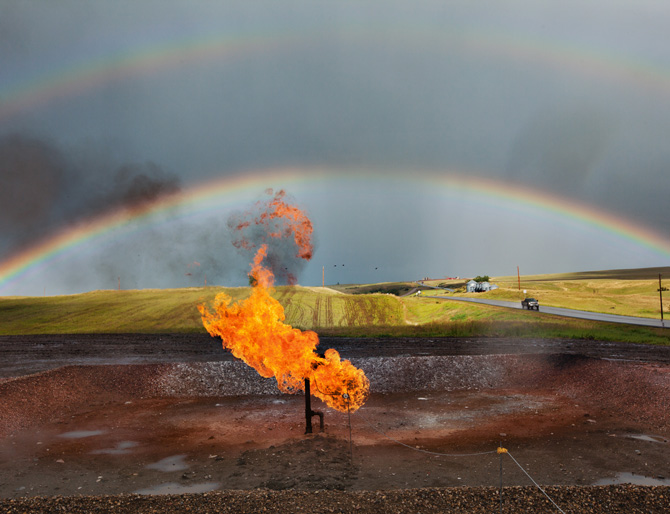
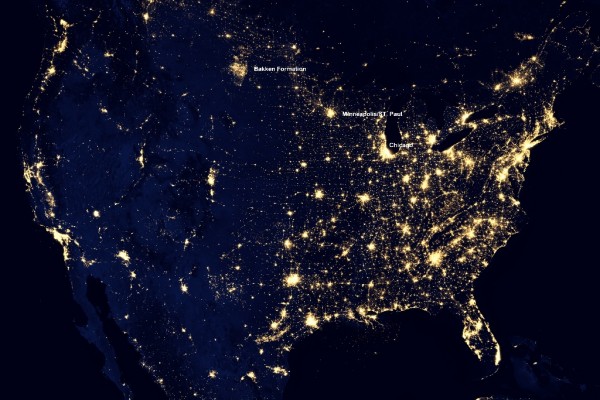
Satellite photo of US at night. Flares from Bakken shale wells in North Dakota

Satellite photo of US at night. Flares from Bakken shale wells in North Dakota

We have large deposits of shale oil – in the Marcellus shale in Pennsylvania, and in the Bakken formation in North Dakota and Canada.  Estimates vary. USGS, 2008 estimated 3.0 to 4.3 Billion Barrels of recoverable oil.  Today, the North Dakota Geological Survey (PDF) estimates 18 Billions Barrels of recoverable oil.  It also states

“the Bakken play on the North Dakota side of the basin is still early in the learning curve. Technology and the price of oil will dictate what is recoverable from this formation.”

Here in the US, according to the US Energy Information Agency, we consumed about 7.0 Billion barrels of refined petroleum products in 2010, slightly less, 6.7 Billion barrels, in 2011.  This is roughly 22% of world demand.  (here)

The Bakken formation holds Five Months to Two and One Half Years of US Oil needs.

Continue reading

Antibiotic Resistance Poses ‘Catastrophic Threat’ To Medicine, Says Britain’s Top Health Official

Sally Davies, the chief medical officer for England, said global action is needed to fight antibiotic, or antimicrobial, resistance and fill a drug "discovery void" by researching and developing new medicines to treat emerging, mutating infections.

Only a handful of new antibiotics have been developed and brought to market in the past few decades, and it is a race against time to find more, as bacterial infections increasingly evolve into "superbugs" resistant to existing drugs.

"Antimicrobial resistance poses a catastrophic threat. If we don’t act now, any one of us could go into hospital in 20 years for minor surgery and die because of an ordinary infection that can’t be treated by antibiotics," Davies told reporters as she published a report on infectious disease.

"And routine operations like hip replacements or organ transplants could be deadly because of the risk of infection."

One of the best known superbugs, MRSA, is alone estimated to kill around 19,000 people every year in the United States – far more than HIV and AIDS – and a similar number in Europe.

via Antibiotic Resistance Poses 'Catastrophic Threat' To Medicine, Says Britain's Top Health Official.

London To Create Unbroken Network of Bike Routes

Urban_Cycling

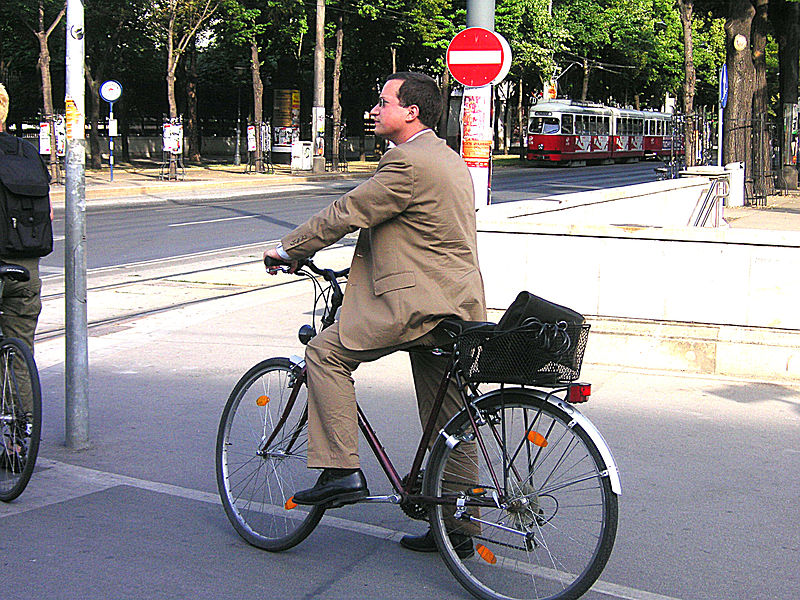
Commuter on Ringstrasse, Vienna, 2005. Image courtesy Wikipedia

Bicycle Commuting, lowers CO2 emissions, and is healthy for the commuter. , transport correspondent for The Guardian, reports on London’s ambitious plans to encourage bicycle use.

An unbroken network of cycle routes with some Dutch-style segregated lanes has been pledged as part of a £913m 10-year plan to make London safer for cyclists – including an east-west superhighway dubbed “Crossrail for the bike”.

Continue reading

Sequestration illuminates absence of long-term, coherent risk policies

Our national policy for disaster recovery and rebuilding – putting aside, for the moment, risk assessment, mitigation, planning, and response – is effectively no policy. We make it up as we go along.  Did victims of terrorism on September 10, 2001, or beforehand receive compensation? Did airlines before 9/11 get special legislation absolving them of liability? Even assuming that there is a legitimate question about the etiology of Ground Zero responders’ illnesses, wouldn’t a reasonable and compassionate country willingly support dying and seriously ill responders and their families – rather than stalling, essentially starving them out? James Zadroga,   The James Zadroga 9/11 Health and Compensation Act allocated $4.2 billion to create the World Trade Center Health Program; the legislation was signed in January 2011; Zadroga died in January, 2006.  Then, as now, partisan legislative politics delayed the matter.


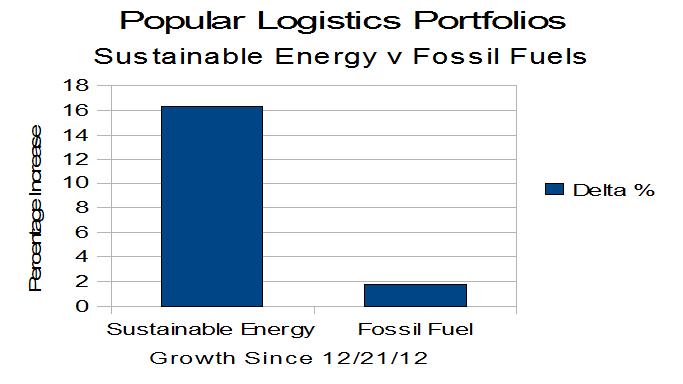
Sustainable Energy Portfolio UP 16% & Fossil Fuel Portfolio Up 1.7% – Dec.21, 2012 to March 1, 2013

E_Portfolios.130301

As of the close of trading on March 1, 2013, the virtual portfolio I created in Sustainable Energy stocks on 12/21/12 is up $1.3 Million, 16.31%, from $8.0 Million to $9.3 Million. The Fossil Fuel Reference Virtual Portfolio is up 1.71%, from $8.0 Million to $8.137 Million in the same time frame. The Dow Jones Industrial Average is up 7.63% and the S&P 500 is up 6.15%.

Continue reading

Reuters: “First spill trial witness: BP put cost cuts over safety”

The oil slick in the gulf

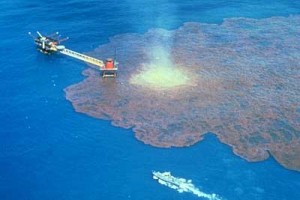
Deepwater Horizon Oil Slick, May 10, 2010.

From Reuters reporting on the BP oil spill trial;  First spill trial witness: BP put cost cuts over safety.

BP Plc fostered a culture that put cost-cutting over safety before the deadly 2010 Gulf of Mexico oil spill, a noted forensic engineer said in the first day of testimony in the federal civil trial centered on the disaster. “There is ample evidence of intense pressure within the system to save time and money,” said Bob Bea, co-founder of the Center for Catastrophic Risk Management at the University of California, Berkeley. “With stress and pressure come sacrifices to safety.” Bea was the first witness for the plaintiffs, the U.S. Justice Department and U.S. Gulf Coast states suing Macondo well owner BP, rig owner Transocean Ltd and well cement provider Halliburton Co. The plaintiffs plan to call Lamar McKay, chairman and president of BP America, to testify as a hostile witness once Bea wraps up. McKay is a member of the London-based oil company’s executive committee, alongside Chief Executive Officer Bob Dudley.

Bear in mind that this was filed after the first day of a long trial. (We think we found access to transcripts at MDL 2179 Trial Docs and Plaintiffs Steering Committee, and provide better daily coverage). It’s likely that things will look worse for BP before they look better.  Of course, there is the possibility that BP, in cross-examining witnesses, and putting on its own case, will be able to demonstrate that that its conduct was entirely proper and honorable.

And also bear in mind that oil gushed into the Gulf of Mexico at the rate of 60,000 barrels per day for 85 days; an approximate total of 5,100,000 barrels of crude oil.

Jonathan Soroko, Esq, is an attorney and an investigative consultant. In addition to writing for Popular Logistics, he writes for Caton Ave and Discovery Strategist blog, where this is posted.

Popular Logistics Series on the Deepwater Horizon / Macondo Spill

  1. Fossil Fuels and a Walk on the Moon, May 3, 2010.
  2. Drill Baby Drill or Drill Baby Oops, May 7, 2010.
  3. The Magnitude of the Spill, May 15, 2010.
  4. One Month After The Spill BP Siphoning 3,000 Barrels Per Day, May 20, 2010.
  5. Deep Water Horizon – The Chernobyl of Deepwater Drilling?, June 2, 2010.
  6. The Deepwater Horizon: 40,000 Barrels Per Day or 70,000, June 13, 2010.
  7. The Deepwater Horizon After the Macondo Well Explosion, June 19, 2010.
  8. Deepwater Horizon – Bombs and Hurricanes, July 1, 2010,
  9. Like a Bad High School Math Problem, July 14, 2010,
  10. Crisis Management and the Gulf Oil Spill, July 16, 2010,
  11. The Deepwater Horizon: The Good, The Bad, and The Ugly, October 7, 2010.

Turning discarded wooden pallets into cabinets

Inhabitat - James Higginson - recycling pallets

The keen-eyed folks at Inhabitat have identified a useful way of re-using wooden pallets; you can read about this furniture project, developed by James Higginson –  turning pallets into cabinets. Not for beginners, we think, but in any case it’s inspired: the pallets are common, are abandoned as soon as they’re damaged, and, it’s clear, that in the right hands they can  be repurposed as beautiful cabinets.

Announcing the Popular Logistics Virtual Portfolio in Information Technology

Hot on the heels of the December 21, 2012 launch of the Popular Logistics Virtual Portfolio in Sustainable Energy, here, up 22.36%, I am announcing the launch of the Popular Logistics Virtual Portfolio in Information Technology. Roughly $1.0 million in Apple, Google, HP, IBM, Intel, Microsoft, and Oracle.(Their investor relations pages are AppleGoogle, HPIBM, Intel, Microsoft, and Oracle.)


Tech Virtual Portfolio
Item Stock Price Shares Total
1 Apple $446 2,242 $1,000,000
2 Google $795 1,258 $1,000,000
3 HP $17 59,559 $1,000,000
4 IBM $198 5,051 $1,000,000
5 Intel $20 50,000 $1,000,000
6 Microsoft $27 37,037 $1,000,000
7 Oracle $24 41,667 $1,000,000
total $7,000,000
Table 1. Acquisitions, Start of Business, 2/22/13

Generally speaking, here’s what I expect:

  • Apple, IBM: I expect to significantly outperform the Dow Jones and S&P 500.
  • Google: I expect to perform in line with the Dow Jones and S&P.
  • HP: An investment in HP is speculative. Whitman may turn the company around. The stock might wildly outperform the Dow & the S&P. As Gerstner might say, however, it’s hard to teach an elephant to dance. The stock may plummet.
  • Intel, Oracle, I don’t know enough to have an expectation.
  • Microsoft may become a leading indicator of the economy.  Thus, if the S&P does well, Microsoft may do better.

These are in table 2, below

Continue reading

Apple at $665 per share – or $705 – or $1077

space-apple-logo

Apple, if it can be compared to Google, IBM, Intel, Microsoft, and Oracle, should be priced at 665 per share. This analysis is simply based on Stock Price, Earnings per Share (EPS) and the Price Earnings ratio. or P/E. The average P/E of these companies is 15.08. If Apple’s stock was 15.08 times earnings, it would be 665. If you take Apple out of the mix, the average P/E becomes 16.01. At 16.01 times earnings, Apple’s stock price would be 705. And if priced like Google, $1077. Continue reading

Gold Bricks and Sink-Holes – The Risk & Reward of Fossil Fuel, Solar & Wind


3 Gold-BrickOn Dec. 21, 2012, with virtual portfolios of 7 sustainable energy and 7 fossil fuel companies, I launched the Popular Logistics Sustainable Energy simulation, here.

On Feb. 8, 2013, after 6 weeks, after exercising virtual options to invest in 2 additional companies at 12/21/12 prices, I reported the results, here.

  • The Sustainable Energy portfolio is up 12.6%
  • The Fossil Fuel portfolio is up 5.09%.
  • The Dow Jones Industrial Average is up 6.52%
  • The S&P 500 is up 5.52%.
  • The Sustainable Energy Portfolio is up significantly more than the Fossil Fuel Portfolio, and the major indices.
  • The Fossil Fuel Portfolio is up, but lags the major indices.


Guatemala-Sinkhole

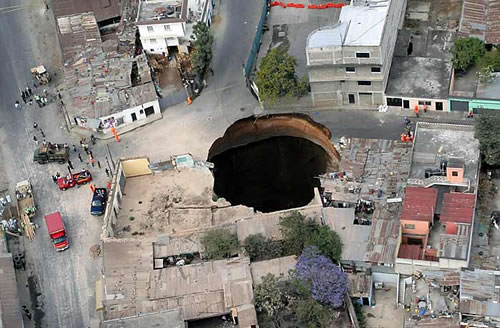
These results are not that surprising. Continue reading

Nega-Watts, Nega-Fuel-Watts, Mega-Bucks

 PopLog4


On Dec. 21, 2012, I launched the Popular Logistics Sustainable Energy Portfolio Simulation. After 6 weeks, as of the close of business 2/7/13, the results are:

  • The Sustainable Energy Portfolio is UP 12.6%
  • The Fossil Fuel Reference Portfolio is UP 5.09%

In comparison,

  • The Dow Jones Industrial Average is UP 6.52%
  • The S&P 500 is UP 5.52%

While six weeks is a very short time frame, except for fruit flies and Day Traders, the Popular Logistics Sustainable Energy Portfolio outperformed the Dow, the S&P 500, and the Fossil Fuel Reference Portfolio by a wide margin. In the same time frame the Fossil Fuel Reference Portfolio also underperformed these indices.

Details are below

Continue reading

Forget the Great Wall – Meet The Great Haze

Beijing from space, courtesy NASA

Image 1. Beijing from space, Jan., 2013, courtesy NASA

忘了长城 – 我们现在有大的雾度

“Forget the Great Wall – We Now Have the Great Haze”

– Translation by Google

In the 1960’s and 1970’s astronauts showed that we could see the Great Wall of China from space. Today, it’s the Great Haze of China that we can see from space .  The New York Daily News, here, published this image, taken by NASA in January 12, 2013 (here) when the Air Quality Index, AQI, reached 775.

The AQI was established by the US EPA. AQI above 300 is considered dangerous. AQI at 775 is probably deadly.

Continue reading

Buono for New Jersey

buonoheadshotPopular Logistics is a Policy Blog, not a Politics Blog. However, as Deborah Stone wrote in “The Policy Paradox,” ISBN 0393-976-254, In order to make policy you need to win at politics.

NJ State Senator Barbara Buono, a progressive Democrat, has a diametrically opposed political philosophy – and a very different leadership style, compared to Gov. Chris Christie.   She has been fighting for the middle class since starting her career, and promises to continue to fight for the middle class if elected Governor.

OffshoreWind2When I called the election for Senator Buono (here) and criticized Gov. Christie (here)  it was less an endorsement of Buono than a statement that we need to change direction. Based on the policy statements in her press releases, her statement at the Campaign kick-off, Saturday, Feb. 2, and very brief conversations I had with Senator Buono, as Governor, Barbara Buono would lead New Jersey in the right direction.

The most important questions are:

What would a Governor Buono do to develop a sustainable energy infrastructure and a healthy, sustainable economy?

How can she wield the power of the Governor’s office to strengthen the middle class and help the poor – to create good jobs, to lower the unemployment rate, lay a strong foundation for the future?

These are really the same question. Stay Tuned. I think we will find out over the next four to eight years.

Politics, Policy, & Jersey

Popular Logistics is a Policy ParadoxPolicy Blog, not a Politics Blog. However, as Deborah Stone wrote in “The Policy Paradox,” ISBN 0393-976-254,

In order to make policy you need to win at politics.

Chris Christie

Chris Christie, left, who is good at politics, seems to have made several serious policy blunders during his first term as Governor of New Jersey.  I have questions about his capabilities in areas including Law & Order Fiscal Responsibility, Leadership, Mass Transit and Infrastructure and the Environment, and the intersection of these domains – the ‘Bio-Humano-Sphere’.

Bill Palatucci

  • Law & Order: I am concerned about the concept of privatizing prisons and law enforcement agencies. Gov. Christie’s ties to his former boss and former partner Bill Palatucci, left, formerly of Community Education Centers, the company that operates most of the half-way houses in New Jersey’s privatized prison system, from which, as Mitt Romney might say, convicted felons “Self-Pardon”.
  • Fiscal Responsibility: there are Gov. Christie’s management of the “Race to the Top”, his supports of tax cuts for millionaires, and tax hikes on the middle class. He refuses to raise the minimum wage. He claims to not have raised taxes, yet he cut $7.4 million from woman’s health care, he is misusing Clean Energy funds to meet other obligations, and deferring funding on pensions.
  • Infrastructure & Mass Transit: we need more investment in infrastructure and mass transit. Gov. Christie killed the proposed new tunnel between NY and NJ.
  • The Biosphere / Environment / Bio-Humano-Sphere: while Gov. Christie may understand that global warming is a real problem, and while he vetoed the “Purgen” coal with sequestration plant; he pulled NJ out of the Regional Greenhouse Gases Initiative, RGGI and has not articulated a plan to modernize our electricity and energy infrastructure, or develop a renewable sustainable energy infrastructure.
  • Leadership: Rather than taking responsibility for the Race to the Top debacle, Gov. Christie blamed one-time rival Bret Schundler, who he appointed to head the team. He is, simply put, a bully. This is leadership at its worst.

Continue reading

What Next? – For the 21st Century

Barack-Obamajoe-biden

What should we do now?

  1. Strengthen the safety net.
  2. Reverse the Citizens United and Florence v Burlington rulings.
  3. Place reasonable restrictions on Second Amendment rights, as  reasonable restrictions exist on First Amendment rights. And tax properties and income of religious institutions.
  4. Address Climate Change.
  5. Develop a Renewable & Sustainable Energy Infrastructure – Clean & Green within 15.

As President Obama said, in his Second Inauguration, (White House . Gov / The Atlantic)

The commitments we make to each other …  do not sap our initiative; they strengthen us.  They do not make us a nation of takers; they free us to take the risks that make this country great.

“We will respond to the threat of climate change, knowing that the failure to do so would betray our children and future generations. 

“The path towards sustainable energy sources will be long and sometimes difficult.  But America cannot resist this transition, we must lead it.

Continue reading